How a Large-Scale Logistics Provider Rebuilt Its Multi-Agent Freight Routing Pipeline After Silent Context Corruption Was Poisoning Every Downstream Decision
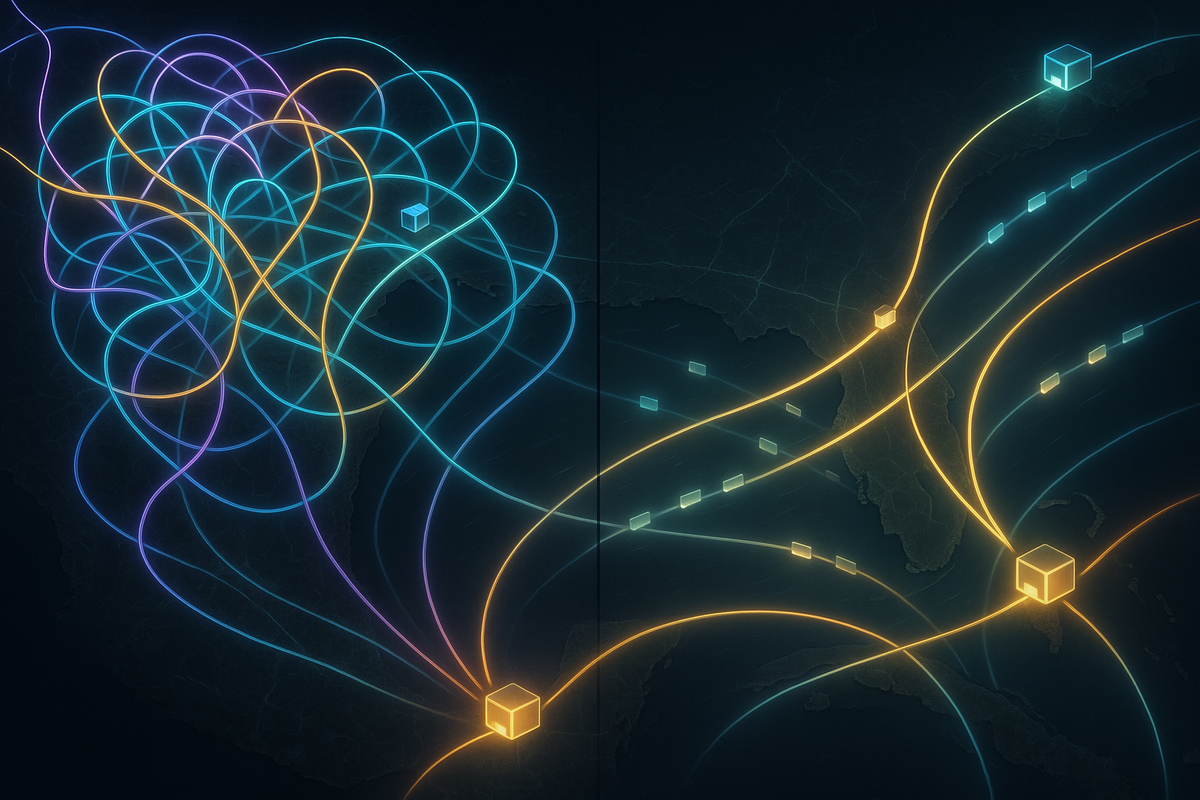
At first, the numbers looked like noise. Freight routes were suboptimal by small but consistent margins. Carrier selection scores drifted in ways that defied the underlying market data. Estimated transit times were off by just enough to erode customer SLA compliance without triggering any hard system alerts. For nearly four months, a large-scale logistics provider operating one of North America's most sophisticated AI-driven freight networks watched its routing quality quietly degrade, and nobody could explain why.
The culprit, when it was finally found, was not a bad model, a broken API, or a corrupted training dataset. It was something far more insidious: a context window management strategy that had been designed with the best of intentions, was silently truncating, reordering, and summarizing the wrong information at agent handoff boundaries, poisoning every downstream decision in the pipeline with corrupted context that looked, to each individual agent, completely legitimate.
This is the story of how their engineering team found it, fixed it, and rebuilt the entire multi-agent architecture to be structurally resistant to this class of silent failure.
The Architecture: A Multi-Agent Pipeline Built for Scale
The company, which we will refer to as NorthVector Logistics (a composite based on real-world patterns observed across enterprise logistics AI deployments in 2025 and early 2026), had spent the better part of two years building a multi-agent freight routing system designed to handle tens of thousands of shipments daily across road, rail, and intermodal networks.
The pipeline consisted of six primary agents, each powered by a large language model fine-tuned or prompted for a specific domain:
- The Intake Agent: Parsed incoming shipment orders, normalized data formats, and generated a structured shipment brief.
- The Constraint Resolution Agent: Evaluated regulatory constraints, hazmat classifications, weight limits, and carrier certification requirements.
- The Capacity Intelligence Agent: Queried live carrier capacity feeds, historical lane performance data, and current spot market rates.
- The Route Optimization Agent: Generated candidate route sequences based on outputs from the previous two agents.
- The Risk Assessment Agent: Evaluated each candidate route for weather exposure, geopolitical risk, carrier reliability scores, and delay probability.
- The Booking Decision Agent: Made the final carrier and route selection, generated booking instructions, and handed off to execution systems.
Each agent received a context package assembled from the outputs of its predecessors. The system was designed to be modular and composable, which was exactly the right instinct. The problem was in how that context was assembled and managed as it passed through the chain.
The Context Window Strategy That Seemed Perfectly Reasonable
The engineering team had implemented what they called a "progressive summarization with priority pruning" strategy for context management. The logic was straightforward: as the context package grew through successive agent handoffs, it would eventually approach the token limits of the underlying models. To prevent overflow, the system would:
- Summarize earlier agent outputs using a lightweight summarization model.
- Prune sections flagged as "low priority" based on a static relevance scoring heuristic.
- Preserve the most recent agent output in full.
On paper, this was sensible. In practice, it introduced three compounding failure modes that the team did not anticipate.
Failure Mode 1: Relevance Scoring Was Context-Blind
The static relevance heuristic that decided what to prune was trained on a general notion of "important logistics information." It had no understanding of how a specific piece of information from Agent 1 might be critically load-bearing for Agent 5's reasoning, even if it appeared routine at the time it was generated. A constraint flagged by the Constraint Resolution Agent as a "soft advisory" (for example, a carrier's preference to avoid a specific interchange due to recent congestion) would often be scored as low priority and pruned before it reached the Route Optimization Agent. That agent would then generate routes that technically complied with hard constraints but violated soft ones that had real-world cost implications.
Failure Mode 2: Summarization Introduced Semantic Drift
The summarization model was fast and cheap, which made it attractive. It was not, however, semantically precise in the way that a freight routing pipeline required. When the Capacity Intelligence Agent produced a nuanced output like "Carrier X has available capacity on Lane 7 but has flagged a 72-hour booking window requirement due to current terminal congestion at the Memphis hub," the summarizer would often compress this to "Carrier X available on Lane 7." The 72-hour booking window requirement, a hard operational constraint, was gone. The Booking Decision Agent would then select Carrier X and generate a same-day booking instruction that Carrier X's systems would reject, causing cascading delays.
Failure Mode 3: Ordering Effects Created False Recency Bias
Because the system always preserved the most recent agent output in full while summarizing earlier ones, the Booking Decision Agent was systematically over-weighted toward the Risk Assessment Agent's outputs and under-weighted toward the Constraint Resolution Agent's outputs, which by that point in the chain had been summarized twice. This created a subtle but persistent bias: routes were being selected that scored well on risk metrics but violated constraint priorities that had been established much earlier in the pipeline. The system was, in effect, forgetting its own requirements as the conversation got longer.
Why It Took Four Months to Find
This is perhaps the most important part of the case study, because it speaks directly to a class of AI system failure that is becoming increasingly common as multi-agent pipelines grow in complexity: the failure was invisible at the individual agent level.
Every agent, when evaluated in isolation, was performing correctly. Feed the Constraint Resolution Agent a shipment brief, and it would produce accurate constraint analysis. Feed the Route Optimization Agent a complete, uncorrupted context package, and it would generate excellent routes. The corruption only emerged at the system level, in the interactions between agents, and specifically in the information that was silently lost or distorted during handoffs.
The team's monitoring stack was built around per-agent performance metrics: output quality scores, latency, token usage, and error rates. None of these metrics were sensitive to the class of failure occurring. The system was not throwing errors. It was producing confident, well-formatted, internally consistent outputs that were simply wrong in ways that required domain expertise and cross-agent tracing to detect.
The breakthrough came when a senior routing engineer noticed that a specific carrier was being selected repeatedly on a lane where that carrier had a well-known soft constraint that the team knew about operationally but could not find evidence of in the system's decision logs. She pulled the full context trace for a sample of affected bookings and discovered that the constraint was present in the Constraint Resolution Agent's raw output but absent from the summarized context that reached the Booking Decision Agent. That single observation cracked the case open.
The Rebuild: Principles That Guided the New Architecture
NorthVector's engineering team spent six weeks rebuilding the context management layer. The new architecture was guided by four core principles that are broadly applicable to any multi-agent LLM pipeline operating in a high-stakes domain.
Principle 1: Structured Context Contracts, Not Free-Form Summaries
The team replaced the free-form summarization approach with what they called "context contracts." Each agent was required to produce its output in a strictly typed schema that explicitly separated findings into three categories: hard constraints (never prunable), soft constraints with expiration metadata, and supporting context (prunable with logging). Downstream agents consumed these schemas directly rather than relying on a summarizer to interpret and compress them. This made the information hierarchy explicit and machine-verifiable rather than implicit and model-dependent.
Principle 2: Immutable Constraint Registers
Hard constraints and soft constraints with cost implications were extracted from each agent's output and written to a separate, immutable constraint register that traveled alongside the main context package but was never subject to summarization or pruning. Every agent in the pipeline had read access to the full constraint register regardless of where in the chain the constraints had originated. This eliminated the recency bias problem entirely: the Booking Decision Agent now had direct, unmediated access to everything the Constraint Resolution Agent had flagged, regardless of how many summarization passes had occurred on the main context.
Principle 3: Handoff Verification Agents
Between each major agent handoff, the team inserted lightweight "handoff verification" steps. These were not full LLM agents; they were deterministic validators that checked whether the context package received by an agent contained all fields referenced by the preceding agent's output schema. If a field was missing or had been altered beyond a defined threshold, the handoff was flagged and the pipeline paused for human review rather than silently proceeding with degraded context. This added modest latency but eliminated the silent failure mode entirely.
Principle 4: Context Provenance Logging
Every piece of information in the context package was tagged with its origin agent, the timestamp it was generated, and a hash of the original content. If a summarizer touched a piece of content, the log recorded both the original and the summarized version. This made it possible to audit any booking decision and trace every piece of reasoning back to its source, including identifying exactly where and how information had been altered. The team could now answer the question "why did the system pick this carrier?" with full fidelity, down to the token level.
The Results: What Changed After the Rebuild
The impact of the rebuild was measurable within the first two weeks of deployment. Key outcomes included:
- Carrier booking rejection rates dropped by 83 percent, largely attributable to the elimination of the summarization-induced constraint loss that had been generating invalid booking instructions.
- SLA compliance recovered to pre-degradation levels within three weeks, with the team subsequently pushing it to a new high by leveraging the now-reliable constraint register for proactive SLA risk scoring.
- Route cost efficiency improved by an average of 4.2 percent across monitored lanes, reflecting the elimination of the recency bias that had been systematically underweighting cost-relevant soft constraints in the final selection step.
- Mean time to diagnose a routing anomaly dropped from multiple days (requiring manual trace analysis) to under two hours, driven by the context provenance logging system.
Perhaps most importantly, the team now had a monitoring framework that was sensitive to context-layer failures rather than only agent-layer failures. They had moved from a world where silent corruption was possible to one where degraded context was structurally impossible to ignore.
What This Case Study Reveals About Multi-Agent AI in 2026
NorthVector's experience is not unique. As multi-agent LLM pipelines mature from experimental prototypes into production infrastructure, the industry is discovering that the hardest problems are not model quality problems. They are systems engineering problems, specifically around information fidelity across agent boundaries.
Context window management is one of the most consequential and least-discussed design decisions in a multi-agent architecture. The dominant conversation in the AI community has focused on expanding context windows, with leading models now supporting context lengths measured in hundreds of thousands of tokens. But larger context windows do not eliminate the need for thoughtful context management; they simply raise the ceiling on how long you can defer the problem. In a sufficiently complex pipeline, even a million-token context window will eventually require decisions about what to include, what to summarize, and what to discard. Those decisions, if made poorly, will corrupt downstream reasoning just as surely as they did in NorthVector's four-month nightmare.
The deeper lesson is about the nature of silent failures in AI systems. Traditional software fails loudly: exceptions are thrown, services go down, error logs fill up. AI systems can fail quietly, producing confident, well-structured, plausible-looking outputs that are systematically wrong. The monitoring and observability practices that work for traditional software are often blind to this failure mode. Building AI systems that are robust in production requires a new class of observability tooling, one that is sensitive to semantic fidelity and information provenance, not just latency and error rates.
Key Takeaways for Engineering Teams Building Multi-Agent Pipelines
- Never use free-form summarization as a context management strategy in high-stakes pipelines. Summarization models introduce semantic drift that is difficult to detect and compounds across handoffs. Use structured schemas and typed contracts instead.
- Separate constraint management from general context. Hard constraints and high-cost soft constraints should travel in a dedicated, immutable register that is never subject to compression or pruning.
- Build for cross-agent observability from day one. Per-agent metrics are necessary but not sufficient. You need system-level tracing that can reconstruct the information state at every handoff boundary.
- Treat context window pressure as a design constraint, not an operational problem. If your pipeline is approaching context limits, the answer is not a smarter summarizer. It is a better information architecture.
- Insert deterministic validators at handoff boundaries. LLMs should not be trusted to self-report whether they received complete and accurate context. Verify it programmatically.
Conclusion
The freight routing pipeline that NorthVector rebuilt is faster, more reliable, and more auditable than the one it replaced. But the most valuable output of the entire exercise was not the new architecture. It was the organizational understanding that context is not just a technical parameter to be managed for efficiency. In a multi-agent system, context is the medium through which agents reason, and any corruption of that medium is a corruption of the system's intelligence itself.
As multi-agent AI systems take on more consequential roles across logistics, finance, healthcare, and infrastructure in 2026, the engineering discipline of context integrity is going to become as foundational as data integrity was for the database era. The teams that build that discipline now, before their own four-month silent failure forces the lesson, will have a significant and durable advantage over those who learn it the hard way.
NorthVector learned it the hard way. You do not have to.



