The Silent Burnout Crisis No One in Enterprise Tech Is Talking About: Agentic On-Call Rotations
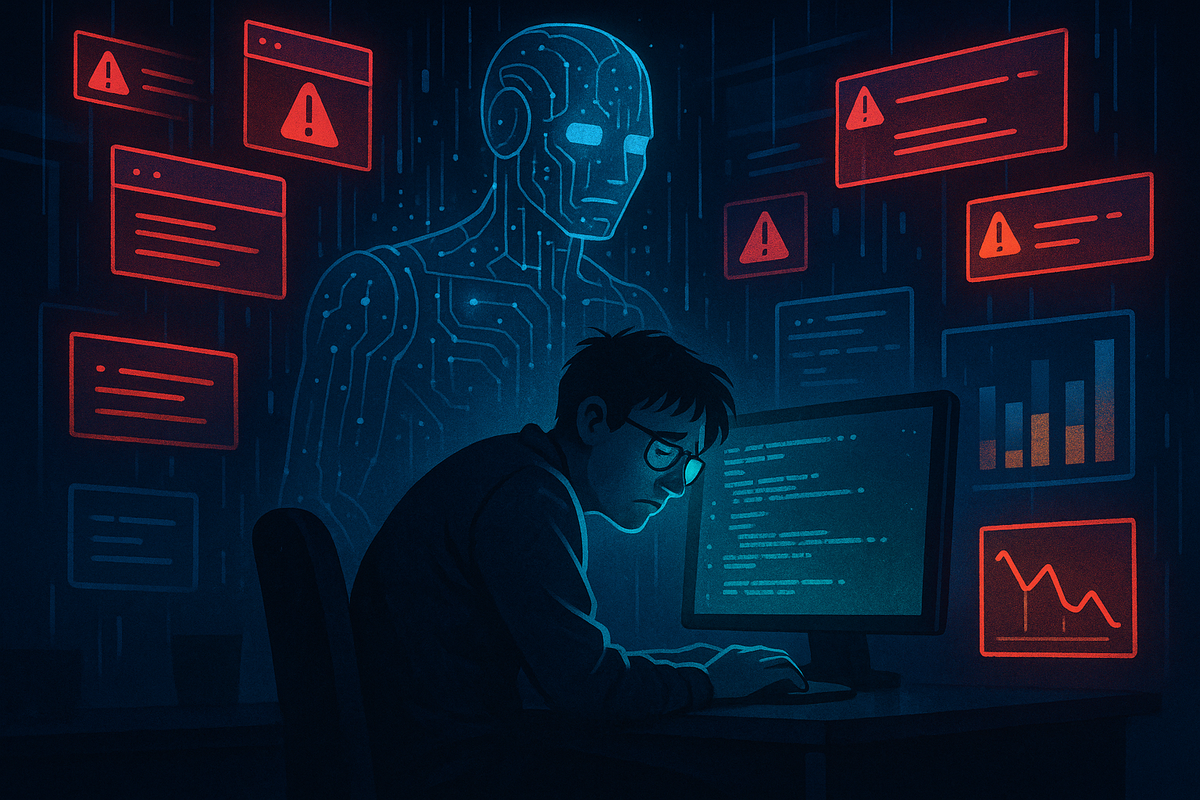
Let me say something that will make a lot of engineering leaders uncomfortable: the burnout crisis quietly unfolding inside enterprise backend teams in 2026 has almost nothing to do with alert volume. It is not about too many PagerDuty notifications at 3 a.m. It is not about understaffed SRE teams or poorly tuned thresholds. Those are old problems with old solutions.
The new crisis is something far more psychologically corrosive. It is the experience of being woken up, handed a system failure caused by an autonomous AI agent, and then being asked to explain what happened to a room full of stakeholders, knowing with absolute certainty that you cannot. Not because you are not good enough. But because the failure was, by the nature of the system itself, fundamentally non-reproducible.
This is the agentic on-call problem. And enterprise engineering organizations are walking straight into it with their eyes closed.
What "Agentic" Actually Means for the People Holding the Pager
The industry has spent the better part of two years evangelizing agentic AI systems: autonomous agents that plan, reason, call tools, spawn sub-agents, and adapt their behavior mid-execution based on intermediate outputs. The pitch is compelling. Agentic systems can handle complex, multi-step workflows without human intervention. They reduce toil. They scale decision-making.
What the pitch omits is what happens when they fail.
A traditional backend failure has a shape. A database query times out. A memory leak degrades a service. A misconfigured load balancer drops packets. These failures are deterministic, or close enough to it. You can replay logs. You can reproduce the condition in staging. You can point at a line of code, a config value, or a dependency version and say: this is what broke.
Agentic systems do not fail that way. An agent's behavior at step seven of a twelve-step workflow is a function of every LLM inference call, every tool response, every intermediate state, and every subtle variation in input context that preceded it. Change any one of those variables, and you get a different agent. The failure you are debugging at 2 a.m. is a ghost. It existed once, in a specific sequence of probabilistic decisions, and it will likely never exist in exactly that form again.
For the engineer holding the pager, that is not just a technical inconvenience. It is a psychological trap.
The Cognitive Weight of Unexplainable Failures
There is a well-established body of research in occupational psychology around what makes high-stress jobs tolerable versus destructive. One of the most consistent findings is that perceived control is a far stronger predictor of burnout than raw workload. Workers who face heavy demands but retain a sense of agency over outcomes tend to cope far better than those who face moderate demands with no sense of control.
On-call engineering, at its best, preserves a sense of control. You get paged. You investigate. You find the cause. You fix it or mitigate it. You write a postmortem. You implement a preventive measure. The loop closes. There is cognitive resolution, even if the night was brutal.
Agentic on-call rotations break that loop at the worst possible moment.
Here is what the experience actually looks like for a backend engineer in 2026 whose team has deployed autonomous agents into production workflows:
- The alert fires. An agentic pipeline has failed, producing a bad output, triggering a downstream error, or silently completing with incorrect results that a monitoring hook eventually caught.
- The investigation begins. Logs exist, but they capture inputs and outputs, not reasoning. The agent's decision trace is a sequence of LLM calls whose internal logic is opaque by design.
- Reproduction fails. The engineer attempts to replay the scenario in a staging environment. The agent behaves differently. The temperature settings, the model version, the tool response latencies, all of it produces a subtly different execution path.
- The postmortem is written in fog. The root cause section contains phrases like "the agent appears to have misinterpreted" or "the model likely weighted" or "we believe the tool response at step four may have caused." These are not root causes. They are educated guesses dressed in postmortem language.
- Stakeholders ask questions that cannot be answered honestly. "Will this happen again?" "What exactly went wrong?" "Is the fix confirmed?" The engineer either admits uncertainty (which erodes confidence) or overstates certainty (which is dishonest and sets up the next burnout cycle).
Run that loop a few times a month, and you have not just a tired engineer. You have an engineer who has lost faith in their own competence, who dreads the pager not because of the hours but because of the humiliation of being responsible for systems they cannot fully understand or explain.
Why This Is Different From "Normal" Distributed Systems Complexity
Some readers will push back here. Distributed systems have always been hard to debug. Race conditions, network partitions, cascading failures in microservice architectures: these are not new. Engineers have been dealing with non-determinism for decades. Why is agentic complexity categorically different?
The distinction lies in the nature of the non-determinism and, critically, in where accountability lands.
In a traditional distributed system, non-determinism is a property of infrastructure. Timing, network conditions, hardware failures. It is impersonal. No one expects you to explain why a cosmic ray flipped a bit. The postmortem focuses on resilience design, not on the behavior of an actor that was supposed to be making intelligent decisions.
Agentic systems are sold, internally and externally, as intelligent decision-makers. When they fail, the implicit question is not "why did the infrastructure behave unexpectedly?" It is "why did the agent make the wrong decision?" That framing shifts accountability toward the humans who built, deployed, and monitor the system. It invites a kind of second-guessing that infrastructure failures do not. It personalizes the failure in a way that is genuinely damaging to the engineers involved.
There is also the matter of explainability theater. Enterprise organizations have compliance requirements, audit trails, and stakeholder reporting obligations. When an agentic system causes a financial error, a data quality incident, or a customer-facing failure, someone will need to explain it. That someone is almost always the on-call engineer or their team lead. The pressure to produce a coherent, confident explanation for something that is genuinely inexplicable creates a specific kind of chronic stress that has no good outlet.
The Organizational Failure Hiding Behind the Technical One
Here is where I want to be direct with engineering leaders, because this is where the real accountability sits.
Most enterprise organizations deploying agentic systems in 2026 have done so without meaningfully updating their incident response frameworks, their postmortem cultures, or their on-call support structures. They have taken operational models designed for deterministic systems and applied them, unchanged, to probabilistic ones. The result is engineers being held to accountability standards that the systems themselves cannot support.
Asking an engineer to produce a definitive root cause for a non-reproducible agentic failure is not a quality standard. It is a category error. And when organizations enforce that standard anyway, they are not maintaining rigor. They are manufacturing shame.
The signs that your organization is already in this failure mode are subtle but consistent:
- Postmortems for agentic incidents are consistently longer than average but contain less actionable content.
- Engineers volunteer less frequently for on-call rotations that include agentic system coverage.
- There is an unspoken understanding that certain incidents are "just how the agent is" with no real follow-through on prevention.
- Senior engineers are disproportionately absorbing agentic incidents because junior engineers feel unequipped to handle the ambiguity.
- Retrospectives for agentic failures devolve into philosophical debates about model behavior rather than concrete action items.
If two or more of those sound familiar, the burnout is already happening. It is just not yet visible in your attrition numbers.
What Responsible Agentic Operations Actually Look Like
I want to be clear that the argument here is not "do not deploy agentic systems." The productivity and capability gains are real, and organizations that refuse to engage with agentic infrastructure will fall behind. The argument is that deployment without operational maturity is a form of negligence toward the engineers who have to keep those systems running.
Here is what responsible agentic operations require, in concrete terms:
1. Probabilistic Postmortem Frameworks
Postmortems for agentic incidents need a different template. Instead of demanding a single root cause, they should document a probability-weighted failure hypothesis: the two or three most likely contributing factors, the evidence supporting each, and the confidence level attached to each. This is intellectually honest, reduces the pressure to fabricate certainty, and produces more useful signal over time as patterns emerge.
2. Agent Observability as a First-Class Requirement
Logging inputs and outputs is not enough. Production agentic systems need structured decision traces: every tool call, every intermediate reasoning step where accessible, every branch point. Frameworks like LangSmith, Langfuse, and emerging enterprise-grade agent observability platforms are moving in this direction, but adoption inside enterprise backend teams remains inconsistent. This cannot be optional. It is the difference between debugging with a flashlight and debugging in complete darkness.
3. Explicit Non-Reproducibility Acknowledgment in SLAs
Service level agreements and incident severity definitions need to account for the fact that some agentic failures cannot be reproduced or definitively explained. Building that acknowledgment into formal documentation removes the implicit pressure on engineers to produce certainty they do not have. It also signals to stakeholders, early and clearly, that agentic systems operate under different epistemic constraints than traditional software.
4. Rotation Design That Accounts for Cognitive Load, Not Just Alert Volume
On-call rotation design in most organizations is calibrated around alert frequency and incident duration. Neither of those metrics captures the cognitive load of agentic debugging. A single two-hour agentic incident that produces no clear resolution can be more psychologically exhausting than six straightforward infrastructure incidents in the same shift. Rotations covering agentic systems should be shorter, should include mandatory decompression periods, and should pair engineers rather than leaving individuals to absorb the ambiguity alone.
5. Stakeholder Education as an Engineering Responsibility
This one is uncomfortable, but it is necessary. Engineering teams deploying agentic systems need to proactively educate their business stakeholders about the nature of probabilistic failure. Not after an incident, when everyone is already frustrated, but before deployment, as part of the operational readiness review. Stakeholders who understand that "we cannot fully reproduce this failure" is a property of the technology, not a reflection of team incompetence, create far less psychological pressure on the engineers responding to incidents.
The Burnout You Cannot See Until It Is Too Late
The most dangerous aspect of agentic on-call burnout is how invisible it is until it reaches a critical threshold. Traditional on-call burnout tends to produce visible signals: alert fatigue, explicit complaints about volume, engineers pushing back on rotation assignments. Those signals give organizations time to respond.
Agentic burnout is quieter. It looks like engineers who are technically present but increasingly disengaged. It looks like postmortems that are filed on time but feel hollow. It looks like the slow, steady erosion of the conviction that your work is meaningful and comprehensible. By the time it becomes visible in attrition data or in a team's inability to recruit senior engineers for on-call coverage, significant damage has already been done.
The engineers most at risk are often the strongest ones: the people senior enough to be assigned to complex agentic incidents, experienced enough to know that the explanations they are producing are inadequate, and professional enough to keep showing up anyway. They are absorbing the cognitive cost of a systemic organizational failure, and they are doing it quietly.
A Final Word to Engineering Leaders
If your organization has deployed agentic systems into production in the past twelve months, you have almost certainly already created an on-call experience that is meaningfully different from anything your incident response framework was designed to handle. The question is not whether to address that gap. It is whether you address it before or after you lose the engineers who are currently holding it together.
The agentic future is real. The productivity gains are real. But the human infrastructure that keeps these systems running is also real, and it is not infinitely elastic. Engineers who spend months debugging failures they cannot explain, writing postmortems that satisfy no one, and answering stakeholder questions with confidence they do not have will eventually stop doing it. Some will leave. Some will simply stop caring. Both outcomes are expensive in ways that do not show up on any dashboard that currently exists.
Build the observability. Reform the postmortem culture. Redesign the rotations. Educate the stakeholders. And above all, stop treating the human cost of agentic operations as a soft concern that can wait until the technology matures. The technology is already in production. The humans are already paying the price.
The question is whether your organization is paying attention.



