The Human Escalation Fallacy: Why Enterprise Multi-Agent Override Systems Look Reassuring on Paper But Guarantee Worse Outcomes When It Actually Matters
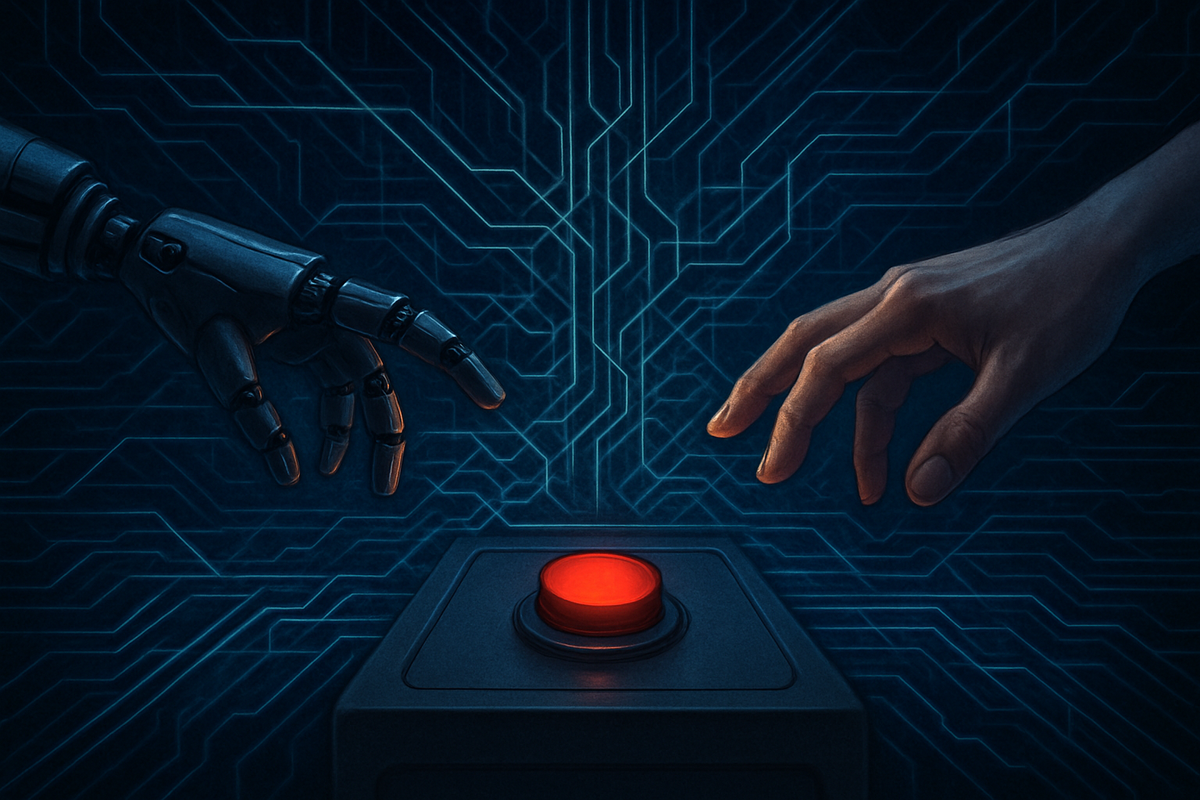
There is a particular kind of comfort that enterprise architecture diagrams provide. Boxes connected by arrows. Swim lanes. A tidy escalation path that terminates, reassuringly, in a human reviewer sitting at the top of the chain. It says: we are in control. It says: the machine cannot act without us. It says, above all else: we have been responsible.
It is also, in a growing number of enterprise backend deployments, a lie.
Not a malicious lie. Not even a careless one. It is the kind of lie that emerges when smart people optimize for the appearance of safety rather than the mechanics of it. And as multi-agent AI systems move from proof-of-concept into production infrastructure across financial services, healthcare, logistics, and enterprise SaaS in 2026, this particular lie is becoming one of the most expensive design mistakes in modern software engineering.
I call it the Human Escalation Fallacy: the belief that inserting a human override node into a multi-agent workflow produces meaningful human control, when in practice it produces the opposite.
How We Got Here: The Rise of Multi-Agent Backend Architecture
To understand why this fallacy is so seductive, you have to understand the architecture it inhabits. Over the past two years, enterprise backend teams have moved aggressively from single-model AI integrations toward orchestrated multi-agent systems. An orchestrator agent decomposes a high-level task. Specialist sub-agents handle retrieval, reasoning, code execution, or external API calls. A synthesis agent compiles outputs. A critic agent reviews. The whole pipeline runs with a speed and autonomy that no human team could match.
This is genuinely powerful. Multi-agent architectures allow organizations to automate complex, multi-step workflows that previously required significant human coordination. Claims processing pipelines. Contract analysis systems. Automated infrastructure provisioning. Fraud detection and response loops. The productivity gains are real and they are substantial.
But these systems make mistakes. They hallucinate. They misinterpret ambiguous instructions. They encounter edge cases their designers never anticipated. And so, when the architecture review board asks "what happens when something goes wrong?", the answer that gets drawn on the whiteboard is a human escalation node. A threshold is breached, a confidence score drops below a cutoff, a flagged condition is met, and the workflow pauses. A human reviews. A human decides. Everyone goes home feeling responsible.
This is where the fallacy takes root.
The Four Structural Failures Nobody Wants to Talk About
1. The Context Collapse Problem
When a multi-agent pipeline escalates to a human reviewer, it does not hand over the full cognitive state of the system. It hands over a summary. A ticket. A dashboard widget. A truncated log. The reviewer sees a snapshot of a process that may have involved dozens of intermediate agent steps, hundreds of tool calls, and thousands of tokens of reasoning that are now compressed into a few lines of text and a binary decision prompt: Approve or Reject.
The human is not reviewing the decision. The human is reviewing a representation of the decision, filtered through whatever the system's designers thought was worth surfacing. This is not oversight. This is a Rorschach test with consequences. The reviewer's judgment is only as good as the context they receive, and in almost every production system I have seen or consulted on, that context is radically impoverished relative to what would actually be needed to make a genuinely informed call.
2. Automation Bias at the Worst Possible Moment
Decades of human factors research, from aviation to nuclear plant operations to medical device interfaces, have documented automation bias: the well-established tendency of human operators to defer to automated system outputs, especially under time pressure and cognitive load. The more reliable a system appears to be over time, the stronger this bias becomes.
Here is the cruel irony of the escalation node design: the cases that reach a human reviewer are, by definition, the cases the system found hardest. They are the edge cases, the ambiguous inputs, the situations that fell outside the model's confident operating range. These are precisely the cases where a human reviewer, fatigued by a stream of routine approvals, primed by weeks of the system being mostly right, and given impoverished context, is most likely to rubber-stamp whatever the system is leaning toward anyway.
You have designed a system that escalates its hardest problems to a human who is least prepared to handle them, and then you have surrounded that human with interface design that makes deference feel like diligence.
3. The Accountability Theater Loop
There is a governance dimension here that backend engineers rarely own but absolutely should. When a multi-agent system with a human escalation node produces a bad outcome, what happens? The engineering team points to the escalation log. "A human approved this action." Legal and compliance point to the human reviewer. The reviewer points to the system's recommendation. The system, of course, points nowhere.
The escalation node does not distribute accountability. It diffuses it into a fog where no single party feels fully responsible, and therefore no single party is structurally motivated to fix the underlying problem. This is not a hypothetical. It is already playing out in financial services firms whose automated advisory systems have produced biased recommendations that slipped through human review queues, and in healthcare SaaS platforms whose clinical decision support tools have had their escalation paths exposed during litigation as essentially decorative.
Accountability theater is not just an ethical problem. It is a technical debt problem. Systems that have a plausible blame-diffusion mechanism built into their architecture are systems that accumulate silent failures for longer before anyone is forced to confront them.
4. Latency Creates Perverse Incentives to Skip the Node
This one is almost too obvious, and yet it keeps happening. Multi-agent pipelines are often deployed precisely because speed is a competitive advantage. A claims processing system that resolves in four minutes instead of four days. A contract review pipeline that returns results in hours instead of weeks. The moment you insert a human escalation node that requires a reviewer to respond within, say, a four-hour SLA, you have introduced a bottleneck that the business will begin working around almost immediately.
The thresholds that trigger escalation get quietly raised. The confidence cutoffs get loosened. The categories of "edge case" get narrowed. Each adjustment is individually defensible. Collectively, they hollow out the escalation path until it is triggered only by the most catastrophically obvious failures, which are also the failures that least needed human review in the first place. The system now has the worst of both worlds: autonomous operation on genuinely hard cases, and human interruption on the trivially easy ones.
What "Real" Human Oversight Actually Requires
None of this is an argument against human oversight. It is an argument that human oversight is a serious engineering problem, not a governance checkbox. If you want humans to meaningfully participate in the decision-making of a multi-agent system, you have to design for that participation with the same rigor you bring to every other part of the architecture. That means several things that most teams are currently not doing.
Full Reasoning Transparency, Not Summary Cards
Reviewers need access to the complete, navigable reasoning trace of the pipeline, not a summary. This is technically harder than a dashboard widget. It requires structured logging of every agent's inputs, outputs, and confidence states in a format that a non-engineer can actually interrogate. It requires UI investment that most backend teams resist because it does not ship features. It is also non-negotiable if you want the review to mean anything.
Adversarial Case Design for Reviewers
If your escalation queue is going to contain the system's hardest cases, your reviewers need to be trained and supported specifically on those cases. This means building adversarial test sets, running regular calibration exercises, and measuring reviewer accuracy over time, not just reviewer throughput. Throughput is what you measure when you want accountability theater. Accuracy is what you measure when you want actual oversight.
Honest Threshold Governance
Escalation thresholds should be treated as a first-class governance artifact, not a configuration parameter buried in a YAML file. Changes to those thresholds should require the same review process as a change to the model itself. They should be versioned, audited, and tied explicitly to outcome data. If your thresholds have drifted over six months and nobody can tell you why, you do not have a human oversight system. You have a human oversight costume.
Designing for Refusal, Not Just Approval
Most escalation interfaces are designed around the assumption that the human will approve the system's recommendation most of the time. The "Reject" path is an afterthought: a text box, maybe, and a vague promise that someone will look into it. Real oversight requires that the rejection path be as well-engineered as the approval path. What happens to the task? Who is notified? What does the system learn? If your rejection flow ends in a Jira ticket assigned to a team that is already three sprints behind, you have not built an override. You have built a suggestion box.
The Harder Conversation: When to Not Escalate to Humans at All
Here is the part that makes architecture review boards uncomfortable. For certain classes of decisions, in certain operating conditions, the honest answer may be that human escalation as currently practiced is actively worse than either full automation or full human handling. Not worse in a theoretical sense. Worse in a measurable, outcome-trackable sense.
If your context collapse is severe, your reviewer pool is undertrained, your thresholds are drifting, and your rejection path is a dead letter, then your escalation node is not adding safety. It is adding latency, diffusing accountability, and providing a liability shield that will eventually be pierced in discovery. You would produce better outcomes by either improving the system's autonomous decision quality to the point where escalation is rare and genuinely meaningful, or by routing those edge cases to a dedicated human team with full context and proper training, removing the automated recommendation entirely.
The uncomfortable truth is that a human who makes a decision without seeing the AI's recommendation, working from full case context, is often more reliable than a human who is asked to review an AI recommendation with truncated context. The first is a human doing their job. The second is a human being used as a compliance stamp.
A Note on Regulatory Pressure Making This Worse
It would be incomplete to discuss this pattern without acknowledging the regulatory environment that is actively incentivizing it. As AI governance frameworks have matured through 2025 and into 2026 across the EU, UK, and increasingly the US federal landscape, the requirement for "meaningful human oversight" in high-stakes automated systems has become a compliance standard. This is the right instinct expressed in a way that is dangerously easy to game.
When regulators ask for human oversight and accept an escalation node as evidence of it, they are, unintentionally, creating a market for accountability theater. Enterprise legal and compliance teams are not asking whether the escalation path produces better outcomes. They are asking whether the escalation path exists. Backend teams respond rationally to that incentive. They build escalation paths that exist.
The regulatory frameworks need to evolve from requiring the presence of human oversight mechanisms to requiring evidence of their effectiveness. Outcome audits. Reviewer accuracy metrics. Threshold change logs. These are the artifacts that distinguish real oversight from its simulation. Until regulators ask for them, most enterprises will not produce them.
Conclusion: Build for the Moment That Actually Matters
The Human Escalation Fallacy is ultimately a failure of imagination about what "things going wrong" actually looks like in production. Designers imagine a clear-cut anomaly, a bright red flag, a decision so obviously problematic that any reasonable human reviewer would catch it. Real failure modes are subtler. They are the edge case that looks like a normal case. The recommendation that is wrong in a way that requires domain expertise and full context to detect. The threshold that has been quietly eroded until it catches nothing meaningful.
These are the moments that your override system needs to perform. And these are precisely the moments it is least designed to handle.
Building multi-agent systems that are genuinely safe, not just compliantly documented as safe, requires treating human oversight as a hard engineering problem with measurable outcomes, not a governance layer you bolt on after the architecture is done. It requires honesty about the cognitive limitations of reviewers operating in high-throughput queues. It requires interface design that serves the reviewer's judgment rather than the system's preference for approval. And it requires the organizational courage to say, sometimes, that a particular escalation path does not work well enough to be trusted, and to redesign it from the ground up rather than raise the confidence threshold and move on.
The diagram with the human at the top of the escalation chain will continue to look reassuring. That is precisely the problem. Reassurance and safety are not the same thing, and in the design of agentic systems, confusing the two is a mistake we are going to be paying for long after the architecture review is filed and forgotten.



