Synchronous AI Agent Orchestration vs. Event-Driven Choreography: Which Multi-Agent Coordination Model Should Enterprise Backend Teams Choose in H2 2026?
There is a quiet architectural war being fought inside enterprise backend teams right now. On one side: the clean, predictable control of synchronous AI agent orchestration. On the other: the resilient, decoupled power of event-driven agent choreography. Both camps have passionate advocates, credible benchmarks, and real production scars to show for their convictions.
The problem is that most guidance on this topic treats the two models as philosophically opposed, when the real question is far more surgical: what happens when your latency SLAs and your fault isolation requirements point in opposite directions? That is exactly the collision course that backend teams are navigating in H2 2026, as agentic workloads move from experimental pilots into tier-one production systems with genuine business consequences.
This article is not a gentle introduction to either pattern. It is a decision framework for engineers and architects who already understand the basics and need to make a defensible call under real constraints.
Setting the Stage: Why This Decision Got Harder in 2026
Through 2024 and 2025, most enterprise AI agent deployments were relatively forgiving. Agents handled background tasks, document summarization, internal tooling, and low-stakes automation. Latency tolerances were wide, and a crashed agent was an inconvenience rather than a revenue event.
That era is over. In H2 2026, agentic systems are embedded in customer-facing workflows, financial transaction pipelines, real-time supply chain decisions, and healthcare triage routing. The stakes have fundamentally changed across three dimensions:
- Latency expectations have tightened. Enterprise SLAs that once accepted 10-second agent response windows now demand sub-2-second p99 thresholds for interactive agentic flows.
- Agent graphs have grown deeper. What began as two or three cooperating agents has matured into graphs of 15 to 40 specialized agents, each with distinct tool access, memory scopes, and failure modes.
- Regulatory pressure has arrived. EU AI Act compliance obligations, SOC 2 Type II audit trails, and HIPAA-adjacent agentic data handling rules now require demonstrable fault boundaries and traceable execution paths.
Against this backdrop, the orchestration-vs-choreography choice is no longer an architectural preference. It is a risk management decision.
Defining the Two Models Precisely
Synchronous AI Agent Orchestration
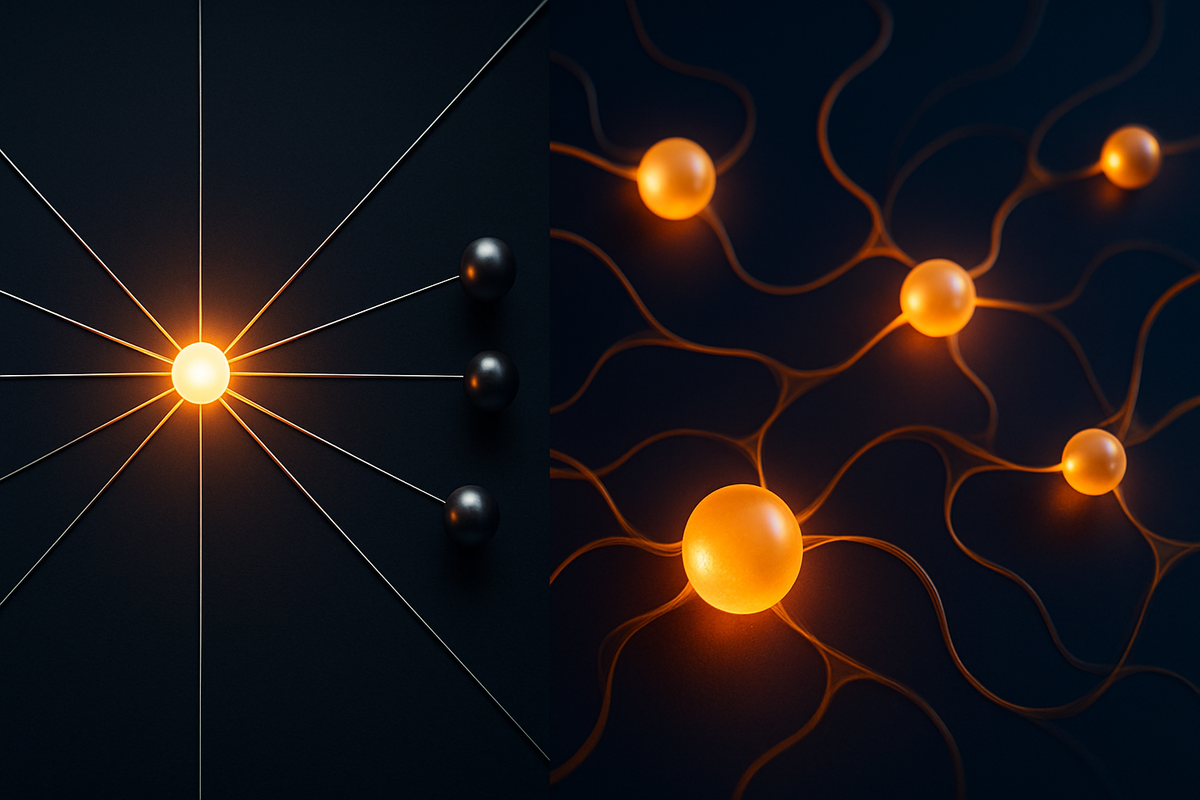
In the orchestration model, a central controller agent (often called an orchestrator, planner, or supervisor) holds the execution graph explicitly. It calls sub-agents in a defined sequence or conditional branching structure, waits for each response before proceeding, and maintains a unified state object across the entire workflow.
Think of it as a conductor leading an orchestra: every instrument plays when told, in the order specified, and the conductor knows the full score. Popular frameworks implementing this pattern in 2026 include LangGraph's StateGraph with interrupt checkpoints, AutoGen's GroupChat with a designated speaker selector, and the OpenAI Agents SDK's handoff chains with structured output validation at each hop.
Key structural characteristics:
- Execution is blocking at each agent boundary by default
- State is centralized and serializable at any checkpoint
- The orchestrator has full visibility into the plan at all times
- Failures surface immediately and synchronously to the calling layer
- Tracing and observability are straightforward: one call tree, one trace ID
Event-Driven Agent Choreography
In the choreography model, no single agent owns the execution plan. Instead, agents are autonomous consumers and producers on an event bus or message broker (Kafka, Pulsar, NATS JetStream, or cloud-native equivalents). Each agent reacts to events it is subscribed to, performs its work, and emits new events that trigger downstream agents, without any central coordinator directing the sequence.
Think of it as a jazz ensemble: each musician knows their part, listens to what others are playing, and responds accordingly. No conductor is required because the rules of engagement are embedded in the event contracts themselves.
Key structural characteristics:
- Execution is non-blocking and asynchronous by default
- State is distributed across event logs and agent-local stores
- No single agent has a global view of the workflow in progress
- Failures are isolated to the agent that encounters them; the bus continues
- Tracing requires distributed correlation IDs and event stream reconstruction
The Core Tension: Where Latency SLAs and Fault Isolation Collide
Here is the uncomfortable truth that most architecture decision records gloss over: the properties that make orchestration good for latency are the same properties that make it bad for fault isolation, and vice versa for choreography.
This is not a coincidence. It is a fundamental consequence of where control and state live in each model.
Orchestration's Latency Advantage (and Its Hidden Cost)
When an orchestrator calls Agent B immediately after Agent A responds, the round-trip latency is essentially the sum of individual agent inference times plus network hops. There is no queue serialization delay, no consumer group rebalancing, no broker persistence overhead. For a three-agent chain where each agent takes 400ms, your theoretical minimum latency is around 1.2 seconds plus overhead. In practice, well-tuned orchestration pipelines on co-located infrastructure regularly hit p50 latencies in this range.
However, the orchestrator is also a single point of coupling. If Agent C in a five-agent chain throws an unhandled exception, the orchestrator must decide: retry, reroute, or surface the failure. While it is deciding, the entire workflow is blocked. Worse, if the orchestrator itself becomes a bottleneck under high concurrency (say, 500 simultaneous agentic workflows), you get head-of-line blocking that destroys your p99 latency even if your p50 looks healthy.
Choreography's Fault Isolation Advantage (and Its Latency Tax)
In an event-driven choreography system, Agent C's failure affects only Agent C's consumer group. The event bus retains the message, other agents continue processing their own queues, and a dead-letter queue captures the failed event for inspection or replay. The blast radius of any single agent failure is, by design, contained.
But this isolation comes with a latency tax that is often underestimated. A five-agent choreography pipeline introduces: broker write latency at each hop, consumer poll intervals (even with push-based delivery), partition assignment overhead, and the serialization/deserialization cost of event payloads crossing agent boundaries. On a managed Kafka cluster, each hop realistically adds 20 to 80ms of broker overhead. Across five hops, that is 100 to 400ms of pure infrastructure tax before a single token of LLM inference runs.
For workflows with strict sub-2-second SLAs, this overhead is not trivial. It can consume 20 to 30 percent of your entire latency budget on broker mechanics alone.
A Decision Framework for H2 2026 Enterprise Teams
Rather than declaring a winner, the right approach is to map your specific constraints to the model that minimizes your dominant risk. Use the following framework as a starting point.
Step 1: Classify Your Workflow by Latency Profile
Ask: what is your p99 SLA, and what is the depth of your agent graph?
- Sub-2-second p99, graph depth 1 to 5 agents: Synchronous orchestration is almost always the right call. The latency budget is too tight for broker overhead, and the graph is shallow enough that fault blast radius is manageable.
- 2 to 10 second p99, graph depth 5 to 15 agents: This is the contested middle ground. Both models are viable, and the decision pivots on fault isolation requirements (see Step 2).
- 10+ second p99 or fully async workflows: Event-driven choreography is strongly preferred. The latency budget absorbs broker overhead comfortably, and the fault isolation and scalability benefits compound significantly at this depth.
Step 2: Assess Your Fault Isolation Requirements
Ask: what is the blast radius tolerance if a single agent in the graph fails?
- Zero tolerance for cascading failures (financial transactions, healthcare routing, critical infrastructure): Choreography's natural bulkhead pattern is a strong fit. Even within an orchestration model, you will need to implement circuit breakers, bulkheads, and fallback agents that essentially recreate choreography semantics at higher engineering cost.
- Moderate tolerance with fast recovery acceptable (internal tooling, content generation, analytics): Orchestration with structured retry logic and checkpoint-based resumption (as supported by LangGraph's persistence layer and similar frameworks) is sufficient and simpler to operate.
- Compliance-driven audit trail requirements: Both models can satisfy this, but choreography's event log is a natural immutable audit trail. Orchestration requires explicit trace export to an observability backend like OpenTelemetry-compatible stores.
Step 3: Evaluate Your Team's Operational Maturity
This step is often skipped in architecture reviews, and it is frequently the deciding factor in production outcomes.
- Synchronous orchestration is operationally simpler. Debugging a failed workflow means reading a single trace. Reproducing a bug means replaying a checkpoint. Onboarding a new engineer takes days, not weeks.
- Event-driven choreography requires operational sophistication: distributed tracing with proper correlation ID propagation, dead-letter queue monitoring, consumer lag alerting, schema registry management, and event replay tooling. Teams without existing Kafka or Pulsar operational experience routinely underestimate this by a factor of three in their sprint planning.
The Hybrid Pattern That Most Teams Will Actually Use
In practice, the most resilient enterprise agentic architectures in H2 2026 are not choosing one model. They are applying a hierarchical hybrid: orchestration within bounded workflow segments, choreography between segments.
Here is what this looks like concretely:
- A customer request enters via an API gateway and triggers an orchestrated sub-graph of 3 to 4 agents responsible for intent classification, context retrieval, and initial response generation. This sub-graph runs synchronously to meet the interactive latency SLA.
- The orchestrated sub-graph emits a structured event to the message bus upon completion, triggering a choreographed downstream pipeline of agents responsible for audit logging, CRM updates, personalization model fine-tuning signals, and compliance reporting. These agents run asynchronously, are fully fault-isolated from each other, and have no latency SLA pressure.
This pattern cleanly separates the latency-sensitive hot path (orchestration) from the fault-isolation-critical cold path (choreography). The boundary between the two is an event, which also serves as the natural audit checkpoint for compliance purposes.
Tooling Landscape in H2 2026: What to Actually Use
The framework landscape has matured considerably. Here is a practical mapping of tools to each model as of mid-2026:
For Synchronous Orchestration
- LangGraph (LangChain): The most production-battle-tested option for stateful, checkpointed orchestration with built-in human-in-the-loop support and PostgreSQL-backed persistence.
- OpenAI Agents SDK: Excellent for teams standardized on OpenAI models, with native handoff chains and structured output validation baked in.
- Microsoft AutoGen 0.4+: Strong for multi-agent conversation patterns with asynchronous group chat that can be configured for synchronous sequential execution.
- CrewAI: Approachable for teams newer to agentic systems, with role-based agent definitions and sequential/hierarchical process modes.
For Event-Driven Choreography
- Apache Kafka + custom agent consumers: The enterprise standard for high-throughput, durable event pipelines. Requires the most operational investment but offers the deepest feature set.
- NATS JetStream: A lighter-weight alternative gaining traction for agentic workloads that need low-latency pub/sub without Kafka's operational overhead.
- Dapr (Distributed Application Runtime): Increasingly popular in Kubernetes-native enterprise environments, providing a sidecar abstraction over multiple message brokers and enabling portable choreography logic.
- AWS EventBridge + Step Functions (Agentic Mode): For teams deeply invested in AWS, this combination provides managed choreography with built-in retry, dead-letter, and observability integrations.
Five Questions to Ask Before You Commit
Before finalizing your architecture decision, run your team through these five questions. If you cannot answer all five confidently, you are not ready to commit to either model at production scale.
- What is your p99 latency budget, and have you measured baseline broker overhead in your target infrastructure? Theoretical latency math and production latency math diverge quickly under load.
- What is your agent failure rate in staging, and what is the acceptable downstream impact of a single agent going offline for 60 seconds? This defines your blast radius tolerance concretely.
- Do you have distributed tracing instrumentation in place, or will you be debugging production incidents with log grep? Choreography without proper observability is an operational liability.
- How frequently will your agent graph topology change? Orchestration graphs require code changes to rewire. Choreography graphs can often be rewired by adjusting event subscriptions, which is operationally faster but harder to govern.
- Who owns the schema contract between agents? In choreography, schema drift between event producers and consumers is a silent killer. You need a schema registry and a breaking-change policy before you go to production.
Conclusion: The Right Answer Is the One You Can Operate
The orchestration-vs-choreography debate in agentic AI is not fundamentally different from the same debate that played out in microservices architecture a decade ago. The same lesson applies: the technically superior pattern that your team cannot operate reliably in production is worse than the technically inferior pattern that your team can monitor, debug, and recover from at 2 AM on a Sunday.
In H2 2026, the default recommendation for most enterprise backend teams is to start with synchronous orchestration for any workflow with a sub-5-second SLA or a graph depth under 10 agents, and to introduce event-driven choreography deliberately, at well-defined workflow boundaries, as fault isolation requirements or scale demands justify the operational investment.
Reserve the full choreography model for workflows where fault isolation is a hard regulatory or business requirement, where your team has genuine event streaming operational experience, and where your latency budget comfortably absorbs broker overhead without threatening your SLA.
The teams that will win with agentic AI in the next 18 months are not the ones who chose the most sophisticated coordination pattern. They are the ones who chose the most appropriate pattern and built the observability, runbooks, and failure playbooks to back it up.
Build for the failure mode you cannot predict. The coordination model is just the frame around that discipline.



