Robotaxi Fleet AI vs. Human Dispatcher Hybrid Models: Which Operational Architecture Actually Delivers Safer Incident Response Times?
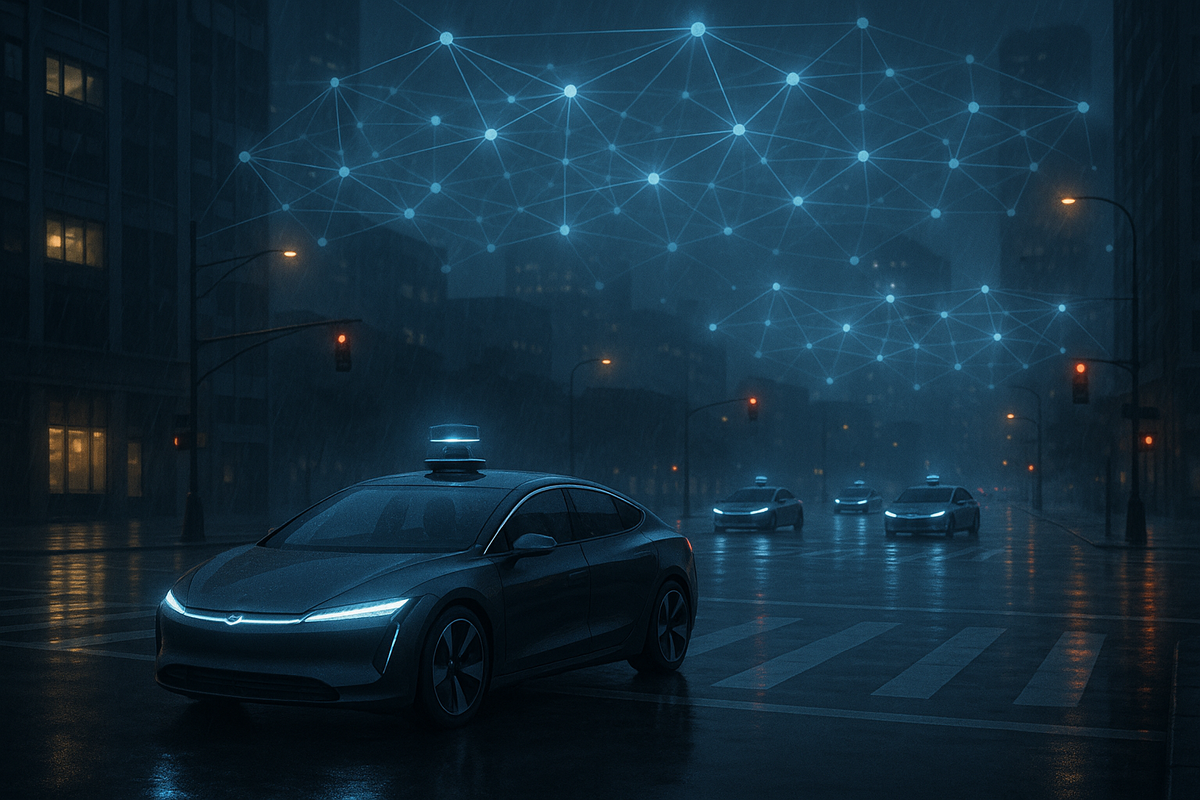
Here is a scenario that keeps enterprise mobility operators awake at night: a robotaxi in your 200-vehicle fleet detects an obstacle at 2:47 AM in a geofenced urban corridor. Within the next 90 seconds, the outcome of that incident will be shaped entirely by your operational architecture. Did you bet on a fully autonomous AI dispatch stack? Or did you hedge with a human-in-the-loop hybrid model? In H2 2026, that architectural choice is no longer theoretical. It is a live, revenue-critical, and liability-defining decision.
As robotaxi operators including Waymo, Zoox, WeRide, and a growing cohort of white-label autonomous mobility providers push aggressively into enterprise fleet contracts, the debate over fully autonomous AI dispatch versus human-AI hybrid operational models has moved from academic whitepapers onto the desks of fleet procurement officers and chief safety officers. This article breaks down both architectures head-to-head, with a specific focus on the metric that matters most at scale: incident response time and safety outcomes.
Setting the Stage: What "Operational Architecture" Actually Means in 2026
Before diving into the comparison, it is worth defining what we mean by operational architecture in the context of robotaxi fleet management. This is not simply about whether a car drives itself. Every commercial robotaxi fleet, regardless of the autonomy level of its vehicles, requires a backend operational layer that handles:
- Real-time vehicle monitoring across distributed geographic zones
- Incident classification and escalation when anomalies are detected
- Dynamic re-routing and fleet rebalancing in response to disruptions
- Regulatory compliance triggers such as mandatory stop protocols and incident reporting
- Passenger communication and safety assurance during edge-case events
The question is not whether AI or humans handle the vehicle itself. The question is who, or what, manages these operational layers when something goes wrong. Two dominant models have emerged in the enterprise space heading into H2 2026.
Model A: Full-Stack AI Dispatch (The "Lights-Out" Architecture)
The full-stack AI dispatch model, sometimes called the "lights-out" operations center, relies on a centralized AI platform to monitor, classify, and respond to incidents across the entire fleet with no human intervention in the critical response loop. Operators like Waymo Via and several Chinese-market robotaxi platforms deploying in Southeast Asia and the Middle East have pioneered versions of this model at scale.
How It Works
At its core, a lights-out architecture layers several AI subsystems on top of each other. A fleet telemetry ingestion engine processes sensor data from every vehicle simultaneously, typically at sub-100ms polling intervals. An anomaly detection model, usually a fine-tuned transformer architecture trained on millions of edge-case scenarios, classifies incoming events into severity tiers in real time. A decision orchestration layer then executes a pre-approved response playbook: pulling the vehicle to a safe stop, notifying passengers via in-cabin interface, alerting emergency services via API integration, and logging the incident for regulatory review.
Incident Response Time: The Numbers
This is where the AI-only model genuinely shines. In controlled fleet environments, fully automated incident detection and initial response protocols execute in the 200 to 800 millisecond range. Compare that to even the fastest human dispatcher, who requires a minimum of 4 to 8 seconds to cognitively process an alert, assess the dashboard data, and initiate a response action. At the moment of anomaly detection, the AI model is not faster by a small margin. It is faster by an order of magnitude.
For Tier-1 incidents, which are defined as immediate physical safety threats such as collision detection, sudden mechanical failure, or passenger medical emergency, this speed advantage is significant. AI-driven systems can engage vehicle safe-stop protocols, unlock doors for emergency egress, and ping local emergency services before a human dispatcher has finished reading the incident alert on their screen.
The Critical Weakness: Contextual Ambiguity
The lights-out model's Achilles heel is contextual ambiguity. AI systems trained on historical incident data perform exceptionally well within the distribution of scenarios they have encountered before. But in H2 2026, enterprise fleets are being deployed in increasingly complex, dynamic urban environments: mixed-traffic corridors with construction detours, multi-jurisdictional regulatory zones, and culturally nuanced passenger interactions.
When a robotaxi in a hybrid-use corridor encounters a situation that sits outside its training distribution, such as an informal roadblock set up by a local community event, or a passenger who is medically distressed but not triggering biometric sensors, the AI dispatch system can misclassify the event severity and execute an inappropriate playbook. The response is fast, but it may be the wrong response. In safety-critical contexts, a fast wrong answer can be worse than a slower correct one.
Model B: Human-AI Hybrid Dispatch (The "Augmented Operations Center")
The human-AI hybrid model does not replace AI with humans. It positions AI as the first-responder layer and humans as the escalation and judgment layer. This is the architecture being adopted by the majority of enterprise mobility operators in North America and Europe entering into large-scale fleet contracts in 2026, particularly in regulated markets where liability frameworks still require a "qualified human in the loop" for certain incident classifications.
How It Works
In a well-designed augmented operations center, the AI system handles the first 800 milliseconds exactly as it would in a lights-out model. It detects, classifies, and executes immediate automated safety responses. But simultaneously, it surfaces a rich contextual dashboard to a human Remote Vehicle Operator (RVO) or fleet safety supervisor. The human does not need to monitor 200 vehicles simultaneously. The AI pre-filters, prioritizes, and presents only the incidents that require human judgment, typically those classified as Tier-2 or above.
The human's role is not to be faster than the AI. It is to be smarter in the situations where raw speed is less important than contextual reasoning. A trained RVO can recognize that a vehicle flagged for "unusual stop behavior" is actually parked legally outside a hospital entrance, and can override an unnecessary re-routing command in seconds. That nuanced call prevents a cascade of downstream disruptions that an AI system, operating on pattern-matching logic, might not catch.
Incident Response Time: The Honest Assessment
For Tier-1 incidents, the hybrid model's response time is effectively identical to the lights-out model, because the AI automated layer fires first regardless. The human is notified in parallel but does not need to act within the first critical seconds. This is a crucial design point that many enterprise procurement teams misunderstand. A well-architected hybrid model does not slow down emergency response. The AI still executes the immediate safety protocol. The human provides oversight and course-correction on a slightly longer timeline.
For Tier-2 and Tier-3 incidents, which include scenarios like passenger disputes, route ambiguity in construction zones, regulatory compliance edge cases, and reputational risk situations, the hybrid model consistently outperforms the lights-out architecture. Human operators resolving these mid-level incidents typically do so in 12 to 35 seconds with significantly higher accuracy than AI-only resolution, which in complex ambiguous scenarios can have misclassification rates as high as 18 to 22 percent based on industry benchmarking data from early 2026 fleet deployments.
The Scaling Paradox: Where the Math Gets Complicated
Here is the uncomfortable truth that vendors on both sides of this debate tend to obscure: the two models do not scale the same way, and the scaling curve is not linear.
AI-Only Scaling Economics
The lights-out model has an extraordinary marginal cost profile. Once the AI infrastructure is built and validated, adding the 201st vehicle to a 200-vehicle fleet costs almost nothing operationally. The AI system scales horizontally with minimal incremental overhead. This is deeply attractive to enterprise operators building toward 500-plus vehicle fleets in a single metro area.
However, the safety risk profile does not scale as favorably. As fleet size increases, the absolute number of edge-case incidents increases proportionally, even if the per-vehicle incident rate stays constant. A fleet of 500 vehicles experiencing edge-case events at a rate of 0.5 percent per operational hour generates 2.5 edge-case events per hour. At that volume, AI misclassification rates that seem acceptable at small scale begin to generate meaningful safety incidents and regulatory exposure.
Hybrid Model Scaling Economics
The hybrid model's cost curve is less favorable on paper. Human RVOs represent a fixed operational cost that scales, at least partially, with fleet size. Industry benchmarks suggest that a well-optimized augmented operations center can support a ratio of approximately one RVO per 40 to 60 active vehicles, depending on the complexity of the operating environment. For a 500-vehicle fleet, that implies a team of 9 to 13 active RVOs per shift, representing a significant ongoing labor cost.
But here is the counterintuitive insight: at scale, the hybrid model's total cost of safety incidents may be lower, even accounting for higher labor costs. When you factor in the fully-loaded cost of a safety incident, including regulatory fines, insurance premium adjustments, reputational damage, and potential litigation, preventing even two or three serious misclassified incidents per year at a 500-vehicle fleet level can more than offset the annual cost of a full RVO team.
Head-to-Head Scorecard: Six Key Dimensions
For enterprise mobility operators making this decision in H2 2026, here is a direct comparison across the dimensions that matter most:
1. Tier-1 Incident Response Speed
Winner: Tie. Both models execute automated safety protocols in under one second for life-safety incidents. The hybrid model's human layer adds no latency to Tier-1 response if the architecture is properly designed.
2. Tier-2 and Tier-3 Incident Resolution Accuracy
Winner: Human-AI Hybrid. Human judgment consistently outperforms AI classification in ambiguous, context-dependent scenarios. The gap is most pronounced in novel or out-of-distribution situations that are increasingly common as fleets expand into new geographies.
3. Operational Cost at Scale (500+ Vehicles)
Winner: Full-Stack AI (on paper). Marginal cost per additional vehicle is near-zero for lights-out operations. However, this advantage narrows significantly when total cost of safety incidents is factored into the model.
4. Regulatory Compliance Readiness
Winner: Human-AI Hybrid. In H2 2026, the majority of active robotaxi regulatory frameworks in the US (NHTSA AV 4.0 guidelines), the EU (AI Act transportation provisions), and key APAC markets still require documented human oversight capability for commercial fleet operations above certain vehicle thresholds. The hybrid model is structurally more compliant.
5. Passenger Trust and Experience During Incidents
Winner: Human-AI Hybrid. Research consistently shows that passengers experiencing an in-vehicle incident, particularly a medical or security concern, have measurably better outcomes and higher satisfaction scores when they can interact with a human operator via the in-cabin communication system. AI voice interfaces, even with 2026-generation LLM capabilities, score lower on passenger trust during high-stress scenarios.
6. Long-Term Safety Improvement Trajectory
Winner: Human-AI Hybrid (for now). Human operator decision data in the hybrid model creates a continuous feedback loop that improves AI classification models over time. Lights-out systems improve only from vehicle sensor data and incident outcomes, missing the rich contextual judgment data that human operators generate. This advantage will narrow as AI systems become more capable, but it remains meaningful through at least 2027 to 2028 by most industry projections.
The Architecture Decision Framework for Enterprise Operators
Given this analysis, how should enterprise mobility operators actually make this decision heading into H2 2026? The answer is not one-size-fits-all. It depends on three key variables:
- Fleet size and growth trajectory: Operators scaling rapidly past 300 vehicles in a single market should lean toward hybrid models to manage safety risk during the high-growth phase, then evaluate AI-only transition at maturity.
- Operating environment complexity: Fleets operating in highly structured, geofenced environments (airports, corporate campuses, planned communities) can tolerate more AI autonomy in the dispatch layer. Mixed urban deployments with high variability require more human oversight.
- Regulatory jurisdiction: Do not make this decision without a detailed read of the specific AV operational requirements in each deployment market. Regulatory requirements in California, Texas, Germany, Singapore, and the UAE differ substantially in 2026, and the wrong architecture choice can create compliance exposure that overrides all other considerations.
The Emerging Third Path: Adaptive Architecture
The most sophisticated enterprise operators in H2 2026 are not choosing between these two models. They are building adaptive operational architectures that shift dynamically between AI-autonomous and human-augmented modes based on real-time context signals. During low-complexity operational windows, such as late-night low-traffic periods in well-mapped geofences, the system operates in near-lights-out mode. During high-complexity windows, such as peak hours, major events, or adverse weather conditions, the system automatically routes more incidents to human oversight queues and increases RVO staffing levels.
This adaptive approach captures the cost efficiency of AI-only operations during favorable conditions while preserving the safety accuracy of human judgment when it matters most. Several enterprise fleet management platforms, including those built on top of NVIDIA's DriveOS fleet stack and custom orchestration layers from fleet software providers, are beginning to offer this mode as a configurable operational parameter rather than a fixed architectural choice.
Conclusion: Safety Is Not a Binary Choice Between Speed and Judgment
The framing of "AI dispatch versus human dispatcher" is a false dichotomy that serves vendors more than it serves operators. The real question for enterprise mobility operators scaling in H2 2026 is: at what tier of incident severity does your operation require human judgment, and how quickly can your architecture surface those situations to the right person?
For Tier-1 life-safety incidents, AI wins on speed, and no human-AI hybrid should slow that down. For Tier-2 and Tier-3 incidents, which represent the vast majority of real-world fleet management complexity, human judgment embedded in a well-designed AI-augmented workflow consistently delivers better outcomes than either pure AI or pure human operations.
The operators who will lead enterprise mobility at scale through the rest of 2026 and beyond are not those who picked the most autonomous architecture. They are those who designed the most intelligent handoff between machine speed and human wisdom. In a domain where the cost of a wrong decision is measured in human safety, that distinction is everything.
Are you evaluating operational architecture decisions for an enterprise robotaxi or autonomous fleet deployment? The frameworks and benchmarks in this article reflect the current state of the industry as of mid-2026. Specific performance metrics will vary based on vehicle platform, operating environment, and software stack. Always consult with certified AV safety engineers and legal counsel familiar with your deployment jurisdiction before finalizing operational architecture decisions.



