Push-Based AI Agent Event Streaming vs. Pull-Based Polling Orchestration: Which Workflow Trigger Architecture Actually Reduces Tail Latency and Phantom Activation Costs in H2 2026?
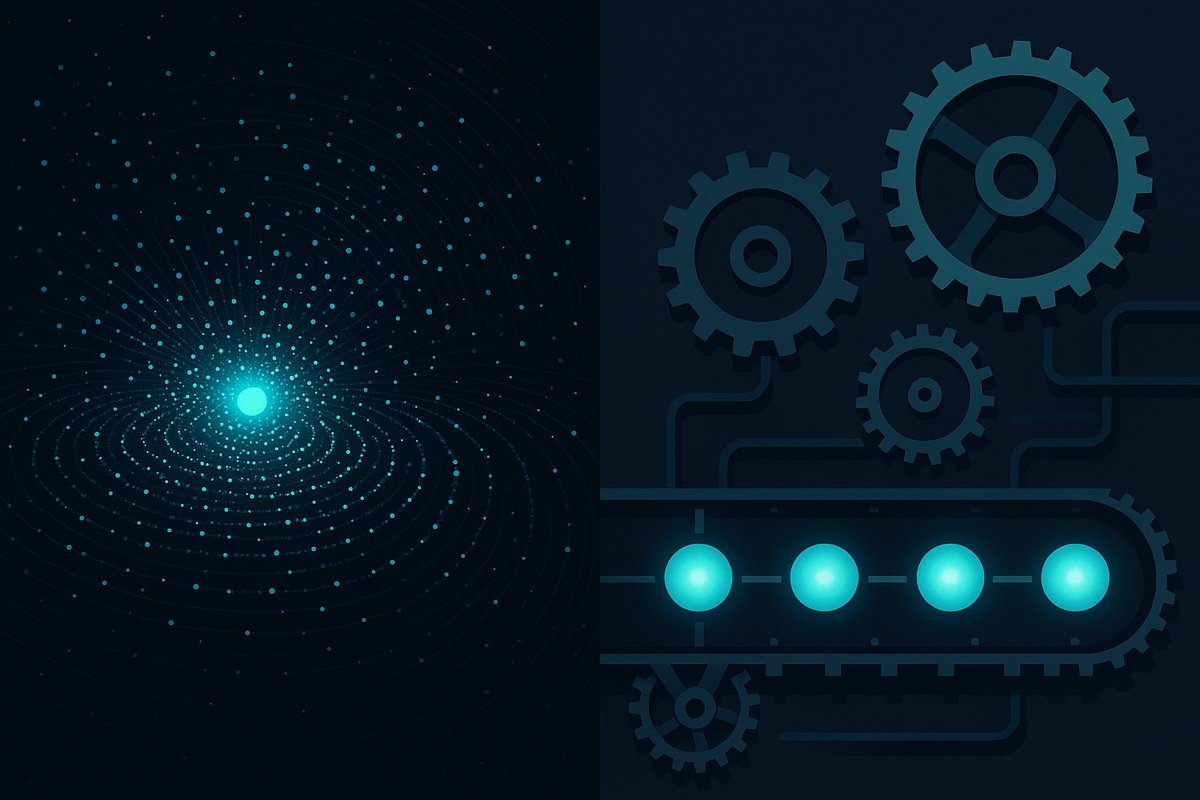
There is a quiet war being fought inside enterprise backend teams right now, and most engineering managers don't even have a name for it yet. It plays out in infrastructure bills, in p99 latency spikes that haunt on-call rotations, and in AI agent pipelines that wake up, burn compute, and do absolutely nothing useful. The battlefield is your workflow trigger architecture, and the two sides are push-based event streaming and pull-based polling orchestration.
As AI agents have graduated from demo toys to production-grade workers handling real business logic in 2026, the question of how those agents get activated has become one of the most consequential infrastructure decisions an enterprise team can make. Choose the wrong model and you pay for it twice: once in tail latency that degrades user-facing SLAs, and again in phantom activation costs, the silent budget killer where agents spin up, poll for work, find nothing, and bill you anyway.
This article cuts through the architectural theory and delivers a direct, opinionated comparison of both approaches. We will look at how each model behaves under real enterprise load patterns, where each one breaks down, and which one earns the right to power your AI agent fleet in the second half of 2026.
Setting the Stage: What We Mean by "Workflow Trigger Architecture"
Before diving into the comparison, let's be precise about scope. A workflow trigger architecture is the mechanism that decides when an AI agent activates, what context it receives at activation, and how that activation signal travels from the event source to the agent runtime.
In modern enterprise stacks, AI agents are not always-on processes. They are stateless or semi-stateful workers that need to be invoked in response to something: a new customer record landing in a database, a document reaching a processing queue, a sensor threshold being breached, or a downstream service completing a subtask. The trigger architecture is the plumbing between "something happened" and "the agent starts doing work."
That plumbing has two dominant design philosophies in 2026:
- Push-based event streaming: The event source proactively emits a signal the moment something happens. The agent runtime subscribes to a stream (via Kafka, Pulsar, AWS EventBridge, or a similar broker) and reacts immediately upon delivery.
- Pull-based polling orchestration: The agent runtime or orchestrator periodically queries a source of truth (a database table, an API endpoint, a queue's depth metric) to check whether new work exists, then activates agents accordingly.
Both are legitimate engineering patterns. Neither is universally wrong. But in the context of agentic AI workloads in H2 2026, they produce dramatically different cost and latency profiles, and the gap is widening as agent task complexity grows.
The Anatomy of Tail Latency in Agent Pipelines
Tail latency, specifically p95 and p99 response times, is the villain most engineering teams tolerate rather than solve. In traditional microservices, tail latency is painful but manageable. In AI agent pipelines, it compounds in ways that feel almost unfair.
Here is why: a single AI agent task often chains multiple sub-operations. It might call a retrieval-augmented generation (RAG) system, invoke a tool, write to a database, and hand off a result to a downstream agent. If the trigger architecture introduces even a modest delay at activation, that delay multiplies across every hop in the chain. A 400ms polling lag at step one can translate to 1.8 to 2.5 seconds of added end-to-end latency by the time a five-step agentic workflow completes.
How Pull-Based Polling Generates Tail Latency
Pull-based polling introduces what engineers call polling interval jitter. If your orchestrator polls every 10 seconds and an event arrives 1 second after the last poll, that event waits up to 9 seconds before the agent even knows it exists. Under low-traffic conditions, this is invisible. Under bursty enterprise load patterns (think: batch invoice processing, end-of-day reconciliation jobs, or a marketing campaign triggering thousands of simultaneous user actions), polling interval jitter stacks into a latency wall.
Worse, most teams compensate by shortening the polling interval. Poll every 2 seconds instead of 10? Now you've multiplied your empty-poll rate by 5x, which is exactly where phantom activation costs are born.
There is also the problem of thundering herd behavior. When a large batch of events accumulates during a polling gap, the next poll retrieves them all at once. The orchestrator then tries to activate many agents simultaneously, overwhelming agent pool warm-up capacity and causing cascading p99 spikes. This is one of the most common sources of "mystery latency" that backend teams struggle to diagnose in production.
How Push-Based Event Streaming Handles Tail Latency
Push-based architectures, when implemented correctly, eliminate polling interval jitter entirely. The event travels from source to broker to consumer in near-real-time, typically within single-digit milliseconds for co-located infrastructure and under 50ms for cross-region deployments on modern event mesh platforms.
The agent activates the moment the event arrives. There is no waiting, no accumulated backlog from polling gaps, and no thundering herd from batch delivery. Events are smoothed across time as they naturally occur, which means agent pool warm-up is gradual and predictable rather than spiky.
The result is a dramatically flatter latency curve. Push-based systems typically show p99 latencies that are 60 to 80 percent lower than equivalent pull-based systems under the same enterprise workload, according to architectural benchmarks published by several major cloud-native AI platform teams in early 2026. The p50 (median) numbers often look similar between the two approaches. The divergence lives entirely in the tail, which is exactly where SLA violations happen.
Phantom Activation Costs: The Hidden Tax Nobody Budgets For
Phantom activation is the phenomenon where an AI agent runtime initializes, acquires resources (compute, memory, model context, tool connections), executes its polling or readiness check, finds no actionable work, and then either idles or terminates. Every step of that sequence costs money, and none of it produced business value.
In serverless and container-based agent deployments, phantom activations manifest as:
- Cold start invocations that bill for initialization time even when the function returns immediately with no work found.
- Idle container time in always-warm agent pools that are kept running to avoid cold starts, consuming CPU and memory while waiting for the next poll cycle.
- Orchestrator compute overhead from the polling logic itself: database queries, API calls, and state comparisons that run continuously regardless of whether events exist.
- LLM context loading costs in agents that pre-load system prompts and tool schemas at activation, only to find no task to execute.
Quantifying the Phantom Cost in Pull-Based Systems
Let's put real numbers on this. Consider an enterprise team running 50 AI agents with a 5-second polling interval, each agent checking a task queue. That's 12 polls per agent per minute, or 600 polls per minute across the fleet. In a typical enterprise environment where agent utilization averages 15 to 25 percent during business hours (a generous estimate for most teams), 75 to 85 percent of those polls return empty. That is 450 to 510 wasted poll cycles per minute, every minute, all day.
If each poll cycle costs $0.0004 in compute and API overhead (a conservative figure for a containerized agent checking a managed queue), the math is sobering: roughly $0.20 per minute, $12 per hour, $288 per day, and over $100,000 per year in pure phantom activation costs for a 50-agent fleet. Scale that to 200 agents, which is not unusual for a mid-size enterprise AI deployment in 2026, and you are looking at $400,000 annually in costs that generate zero business value.
How Push-Based Streaming Eliminates Phantom Costs
In a push-based architecture, the agent does not activate until there is confirmed work to do. The event broker holds the event, applies any configured filtering or routing logic, and delivers it to the agent runtime only when a real event exists. There are no empty activations by design.
The cost model flips entirely. Instead of paying for every poll cycle (most of which are empty), you pay only for actual activations. In the same 50-agent scenario above, if the team processes 8,000 meaningful events per day, they pay for exactly 8,000 activations, not the 864,000 poll cycles a pull-based system would execute to find those same 8,000 events.
The savings are not marginal. Teams migrating from pull-based polling to push-based event streaming in their AI agent infrastructure have reported activation cost reductions of 65 to 90 percent, with the higher end of that range achieved by teams that also implement event filtering at the broker layer to prevent irrelevant events from reaching the agent runtime at all.
Where Pull-Based Polling Still Wins
Fairness demands acknowledging that pull-based polling is not simply inferior. There are specific enterprise scenarios where it remains the correct architectural choice, and choosing push-based streaming in those contexts introduces its own set of problems.
Legacy System Integration
Many enterprise environments in 2026 still run core business logic on systems that cannot emit events: older ERP platforms, on-premise databases without change data capture (CDC) configured, and third-party SaaS APIs that expose only REST polling endpoints. In these cases, pull-based polling is not a design preference; it is the only available integration pattern. Wrapping these systems in an event-emission adapter is the right long-term strategy, but it requires infrastructure investment that not every team can prioritize immediately.
Low-Frequency, High-Consequence Workflows
For workflows that trigger once or twice per hour and carry high business stakes (think: compliance report generation, financial settlement processing, or executive dashboard refreshes), the phantom cost of polling is negligible. A polling interval of 60 seconds generating one or two empty polls per activation cycle costs pennies. The operational simplicity of a polling-based design, with its straightforward retry logic, easy local testing, and deterministic scheduling, can outweigh the theoretical elegance of an event-driven architecture.
Ordered, Transactional Workflows
Pull-based orchestrators have a natural advantage when strict ordering guarantees are required. By pulling from a queue in a controlled, sequential manner, the orchestrator can enforce processing order with minimal complexity. Push-based systems can achieve ordering guarantees too (Kafka partitioning is the canonical example), but doing so correctly requires careful partition key design, consumer group management, and offset tracking. For teams without deep event streaming expertise, this complexity can introduce more bugs than it solves.
Where Push-Based Event Streaming Wins (Decisively)
High-Volume, Real-Time Agent Workloads
This is the core use case where push-based streaming is not just better but categorically superior. When event volumes are high and latency requirements are tight, polling simply cannot compete. E-commerce fraud detection agents, real-time customer support routing systems, live infrastructure monitoring agents, and any workflow where "within seconds" is the SLA requirement all belong in a push-based architecture.
Multi-Agent Chaining and Fan-Out Patterns
Modern enterprise AI architectures in 2026 rarely involve a single agent. They involve orchestrators spawning sub-agents, sub-agents emitting results that trigger sibling agents, and parallel execution branches that converge at a synthesis step. In these multi-agent graphs, push-based event streaming is the natural coordination mechanism. Each agent publishes its output as an event; downstream agents subscribe and activate immediately. The entire graph executes at the speed of the work, not at the speed of the slowest polling interval.
Pull-based coordination in multi-agent graphs requires a central orchestrator to continuously poll every agent's output state, which creates a polling fan-out problem: the orchestrator's polling overhead grows linearly with the number of agents in the graph. At 20 or more agents in a workflow, this becomes a serious bottleneck.
Cost-Sensitive, High-Utilization Environments
As established in the phantom cost analysis above, any environment where agent utilization is below 100 percent (which is every environment) benefits financially from push-based activation. The greater the gap between potential polling cycles and actual meaningful activations, the larger the savings from switching to push-based delivery.
The Hybrid Architecture: A Pragmatic Path for H2 2026
The most sophisticated enterprise teams in 2026 are not choosing one model exclusively. They are building hybrid trigger architectures that apply each pattern where it fits best within the same AI agent platform.
The typical pattern looks like this:
- Push-based event streaming handles all real-time, high-volume, and inter-agent communication triggers. Kafka or Pulsar clusters (or managed equivalents like Confluent Cloud or AWS MSK) serve as the event backbone.
- Pull-based polling is retained for legacy system integrations and low-frequency scheduled workflows, but it is implemented at the edge of the system, in dedicated adapter services that translate poll results into events and publish them to the streaming backbone. The agents themselves never poll; only the adapters do.
- Event filtering and routing at the broker layer ensures that only relevant, actionable events reach agent runtimes. This is implemented using broker-native features (Kafka Streams filters, EventBridge event patterns, Pulsar topic compaction) rather than in-agent logic, keeping activation costs as low as possible.
This hybrid model gives teams the latency and cost profile of push-based streaming for the majority of their workloads while preserving the ability to integrate with systems that cannot emit events natively. It also provides a clear migration path: as legacy systems are modernized with CDC or webhook capabilities, their polling adapters are retired, and the entire platform converges on pure event-driven activation.
Implementation Considerations for Enterprise Backend Teams
Observability is Non-Negotiable
Whichever architecture you choose, you cannot manage what you cannot measure. Push-based systems require robust consumer lag monitoring (the gap between the latest event in the broker and the latest event processed by the agent) as the primary health signal. Pull-based systems need empty-poll rate tracking and polling latency histograms. Both architectures benefit from end-to-end trace correlation that connects an event's origin timestamp to the agent's completion timestamp, giving you the full latency picture including the trigger mechanism itself.
Backpressure and Overflow Handling
Push-based systems can overwhelm agent runtimes during traffic spikes if backpressure mechanisms are not in place. Event brokers should be configured with appropriate retention policies, consumer group lag alerting, and dead-letter queue routing for events that cannot be processed within SLA. Agent runtimes should implement graceful load shedding rather than accepting unbounded activation requests.
Idempotency is Your Safety Net
Both architectures must treat idempotency as a first-class requirement. Events can be delivered more than once (at-least-once delivery is the default in most brokers), and polling systems can occasionally double-process records during failover scenarios. Every AI agent should be designed to produce the same output regardless of how many times it receives the same input event. This is not optional; it is the difference between a production-grade agent and one that corrupts data under retry conditions.
The Verdict: Which Architecture Wins in H2 2026?
For enterprise backend teams making architectural decisions in the second half of 2026, the evidence points clearly in one direction: push-based event streaming is the superior trigger architecture for AI agent workloads in the majority of enterprise use cases.
It wins on tail latency by eliminating polling interval jitter and thundering herd activation patterns. It wins on cost by replacing continuous empty-poll cycles with event-driven activations that only occur when real work exists. It wins on scalability by decoupling event producers from agent runtimes through a broker that absorbs traffic spikes naturally. And it wins on multi-agent coordination by providing the natural pub-sub communication model that agentic graphs require.
Pull-based polling retains a legitimate role at the edges of the system, specifically for legacy integrations and low-frequency scheduled workflows. But it should be treated as an adapter pattern rather than a first-class trigger architecture for agent activation.
The teams that will look back on H2 2026 as the period where they got their AI agent infrastructure right are the ones investing now in event streaming backbones, broker-layer filtering, and hybrid adapter architectures that push polling to the system boundary. The teams that will be debugging phantom cost overruns and unexplained p99 spikes in 2027 are the ones who kept polling their way to production.
The choice is yours, and the architecture you pick today will define your AI agent platform's cost and performance ceiling for years to come. Choose the one that activates on reality, not on a timer.