Centralized vs. Decentralized AI Agent Orchestration: Which Architecture Survives at 100+ Concurrent Agents?
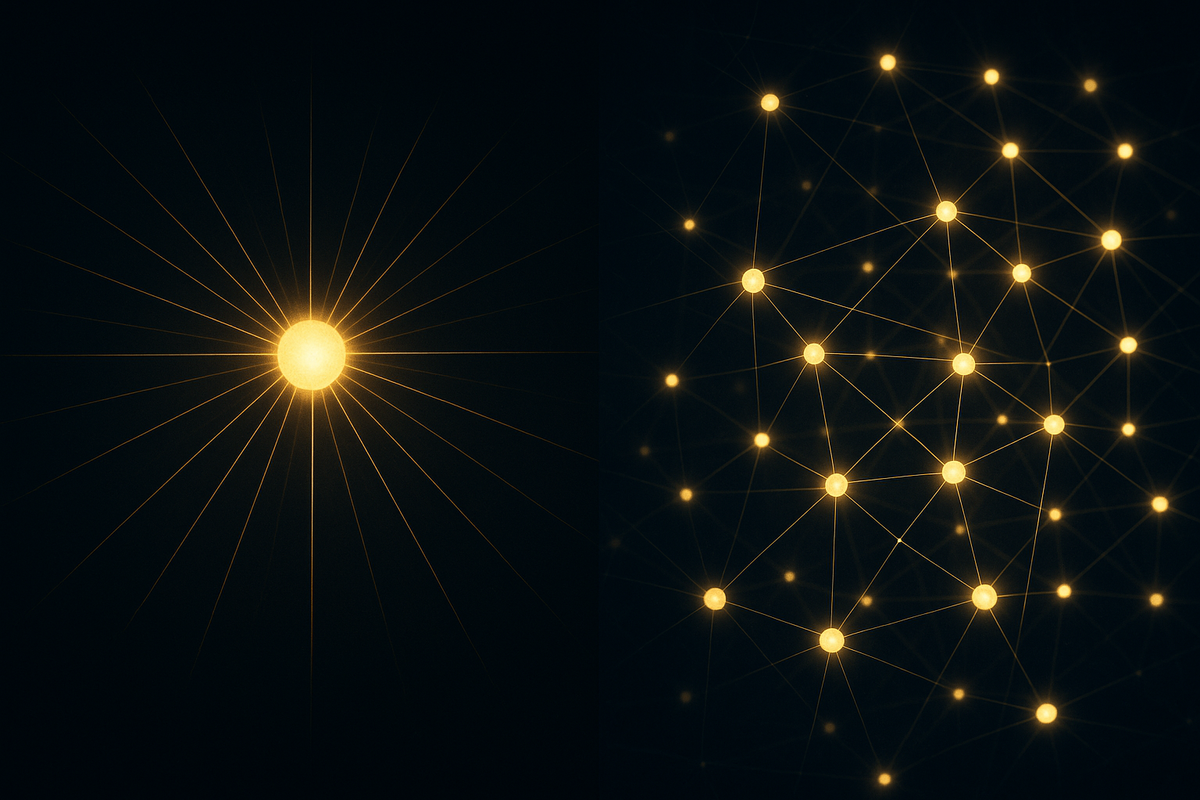
Picture this: it is Q3 2026, and your enterprise multi-agent workflow is humming along beautifully. Forty agents are summarizing contracts, thirty are cross-referencing compliance databases, and another thirty are generating customer-facing reports. Then the orchestrator goes down. In seconds, 100 concurrent agents freeze mid-task, queues pile up, and an entire pipeline worth of work evaporates. Your incident post-mortem has one ugly root cause: a single point of failure at the top of your architecture.
This scenario is no longer hypothetical. As enterprises in H2 2026 push multi-agent AI workflows past the 100-agent threshold, the architectural debate between centralized orchestration and decentralized peer-to-peer (P2P) agent coordination has moved from academic whitepapers to production war rooms. The stakes are real: system resilience, operational cost, task coherence, and the ability to scale without catastrophic collapse.
In this article, we break down both architectures with precision, stress-test them against enterprise-scale failure scenarios, and give you a clear, honest verdict on which model actually holds up when things go wrong at scale.
Setting the Stage: What We Mean by 100+ Concurrent Agents
Before diving into the architectural comparison, it is worth defining the playing field. In early multi-agent frameworks like LangGraph, AutoGen, and CrewAI, most production deployments operated with 5 to 20 agents handling sequential or lightly parallel tasks. By mid-2026, the paradigm has shifted dramatically. Enterprise teams are now deploying agent clusters that include:
- Specialist sub-agents for discrete cognitive tasks (research, synthesis, code generation, validation)
- Tool-use agents that interface with external APIs, databases, and internal microservices
- Monitor and critic agents that evaluate outputs from other agents in real time
- Long-running stateful agents that persist context across multi-hour workflows
At this density, coordination overhead is no longer trivial. The architecture you choose to manage agent communication, task delegation, and failure recovery determines whether your system is robust or brittle. Let us examine each side of the equation.
The Centralized Orchestration Model: Power and Peril
How It Works
In a centralized architecture, a single orchestrator agent (or a tightly coupled orchestration layer) acts as the command-and-control hub for all subordinate agents. The orchestrator receives the top-level goal, decomposes it into subtasks, assigns those subtasks to worker agents, monitors progress, handles retries, and aggregates results. Frameworks like LangGraph's supervisor pattern, Microsoft's AutoGen with a GroupChatManager, and most enterprise-grade agent platforms built on top of model APIs in 2026 default to some variation of this model.
Why Enterprises Love It (At First)
Centralized orchestration is genuinely compelling for several reasons:
- Deterministic task sequencing: The orchestrator enforces strict dependency graphs, ensuring Agent B does not start before Agent A delivers its output.
- Unified observability: Every task, status, and result flows through one node, making logging, tracing, and debugging straightforward.
- Simpler authorization logic: Access controls, rate limiting, and tool permissions are enforced at a single choke point rather than distributed across dozens of agents.
- Easier human-in-the-loop integration: Approval gates and escalation paths are trivially inserted into the orchestrator's control flow.
For workflows under 30 to 40 agents with predictable task graphs, centralized orchestration is genuinely the right call. The cognitive overhead of managing it is low, and the operational benefits are significant.
Where It Breaks: The 100-Agent Cliff
The problems emerge at scale, and they emerge fast. Here is what happens to a centralized orchestrator as concurrent agent count climbs past 100:
- Context window saturation: The orchestrator must track the state of every active agent. At 100+ agents, the state payload alone can overwhelm even frontier model context windows, introducing summarization errors and task misattribution.
- Latency amplification: Every agent action requires a round-trip to the orchestrator for acknowledgment or next-step instructions. At 100 agents, this creates a serialization bottleneck that degrades throughput non-linearly.
- Single-point-of-failure collapse: This is the critical one. If the orchestrator crashes, hangs, or enters a degraded state due to an upstream API timeout or a malformed agent response, the entire fleet of 100+ agents is stranded. There is no fallback coordination layer.
- Cascading retry storms: When the orchestrator recovers, all 100 agents simultaneously attempt to re-register and resume, creating a thundering herd problem that can cause the orchestrator to fail again immediately.
In production environments observed across enterprise AI teams in 2026, centralized orchestrator failures at scale have resulted in mean-time-to-recovery (MTTR) windows ranging from 12 to 45 minutes, with full workflow restart often being the only reliable recovery path. For business-critical pipelines, this is unacceptable.
The Decentralized Peer-to-Peer Coordination Model: Resilience and Complexity
How It Works
In a decentralized P2P architecture, there is no single orchestrator. Instead, agents are designed to be autonomous, self-describing units that advertise their capabilities, negotiate task assignments directly with one another, and coordinate through shared state stores, message queues, or distributed ledger-style coordination protocols. Think of it as a mesh network rather than a hub-and-spoke topology.
Coordination mechanisms in P2P agent systems typically include one or more of the following:
- Shared blackboard systems: A distributed key-value store (such as Redis Cluster or a purpose-built agent state mesh) where agents post tasks, claim work, and publish results without a central coordinator.
- Gossip protocols: Agents propagate state and capability information to their neighbors, which in turn propagate it further, achieving eventual consistency across the fleet without a central registry.
- Auction-based task allocation: Agents bid on tasks based on their current load, capability score, and context relevance, with the highest-bidding agent claiming the task autonomously.
- Emergent role assignment: Rather than being statically assigned roles by an orchestrator, agents dynamically assume coordinator, executor, or validator roles based on task context and peer availability.
Why P2P Coordination Is Having Its Moment in 2026
The rise of truly capable, instruction-following frontier models in 2026 has made P2P coordination architecturally feasible in a way it simply was not in 2023 or 2024. When each agent in your fleet can reliably interpret a shared task schema, reason about its own capabilities, and communicate intent to peers without a supervisor translating everything, the coordination overhead of a decentralized system drops significantly.
The resilience benefits are compelling:
- No single point of failure: The loss of any individual agent, even a de facto coordinator agent, does not bring down the system. Other agents detect the absence via heartbeat monitoring and redistribute the workload.
- Horizontal scalability: Adding agents to a P2P mesh is additive, not multiplicative in complexity. Each new agent registers its capabilities to the shared state store and begins participating immediately.
- Graceful degradation: Under resource pressure, a P2P system naturally sheds non-critical tasks and concentrates agent capacity on high-priority work, without requiring a central coordinator to make that decision.
- Reduced orchestrator API costs: Eliminating the orchestrator's constant polling and state-tracking LLM calls can reduce inference costs by 20 to 40 percent at the 100-agent scale, based on architectural modeling of comparable distributed systems.
The Real Costs of Going Decentralized
P2P coordination is not a free lunch. The engineering complexity it introduces is substantial and should not be underestimated:
- Task coherence risk: Without a central authority enforcing task sequencing, agents can work on conflicting assumptions, duplicate effort, or produce outputs that are locally correct but globally inconsistent.
- Debugging becomes an archaeology project: When something goes wrong in a P2P system, reconstructing the causal chain of agent decisions across a distributed state store is significantly harder than reading a centralized orchestrator's log.
- Consensus latency: Distributed coordination protocols introduce their own latency overhead, particularly for tasks that require synchronization across many agents before proceeding.
- Security surface expansion: Every agent-to-agent communication channel is a potential attack vector. In a centralized model, you secure one hub. In a P2P model, you must secure the mesh.
Head-to-Head: The Five Failure Scenarios That Matter Most
Let us put both architectures through the five failure scenarios that enterprise teams actually encounter at the 100-agent scale:
1. Orchestrator / Coordinator Node Crash
Centralized: Catastrophic. All 100+ agents halt. Recovery requires orchestrator restart, state reload, and coordinated agent re-registration. MTTR: 12 to 45 minutes.
P2P: Localized. The failed agent's tasks are redistributed via heartbeat detection and the shared task queue. Other agents continue uninterrupted. MTTR: 30 to 90 seconds.
Winner: P2P
2. Upstream LLM API Degradation (Partial Outage)
Centralized: The orchestrator, which typically makes the most LLM calls of any node, is disproportionately impacted. Degraded orchestrator performance cascades to all agents.
P2P: Agents individually experience degraded performance, but the system as a whole continues operating at reduced capacity. Agents can route around failed model endpoints if multi-model support is configured.
Winner: P2P
3. Runaway Agent Producing Malformed Outputs
Centralized: The orchestrator catches the malformed output at the aggregation layer and can halt or quarantine the offending agent cleanly.
P2P: A malformed output from one agent can propagate to peer agents that consume it before any validation layer catches the error, potentially corrupting a large portion of the workflow.
Winner: Centralized
4. Sudden 3x Scale Spike (Agent Count Jumps from 100 to 300)
Centralized: The orchestrator's context window, API rate limits, and state management overhead all hit hard limits simultaneously. The system either degrades severely or requires architectural changes to handle the load.
P2P: New agents join the mesh and self-register. The system scales horizontally with minimal architectural change, though coordination latency increases somewhat as the mesh grows.
Winner: P2P
5. Regulatory Audit Requiring Full Workflow Reconstruction
Centralized: The orchestrator's centralized logs provide a clean, sequential audit trail. Reconstructing what happened, when, and why is relatively straightforward.
P2P: Audit reconstruction requires correlating distributed logs across dozens or hundreds of agents. Without purpose-built observability tooling, this is extremely time-consuming.
Winner: Centralized
The Emerging Answer: Hierarchical Mesh Architecture
Here is the insight that the most sophisticated enterprise AI teams in 2026 have arrived at: the binary choice between centralized and decentralized is a false dilemma. The architecture that actually survives at scale is a hierarchical mesh, sometimes called a "federated orchestration" model.
In a hierarchical mesh architecture:
- The top-level workflow goal is decomposed by a lightweight, stateless orchestration layer that assigns work to agent clusters rather than individual agents.
- Within each cluster (typically 10 to 20 agents), coordination is handled via P2P mechanisms: shared state stores, capability broadcasting, and autonomous task claiming.
- Each cluster exposes a single health and status interface to the top-level layer, but the cluster itself is resilient to individual agent failures.
- Cross-cluster dependencies are managed through a shared event bus (Apache Kafka, Redpanda, or equivalent) rather than direct orchestrator-to-agent calls.
This model captures the observability and coherence benefits of centralized orchestration at the workflow level while achieving the fault tolerance and scalability of P2P coordination at the execution level. The orchestrator's blast radius on failure is dramatically reduced because each cluster can continue operating autonomously for a configurable period before requiring top-level coordination.
Practical Recommendations for Enterprise Teams in H2 2026
Based on the architectural analysis above, here is a clear decision framework:
- Under 40 agents, predictable task graphs: Use centralized orchestration. The simplicity, observability, and lower engineering overhead are worth it. Do not over-engineer.
- 40 to 100 agents, mixed task types: Introduce a hybrid model. Keep a lightweight central orchestrator for goal decomposition and audit logging, but implement P2P coordination within agent subgroups using a shared task queue.
- 100+ agents, dynamic workloads: Adopt the hierarchical mesh architecture. Invest in distributed observability tooling (OpenTelemetry for agents is becoming the standard in 2026) before you hit this scale, not after.
- Any scale, regulated industries: Regardless of coordination model, implement a dedicated audit agent that shadows all agent communications and writes immutable logs to a separate store. Do not rely on the coordination layer itself for compliance logging.
Conclusion: Resilience Is an Architectural Choice, Not a Feature
The question of whether centralized or decentralized AI agent coordination "wins" at 100+ agents does not have a single answer. What the evidence makes clear is that pure centralized orchestration is an architectural liability at enterprise scale in H2 2026. Its single-point-of-failure risk is not a theoretical concern; it is a production incident waiting to happen.
Pure P2P coordination, while resilient, introduces complexity and coherence risks that most enterprise teams are not yet equipped to manage. The teams that are building the most durable multi-agent systems right now are not choosing sides. They are layering the strengths of both models into hierarchical mesh architectures that treat resilience as a first-class design constraint, not an afterthought.
The 100-agent threshold is not just a number. It is the point at which the architectural decisions you made at 10 agents either prove their worth or expose their fragility. The time to make those decisions intentionally is before you hit that cliff, not after you have fallen off it.



