Centralized Orchestration vs. Decentralized Mesh: Which Multi-Agent Pipeline Topology Survives a Q4 2026 Regulatory Audit?
Picture this: it's November 2026, your enterprise's multi-agent AI pipeline has been humming along beautifully for eight months, and then the audit notice lands in your CISO's inbox. Regulators want a complete, timestamped, tamper-evident record of every decision, every data handoff, and every agent invocation that touched a customer record or a financial transaction this year. Your backend team has 30 days to produce it.
What happens next depends almost entirely on a single architectural choice your team made back in the design phase: did you build a centralized orchestration topology or a decentralized agent mesh? This is not a theoretical question anymore. With the EU AI Act's tiered compliance obligations now in full enforcement, the US AI Accountability Act provisions active since early 2026, and sector-specific frameworks from FINRA, HIPAA-AI addenda, and the UK's AI Governance Code all demanding explainable, auditable agentic behavior, the topology you chose is either your biggest asset or your most expensive liability.
This article breaks down both architectures honestly, scores them against the specific audit trail requirements that enterprise teams are actually facing in Q4 2026, and gives you a decision framework you can bring directly to your next architecture review.
A Quick Level-Set: What Each Architecture Actually Looks Like
Centralized Orchestration
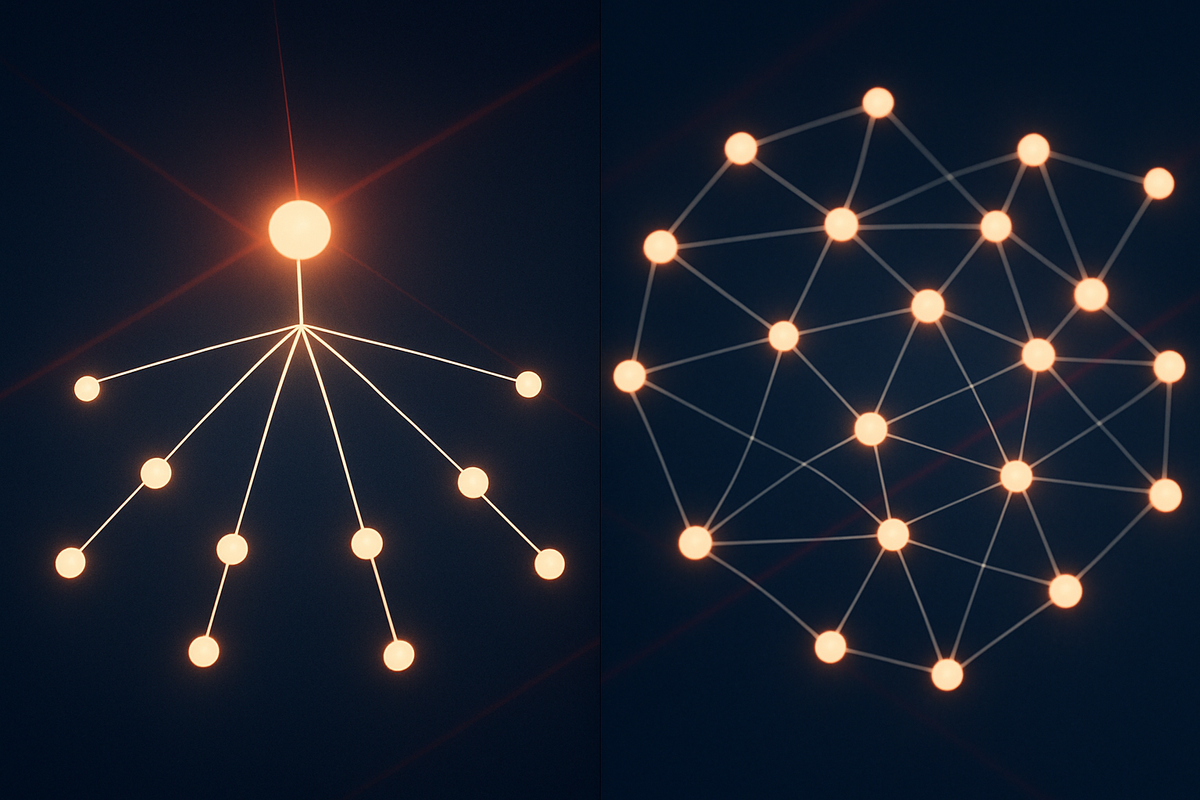
In a centralized orchestration model, a single controller agent (sometimes called a "conductor," "supervisor," or "planner") owns the execution graph. It receives a top-level task, decomposes it into subtasks, assigns those subtasks to specialized worker agents, collects results, and decides what happens next. Frameworks like LangGraph's supervisor pattern, Microsoft's AutoGen with a GroupChatManager, and CrewAI's hierarchical process all implement variations of this model.
The orchestrator is the single source of truth for pipeline state. Every agent action flows through or is at minimum registered with the central controller before proceeding. Think of it as a hub-and-spoke model where the hub has full situational awareness at all times.
Decentralized Mesh Architecture
A decentralized mesh, by contrast, is a peer-to-peer topology where agents communicate directly with one another, negotiate tasks autonomously, and self-organize around goals without a single controlling entity. Agents publish events to shared message buses (Kafka, NATS, or purpose-built agent communication layers like those emerging from the FIPA-inspired open-agent standards gaining traction in 2026), subscribe to relevant streams, and make local decisions about whether and how to act.
This is the architecture that tends to win performance benchmarks. It eliminates the orchestrator as a bottleneck, scales horizontally with relative ease, and handles partial failures gracefully because no single node is load-bearing. Teams building high-throughput document processing pipelines, real-time fraud detection meshes, or large-scale code generation grids often gravitate here for good reason.
The Audit Trail Problem: What Regulators Are Actually Asking For in 2026
Before scoring the two architectures, it is worth being precise about what "audit trail" means in the current regulatory environment. Across the major frameworks active in Q4 2026, auditors are asking for at minimum six categories of evidence:
- Agent identity and version provenance: Which agent (including its model version, system prompt hash, and tool manifest) performed each action?
- Decision rationale logs: What inputs, context, and reasoning steps led to each output? This is where chain-of-thought logging becomes legally material, not just a debugging nicety.
- Data lineage records: What data did each agent read, transform, or write, and from what source with what access credential?
- Inter-agent communication logs: Every message passed between agents, timestamped and sequenced, with sender and receiver identity confirmed.
- Human-in-the-loop checkpoints: Where did a human review, approve, or override an agent decision, and who was that human?
- Tamper-evidence: Cryptographic proof that logs have not been altered after the fact, typically via hash chaining or append-only log stores.
This is not a wishlist. These are the specific line items appearing in audit questionnaires from financial regulators and healthcare compliance officers that enterprise backend teams are navigating right now. With that context, let us score each topology.
Round 1: Agent Identity and Decision Rationale Logging
Centralized Orchestration: Strong Advantage
Because every task assignment and every result return passes through the orchestrator, the central controller naturally accumulates a structured record of who did what and when. Instrumenting this single chokepoint with a structured logging layer (OpenTelemetry spans, for instance, mapped to agent invocations) gives you a coherent, chronologically ordered audit log almost as a side effect of normal operation.
The orchestrator also knows the full task decomposition tree. It can attach the parent task context, the reasoning that led to the subtask assignment, and the evaluation criteria applied to the returned result. Decision rationale is not scattered; it is hierarchically organized and queryable.
Decentralized Mesh: Significant Challenge
In a mesh, agents make local decisions. An agent processing a document chunk may invoke a downstream specialist agent based on a probabilistic classification, and that decision lives only in the invoking agent's local context unless you have explicitly designed a broadcast logging mechanism. Without that mechanism, you end up with islands of log data across dozens of agent instances, with no guaranteed sequencing and no single authority that can reconstruct the full causal chain.
Teams have addressed this with centralized log aggregation (shipping all agent traces to a unified observability platform), but this is a non-trivial engineering investment that effectively re-centralizes the observability plane even while the execution plane remains distributed. You get the worst of both worlds in terms of operational complexity if this is bolted on rather than designed in from day one.
Winner, Round 1: Centralized Orchestration
Round 2: Inter-Agent Communication Logs and Data Lineage
Centralized Orchestration: Moderate Advantage
Orchestrator-mediated communication means the central controller can log every handoff as a first-class event. Data lineage is relatively straightforward: the orchestrator knows it sent Dataset A to Agent X, received Result B, and forwarded it to Agent Y. Reconstructing the lineage graph is a matter of replaying the orchestrator's event log.
The weakness here is that worker agents may themselves call external tools, APIs, or databases without the orchestrator's direct knowledge, depending on how loosely the tool-use boundary is defined. Strict tool-use policies enforced at the orchestrator level (requiring all external calls to be declared and logged through a tool registry) close this gap but add governance overhead.
Decentralized Mesh: Severe Challenge Without Deliberate Design
In a mesh, agents communicate peer-to-peer. Unless every message channel is a logged, durable medium (a Kafka topic with retention, for example, rather than an in-memory queue), inter-agent messages can evaporate. Even with durable messaging, correlating messages across agents into a coherent causal graph requires distributed tracing infrastructure with careful span propagation, the same problem that took the microservices world nearly a decade to solve adequately.
Data lineage in a mesh is similarly fragmented. Agent A may transform data and pass it to Agent B, which passes a derivative to Agent C, but without a lineage-aware data contract enforced at each hop, the provenance chain breaks. Rebuilding it retroactively for an audit is, in many cases, impossible.
Winner, Round 2: Centralized Orchestration
Round 3: Scalability and Fault Tolerance Under Production Load
Decentralized Mesh: Clear Advantage
This is where the mesh earns its reputation. There is no orchestrator to become a bottleneck when pipeline throughput spikes. Agents scale independently, failed agents can be replaced without cascading failures, and the system degrades gracefully rather than catastrophically. For high-volume enterprise workloads (think processing millions of insurance claims, running continuous compliance checks across a large document corpus, or orchestrating a fleet of code-review agents across a monorepo), the mesh's horizontal scalability is a genuine and significant advantage.
Centralized Orchestration: Known Bottleneck Risk
The orchestrator is a single point of contention. At sufficient scale, it becomes the rate limiter for the entire pipeline. Mitigations exist: hierarchical orchestration (orchestrators of orchestrators), sharded orchestration pools, and stateless orchestrator designs backed by distributed state stores like Redis or etcd. But each mitigation adds complexity, and complexity is the enemy of clean audit trails.
Winner, Round 3: Decentralized Mesh
Round 4: Tamper-Evidence and Cryptographic Log Integrity
Centralized Orchestration: Easier to Implement, Harder to Dispute
A single append-only log store with hash chaining (each log entry includes the hash of the previous entry, creating a chain that breaks if any entry is altered) is straightforward to implement when all audit-relevant events flow through one system. Solutions like Amazon QLDB, Azure Immutable Blob Storage with ledger features, or purpose-built audit log databases can be dropped in as the orchestrator's logging backend with relatively modest integration effort.
Regulators and their technical auditors understand this pattern. It maps cleanly to familiar financial ledger concepts, which makes it easier to explain and verify during an audit.
Decentralized Mesh: Distributed Ledger Complexity
Achieving tamper-evidence across a distributed mesh requires either routing all events through a central tamper-evident store (again, re-centralizing the observability plane) or implementing a distributed ledger approach where each agent's log segment is cryptographically linked to its peers. The latter is technically elegant but operationally complex, and it introduces latency at each agent interaction as hashes are computed and verified. It also requires careful key management across a potentially large and dynamic agent fleet.
Winner, Round 4: Centralized Orchestration
Round 5: Human-in-the-Loop Checkpoint Auditability
Centralized Orchestration: Natural Insertion Points
The orchestrator's control flow is the natural place to insert human review gates. The orchestrator can be designed to pause execution, emit a review request to a human queue, wait for approval (with a logged approver identity and timestamp), and resume only upon confirmation. This pattern is clean, auditable, and easy to demonstrate to regulators. The entire approval workflow is visible in the orchestrator's event log as a first-class sequence of events.
Decentralized Mesh: Requires Explicit Governance Layer
In a mesh, human-in-the-loop checkpoints must be implemented as a distinct governance agent or service that intercepts certain inter-agent messages and holds them pending human review. This is achievable, but it requires deliberate architectural investment and introduces the risk that agents bypass the governance agent if routing logic is not carefully enforced. Auditing these checkpoints means correlating events across the governance agent's log and the surrounding agents' logs, which is non-trivial.
Winner, Round 5: Centralized Orchestration
The Scorecard: A Brutally Honest Summary
| Audit Requirement | Centralized Orchestration | Decentralized Mesh |
|---|---|---|
| Agent Identity and Decision Rationale | Strong | Weak (without investment) |
| Inter-Agent Communication Logs | Strong | Weak (without investment) |
| Data Lineage | Moderate | Weak (without investment) |
| Scalability and Fault Tolerance | Moderate | Strong |
| Tamper-Evident Log Integrity | Strong | Complex |
| Human-in-the-Loop Auditability | Strong | Moderate (requires governance layer) |
The Nuanced Truth: It Is Not Always a Binary Choice
Here is the take that most architecture comparison posts miss: the most resilient enterprise multi-agent systems being built in 2026 are not purely one or the other. They are hybrid topologies with a compliance-aware orchestration spine.
In practice, this means:
- A thin centralized orchestration layer owns the audit-critical control flow: task assignment, result validation, human-in-the-loop gates, and tamper-evident logging. This layer is kept intentionally simple to minimize the orchestrator bottleneck problem.
- Decentralized mesh execution handles the high-throughput, low-criticality subtasks within each orchestrated step. Agents within a mesh cluster process work in parallel, and only the aggregate result (with a summary trace) is returned to the orchestrator layer.
- A unified observability plane (OpenTelemetry-based, with W3C Trace Context propagated across all agent boundaries) collects structured traces from both layers and ships them to an append-only audit log store.
This pattern gives you the scalability of a mesh where it matters (inside the execution clusters) and the auditability of centralized orchestration where it matters (at the task boundary and decision-gate level). Teams at large financial institutions and healthcare technology companies have been converging on this pattern throughout 2026 precisely because it threads the needle between engineering pragmatism and compliance necessity.
Practical Recommendations for Q4 2026 Readiness
If your team is evaluating or retrofitting your multi-agent architecture before year-end audits, here are the concrete steps that matter most:
1. Instrument First, Optimize Second
Whatever topology you are running, add structured OpenTelemetry instrumentation to every agent boundary today. Every agent invocation should emit a span with: agent ID, model version, input token hash, output token hash, latency, and parent trace context. This is the minimum viable audit substrate. Do not wait until you have "finished" the pipeline to add observability.
2. Define and Enforce Agent Identity at the Infrastructure Level
Agent identity cannot be self-reported. Use your service mesh or container orchestration layer (Kubernetes service accounts with SPIFFE/SPIRE identities, for example) to cryptographically attest agent identity at the infrastructure level. Logs that say "Agent X did Y" are only as trustworthy as the identity system backing them.
3. Make Your Log Store Append-Only and Hash-Chained Before Q4
This is the single highest-leverage compliance investment you can make right now. An append-only, hash-chained audit log transforms your existing traces from "evidence that could be disputed" to "evidence that cannot be disputed." Most major cloud providers offer this as a managed service. Use it.
4. Document Your Topology Decision as an Architectural Decision Record
Regulators increasingly want to see that architectural choices were made deliberately, with risk awareness. An Architectural Decision Record (ADR) documenting why you chose your topology, what compliance risks you identified, and what mitigations you implemented is a surprisingly effective audit artifact. It demonstrates governance maturity.
5. Run a Tabletop Audit Drill Before the Real One
Simulate the audit. Give a team member the role of auditor and have them ask for a complete causal trace of a specific transaction from 90 days ago. Time how long it takes to produce it. If the answer is "we cannot produce it" or "it would take weeks," you have identified your gap with enough time to close it.
Conclusion: Compliance Is an Architecture Constraint, Not an Afterthought
The central lesson of the Q4 2026 audit environment is one that enterprise backend teams are learning in real time: regulatory compliance is a first-class architectural constraint for multi-agent systems, not a documentation task you handle after the pipeline is built.
Centralized orchestration wins on auditability by a meaningful margin, and if your pipeline operates in a regulated domain (finance, healthcare, insurance, legal, or any space touched by the EU AI Act's high-risk classification), that advantage is decisive. The orchestrator bottleneck is a real engineering problem, but it is a solvable engineering problem. An incomplete audit trail, by contrast, is a compliance failure that no amount of post-hoc engineering can fully remediate.
Decentralized mesh architectures are not wrong. They are the right choice for the right workloads. But if you are running a mesh in a regulated context without a compliance-aware observability spine layered on top of it, you are carrying more risk than your leadership team probably realizes.
The teams that will navigate Q4 2026 audits most cleanly are the ones that treated auditability as a design requirement from sprint one, chose their topology with compliance in mind, and invested in tamper-evident logging infrastructure before they needed it. If that description does not match your current situation, the time to course-correct is now, not when the audit notice arrives.



