Centralized AI Agent Orchestration vs. Decentralized Mesh Architecture: Which Multi-Agent Topology Should Enterprise Backend Teams Deploy in H2 2026?
Here is a scenario that is playing out in engineering war rooms across the Fortune 500 right now: your team has graduated beyond a single LLM call bolted onto a REST endpoint. You are running dozens of specialized AI agents, each owning a slice of a complex production workflow. A billing reconciliation agent hands off to a fraud-detection agent, which triggers a customer-communication agent, which loops back into a ledger-write agent. The pipeline is elegant on a whiteboard. Then production happens.
The central orchestrator times out. Every downstream agent freezes. Your SRE team is paged at 2 a.m. And someone in the post-mortem asks the question that should have been asked six months earlier: should we have built this as a mesh instead?
This is the defining architectural decision for enterprise backend teams in the second half of 2026. The two dominant topologies, centralized orchestration and decentralized mesh, are not just implementation details. They encode fundamentally different assumptions about trust, failure, observability, and team ownership. Getting the choice wrong is expensive. Getting it right is a genuine competitive moat.
This article breaks down both architectures in depth, stress-tests them against real enterprise fault-tolerance requirements, and gives you a decision framework you can bring directly into your next architecture review.
Setting the Stage: What "Multi-Agent" Actually Means in 2026
Before comparing topologies, it is worth being precise about what we mean. A multi-agent system in a production backend context is a collection of autonomous LLM-powered (or hybrid LLM + deterministic) processes, each with its own tool access, memory scope, and decision-making loop. They communicate via structured messages, shared state stores, or event streams. They can run in parallel, in sequence, or in conditional branches.
By mid-2026, the tooling landscape has matured considerably. Frameworks like LangGraph, CrewAI, Microsoft AutoGen 2.x, and Google's Agent Development Kit have moved out of prototype territory and into genuine production deployments. Cloud providers now offer managed agent runtimes with SLA guarantees. The question is no longer can we run multi-agent workflows in production. It is how should we structure them so they do not collapse under real-world load and failure conditions.
Architecture One: Centralized Orchestration
How It Works
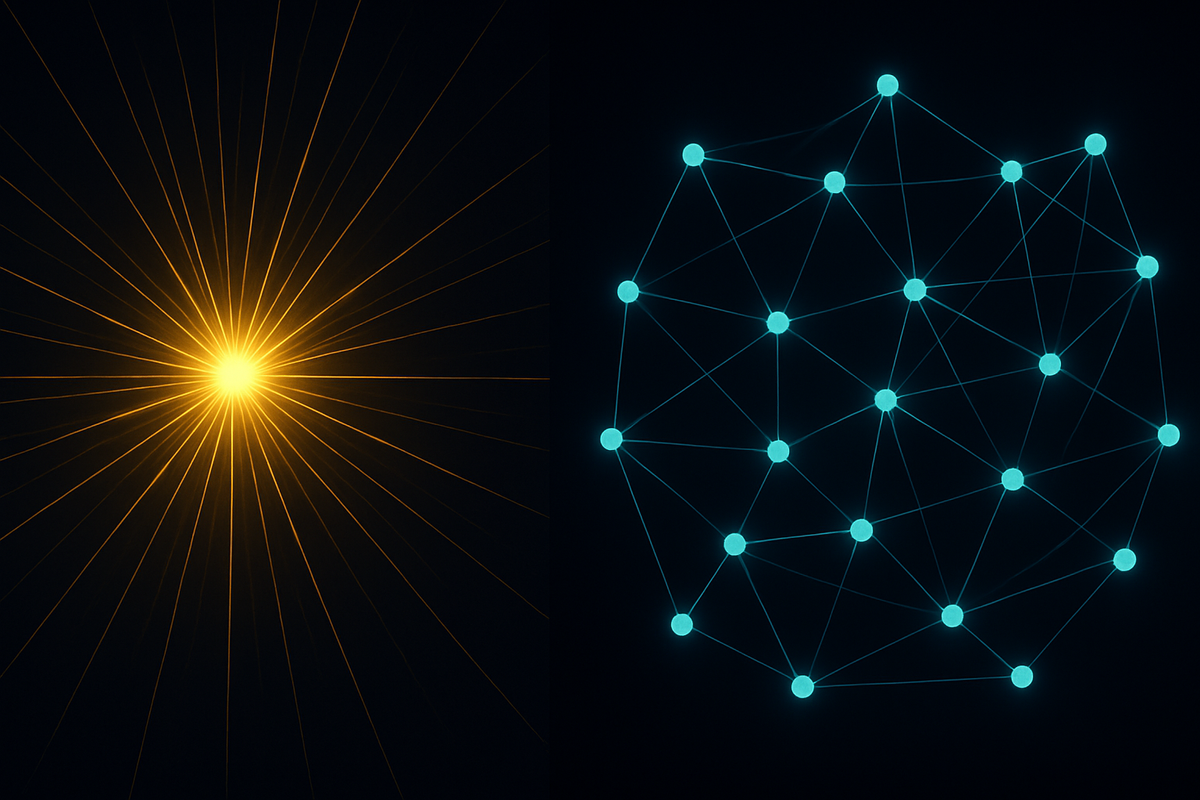
In a centralized orchestration model, a single controller process, often called the orchestrator or planner agent, holds the authoritative view of the workflow. It receives the initial task, decomposes it into subtasks, dispatches those subtasks to worker agents, collects results, handles retries, and decides when the workflow is complete. Worker agents are largely stateless from a workflow perspective. They do their job and report back. The orchestrator is the brain; the workers are the hands.
This maps closely to patterns enterprise teams already know: the conductor in an orchestra, the master node in a Hadoop cluster, or the Saga orchestrator in distributed transaction patterns. The mental model is familiar, and that familiarity is genuinely valuable.
Strengths of Centralized Orchestration
- Deterministic workflow visibility: Because a single process owns the state machine, you get a complete, consistent view of where any given workflow stands at any moment. Debugging is straightforward. Your logging and tracing pipelines have one authoritative source of truth.
- Easier compliance and auditability: Regulated industries, financial services, healthcare, and government procurement all require clear audit trails. When every decision flows through one orchestrator, producing a compliant audit log is a solved problem.
- Simpler coordination logic: Conditional branching, parallel fan-out, and result aggregation are all expressed in one place. There is no need for agents to negotiate with each other or resolve conflicting state views.
- Mature tooling support: Most enterprise-grade agent frameworks ship with centralized orchestration as their primary model. Documentation, community patterns, and vendor support are richest here.
- Predictable token and cost accounting: When the orchestrator mediates all LLM calls, cost attribution per workflow run is clean and auditable, which matters enormously when you are running thousands of workflows per day.
Weaknesses and Failure Modes
- Single point of failure (SPOF): This is the elephant in the room. If the orchestrator crashes, hangs, or enters an infinite reasoning loop, every in-flight workflow is orphaned. High-availability orchestrator deployments (active-passive failover, checkpointed state in Redis or a durable queue) mitigate this but add significant operational complexity.
- Orchestrator as bottleneck: At high throughput, all inter-agent communication flows through one process. This creates a latency ceiling and a scaling wall that is difficult to break through without sharding orchestrators, which reintroduces coordination problems.
- Orchestrator context window bloat: As workflows grow complex, the orchestrator must maintain an ever-larger context to reason about state. This inflates LLM costs, increases latency, and raises the probability of reasoning errors in the controller itself.
- Tight coupling between orchestrator and worker contracts: Changing a worker agent's output schema often requires updating the orchestrator's parsing logic. In fast-moving teams, this creates deployment coupling that slows iteration velocity.
Architecture Two: Decentralized Mesh
How It Works
In a decentralized mesh architecture, there is no single orchestrator. Instead, agents communicate directly with each other, or via a shared event bus or message broker, according to a published protocol. Each agent knows its own responsibilities, subscribes to relevant events or task queues, and publishes its outputs for any downstream agent to consume. Workflow emerges from the interactions between agents rather than being dictated by a central planner.
This maps to patterns like event-driven microservices, actor model systems (think Erlang/Akka), and choreography-based Sagas. The philosophy is borrowed from resilient distributed systems design: remove central coordination, and you remove the central failure domain.
Strengths of Decentralized Mesh
- Inherent fault tolerance: With no single orchestrator, there is no single process whose failure kills the entire workflow. Individual agents can crash and restart without affecting agents that are not directly dependent on them. Workflows can often continue partial progress and resume gracefully.
- Horizontal scalability: Each agent type scales independently. If your document-parsing agent is the bottleneck, you spin up more instances of that agent without touching anything else. This is the same elasticity that made microservices compelling, now applied to AI workloads.
- Team autonomy and ownership: In large engineering organizations, different teams can own different agents. The mesh's loose coupling means team A can redeploy their agent without coordinating a release with team B. This maps well to how platform and product teams are actually structured.
- Reduced context window pressure: No single agent needs to hold the entire workflow state in its context. Each agent reasons only about its local slice of the problem, keeping prompts lean and inference costs lower per agent.
- Emergent resilience through redundancy: In sophisticated mesh implementations, multiple agents can bid to handle the same task, with the first successful result winning. This creates natural redundancy without explicit failover logic.
Weaknesses and Failure Modes
- Observability is genuinely hard: Distributed tracing across a mesh of agents, each making asynchronous LLM calls, is a significant engineering investment. Without proper correlation IDs, structured logging, and a unified trace aggregator, debugging a failed workflow is an archaeology exercise.
- Emergent behavior is unpredictable: When agents coordinate without a central plan, unexpected interaction patterns can emerge. Two agents may enter a feedback loop, or a workflow may reach a dead-end state that no agent is designed to resolve. These failure modes are subtle and hard to reproduce in testing.
- Consistency and ordering guarantees are weaker: In an event-driven mesh, message ordering is not guaranteed by default. Workflows that require strict sequencing need additional infrastructure, such as ordered partitions in Kafka or vector clocks, to enforce it.
- Compliance and audit complexity: Reconstructing the full decision trail of a mesh workflow for a regulatory audit requires stitching together logs from multiple agents and event streams. This is solvable but requires deliberate design from day one.
- Higher initial implementation cost: Building a well-functioning mesh requires investing in the event bus infrastructure, agent discovery, schema registries, and dead-letter queue handling before you write a single line of agent logic. The upfront cost is real.
Head-to-Head: The Fault-Tolerance Scorecard
For enterprise backend teams, fault tolerance is not a nice-to-have. Production AI workflows are increasingly on the critical path for revenue, customer experience, and regulatory reporting. Here is how the two architectures compare across the dimensions that matter most in H2 2026:
| Dimension | Centralized Orchestration | Decentralized Mesh |
|---|---|---|
| Single point of failure risk | High (mitigated with HA setup) | Low by design |
| Horizontal scalability | Moderate (orchestrator is ceiling) | High (per-agent scaling) |
| Debugging and observability | Excellent (single source of truth) | Challenging (requires investment) |
| Compliance and auditability | Excellent | Moderate (requires design intent) |
| Team autonomy | Low (orchestrator is coupling point) | High (loose coupling) |
| Implementation complexity | Low to moderate | High (upfront infrastructure) |
| Predictability of behavior | High | Moderate (emergent risk) |
| Cost efficiency at scale | Moderate | High (lean per-agent contexts) |
The Hidden Third Option: Hierarchical Mesh (and Why It Is Gaining Ground)
The most intellectually honest observation in this debate is that the binary framing is already becoming outdated. The most resilient production architectures emerging in 2026 are hierarchical meshes: systems that use lightweight domain-level orchestrators (not a single global one) coordinating local clusters of agents, while those domain orchestrators communicate with each other peer-to-peer via a mesh protocol.
Think of it as federalism applied to AI systems. A billing domain has its own orchestrator managing five billing-specific agents. A customer-success domain has its own orchestrator. These domain orchestrators publish events and consume events from each other without any global controller above them. The SPOF risk is scoped to the domain level, not the entire system. Observability is tractable because each domain orchestrator maintains its local state log. Team ownership is clean because each domain team owns their orchestrator and their agents.
This pattern borrows from how mature microservice organizations evolved: from monolith, to pure microservice chaos, to domain-driven bounded contexts with clear ownership. The AI agent world is compressing that same evolutionary arc into roughly 18 months.
Practical Decision Framework for H2 2026
Here is a concrete set of questions to guide your architecture decision. Answer them honestly with your team before committing to an implementation:
Choose Centralized Orchestration if:
- Your workflows have fewer than 10 to 15 agent steps and are unlikely to grow significantly.
- You operate in a heavily regulated industry where a clean, linear audit trail is non-negotiable and you cannot afford the engineering time to build distributed audit infrastructure.
- Your team is smaller than 8 to 10 engineers and you need to ship quickly. The operational overhead of a mesh will slow you down more than the SPOF risk will hurt you.
- Your workflows are primarily synchronous and latency-sensitive, where the overhead of async event passing would degrade the user experience.
- You are already invested in a framework like LangGraph or AutoGen that gives you durable, checkpointed orchestration state out of the box. Do not throw away working infrastructure without a clear reason.
Choose Decentralized Mesh if:
- Your workflows are long-running (minutes to hours), involve many parallel branches, and must survive partial infrastructure failures without losing progress.
- You have multiple product teams contributing agents to a shared platform, and you need each team to deploy independently without a centralized release gate.
- Your throughput requirements are high enough (thousands of concurrent workflow instances) that a single orchestrator process is a credible bottleneck.
- You already operate a mature event-driven infrastructure (Kafka, Pulsar, or a cloud-native equivalent) and your team has demonstrated competence maintaining it.
- Your use case tolerates eventual consistency and does not require strict global ordering of agent actions.
Choose Hierarchical Mesh if:
- You are a mid-to-large enterprise with multiple business domains each running their own agent workflows, and you need both intra-domain reliability and inter-domain flexibility.
- You want the auditability benefits of orchestration within each domain without creating a global SPOF across domains.
- Your organization is structured around domain-driven design and you want your AI architecture to mirror your team topology (Conway's Law applies to AI systems too).
The Observability Imperative: Non-Negotiable for Either Choice
Regardless of which topology you choose, one truth holds: production multi-agent systems are unmanageable without purpose-built observability. In H2 2026, this means you need more than generic APM tooling. You need agent-aware tracing that captures LLM reasoning steps, tool call inputs and outputs, token counts, retry events, and inter-agent handoff latencies as first-class trace spans.
Platforms like LangSmith, Arize Phoenix, and Weights and Biases' Weave have matured significantly in this space. OpenTelemetry's semantic conventions for LLM spans are now stable and widely adopted, meaning your agent traces can flow into the same Grafana or Datadog dashboards as your conventional service telemetry. If you are not instrumenting your agents at this level before going to production, you are flying blind, and the topology you chose will not save you.
A Word on Agent-to-Agent Protocol Standardization
One development that is materially shifting the mesh architecture calculus in 2026 is the growing adoption of standardized agent communication protocols. Google's Agent-to-Agent (A2A) protocol and Anthropic's Model Context Protocol (MCP) have both seen significant enterprise adoption, and they are beginning to converge on interoperability standards. This matters for mesh architectures specifically because it reduces the custom integration work required to connect agents built on different frameworks or by different teams.
If your organization is building a mesh, investing in A2A and MCP compatibility now is not premature optimization. It is infrastructure debt prevention. Proprietary agent communication formats are the new vendor lock-in, and the teams that standardize early will have significantly more flexibility when they need to swap out an underperforming agent or integrate a third-party agent capability.
Conclusion: There Is No Universal Winner, But There Is a Right Answer for Your Context
The centralized vs. mesh debate does not have a universally correct answer, and any vendor or framework that tells you otherwise is selling something. What the evidence from production deployments in 2026 does tell us is this: the cost of getting the topology wrong scales with the complexity of your workflows and the size of your organization.
For small teams running focused, auditable workflows: centralized orchestration with durable checkpointing is the pragmatic, defensible choice. For large platform teams running high-throughput, long-running workflows across organizational boundaries: a decentralized mesh or hierarchical mesh is worth the upfront investment. For everyone in between: the hierarchical mesh pattern is increasingly the answer, because it gives you fault isolation and team autonomy without the full complexity of a pure mesh.
The most important thing you can do before H2 2026 production deployments lock in is to make the topology decision explicitly, document the tradeoffs you accepted, and instrument your agents properly from day one. Multi-agent systems are not more forgiving of architectural debt than conventional distributed systems. If anything, they are less so, because the failure modes are subtler and the debugging tools are younger.
Build deliberately. Instrument everything. And revisit the decision when your workflow count doubles. In the agentic era, architecture is not a one-time choice. It is an ongoing negotiation with complexity.