Centralized AI Agent Gateway vs. Decentralized P2P Agent Mesh: Which Multi-Agent Topology Should Enterprise Backend Teams Choose in H2 2026?
There is a quiet architectural war being fought inside enterprise backend teams right now, and most organizations do not even realize they have already picked a side. As autonomous AI workflows mature from experimental pilots into revenue-critical pipelines in H2 2026, the question of how your agents talk to each other has become just as consequential as which foundation model powers them. Get the topology wrong and you will face two punishing outcomes: latency cascades that turn a 200ms user experience into a 12-second nightmare, and billing surprises that make your CFO question the entire AI program.
The two dominant communication topologies competing for enterprise adoption are the Centralized AI Agent Gateway and the Decentralized Peer-to-Peer (P2P) Agent Mesh. Both solve the multi-agent coordination problem. Both have passionate advocates. And both will absolutely destroy your production environment if you apply them to the wrong use case.
This article is a practitioner-level comparison designed for backend engineers, platform architects, and engineering leaders who are making this decision right now. We will go deep on latency behavior, cost modeling, observability, failure modes, and the specific enterprise scenarios where each topology wins decisively.
Why Multi-Agent Topology Is the Defining Infrastructure Decision of H2 2026
Twelve months ago, most enterprise AI deployments were single-agent or simple sequential chains: one LLM call, one tool invocation, one response. That era is functionally over. The agent frameworks that matured through 2025, including LangGraph, AutoGen, CrewAI, and the emerging wave of vendor-native orchestration layers from AWS Bedrock Agents, Google Vertex AI Agent Engine, and Microsoft Azure AI Foundry, have made it trivially easy to spin up networks of specialized agents that collaborate on complex tasks.
The result is that enterprise teams are now routinely deploying workflows where:
- A Planner Agent decomposes a high-level task into subtasks
- Specialist Agents (retrieval, code execution, data analysis, external API calls) execute in parallel or sequence
- A Critic or Validator Agent reviews outputs before they propagate downstream
- A Synthesis Agent assembles final responses or triggers downstream system actions
When you have four to fifteen agents collaborating on a single workflow, the communication topology between them is no longer an implementation detail. It is a first-class architectural decision with measurable impact on latency, cost, reliability, and security posture.
Defining the Two Topologies
The Centralized AI Agent Gateway
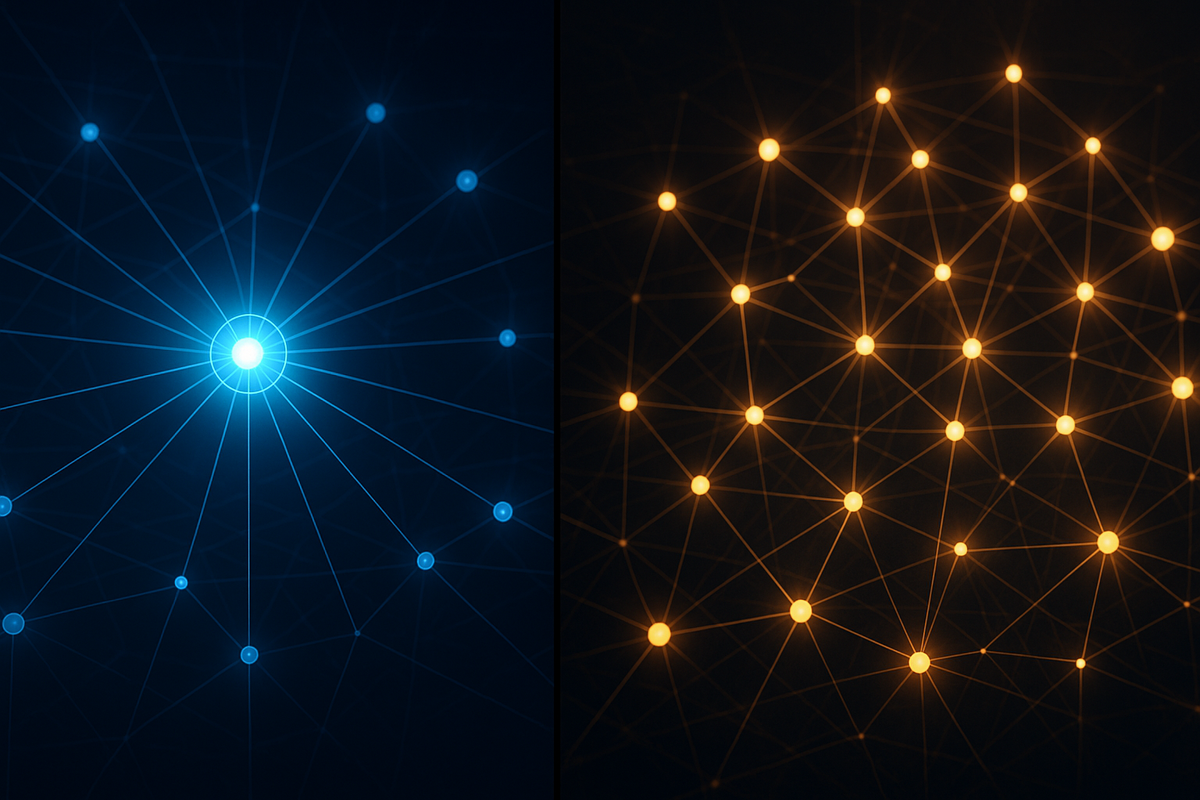
In a centralized gateway topology, all inter-agent communication is routed through a single control plane: the gateway. No agent speaks directly to another agent. Instead, Agent A sends a message to the gateway, which applies routing logic, policy enforcement, rate limiting, token budget management, and observability instrumentation before forwarding the message to Agent B.
Think of it as the API gateway pattern applied to agent communication. Just as mature microservices teams stopped letting services call each other directly and instead routed traffic through an API gateway or service mesh control plane, the centralized agent gateway applies the same principle to LLM-powered agents.
Popular implementations of this pattern in 2026 include:
- Kong AI Gateway with agent routing plugins
- Azure API Management configured as an agent orchestration proxy
- Custom-built gateway services sitting in front of agent clusters, often built on FastAPI or Go with Redis-backed state
- Portkey.ai and similar LLM gateway vendors that have expanded into multi-agent routing
The Decentralized P2P Agent Mesh
In a P2P agent mesh topology, agents discover and communicate with each other directly, without a central routing authority. The mesh relies on a shared protocol layer (often event-driven, using message brokers like Kafka, NATS, or RabbitMQ, or emerging agent-native protocols like Google's Agent2Agent protocol and Anthropic's evolving multi-agent communication specs) to enable agents to publish capabilities, subscribe to task events, and negotiate execution contracts peer-to-peer.
This topology draws inspiration from service mesh architectures like Istio and Linkerd, but replaces the sidecar proxy model with agent-native communication primitives. Each agent is both a consumer and a producer. Routing decisions are made at the edges, not at a central hub.
Representative implementations include:
- NATS JetStream as the backbone for agent pub/sub with capability-based routing
- AutoGen's decentralized runtime with direct agent-to-agent RPC
- Google's Agent2Agent (A2A) protocol, which gained significant enterprise traction through early 2026
- Custom event-driven meshes built on Kafka topics partitioned by agent capability domain
Head-to-Head Comparison: Six Critical Dimensions
1. Latency Behavior and Cascade Risk
Centralized Gateway: Every hop in a multi-agent workflow adds a round-trip through the gateway. In a five-agent pipeline with sequential dependencies, you are looking at five gateway traversals. If your gateway adds even 15-20ms of overhead per hop (realistic for a gateway doing policy evaluation, logging, and token counting), that is 75-100ms of pure infrastructure overhead on top of your LLM inference latency. More critically, the gateway becomes a single point of contention. Under high concurrency, queuing at the gateway creates latency cascades: Agent A is waiting for a gateway slot, which delays Agent B, which delays Agent C, which blows your SLA.
The cascade risk is not theoretical. Backend teams running more than 50 concurrent multi-agent workflows through a single gateway instance routinely observe p99 latency spikes of 3-8x the median during traffic bursts. Horizontal scaling of the gateway helps but introduces distributed state synchronization complexity, particularly for token budget tracking and session affinity.
P2P Agent Mesh: Direct agent-to-agent communication eliminates the gateway hop overhead. Latency between agents in a well-configured NATS or gRPC-based mesh can be sub-millisecond for local cluster communication. Parallel agent execution is also more natural: a Planner Agent can fan out tasks to five Specialist Agents simultaneously without each message queuing through a central router.
However, P2P meshes have their own latency pathology: discovery and negotiation overhead. When an agent needs to find a capable peer, it must query the mesh's capability registry. If that registry is not co-located or well-cached, discovery latency can exceed what a centralized gateway would have cost. Additionally, retry storms in a P2P mesh (where a failing agent is repeatedly contacted by multiple peers) can create cascade effects that are significantly harder to contain than gateway-level circuit breaking.
Winner for latency at scale: P2P mesh for parallel workflows with well-known agent topologies. Centralized gateway for sequential workflows where control-plane overhead is predictable and acceptable.
2. Cost Management and Billing Predictability
This is where the centralized gateway has a decisive structural advantage, and it is the dimension most enterprise teams underestimate until they receive their first five-figure monthly LLM bill with no clear attribution.
Centralized Gateway: Because every token consumed by every agent flows through the gateway, you get a single, authoritative control point for:
- Token budget enforcement: Set a hard cap per workflow, per agent, or per business unit. When Agent B is about to exceed its allocated token budget for a session, the gateway can throttle or reject the call before it hits the LLM provider API.
- Cost attribution: Every LLM call is tagged with workflow ID, agent ID, tenant ID, and business unit. Finance teams can generate accurate showback and chargeback reports without instrumenting every individual agent.
- Model routing for cost optimization: The gateway can dynamically route lower-stakes agent calls (like simple classification tasks) to cheaper models (GPT-4o Mini, Gemini Flash, Claude Haiku) while reserving expensive frontier model capacity for high-value reasoning steps.
- Spend anomaly detection: A runaway agent in an infinite retry loop will hit the gateway's rate limiter before it generates thousands of dollars in unexpected API charges.
P2P Agent Mesh: Cost visibility in a decentralized mesh is genuinely hard. Each agent makes LLM API calls independently. Without disciplined instrumentation at every agent, you lose the centralized accounting that makes cost management tractable. Teams that have adopted P2P meshes and tried to retrofit cost attribution typically end up building a lightweight cost aggregation sidecar for each agent, which partially recreates the gateway pattern at the edge.
There is also a subtler cost problem with P2P meshes: redundant context propagation. In a centralized gateway, the shared conversation context or workflow state can be managed centrally and passed by reference. In a P2P mesh, agents often pass full context payloads directly to each other to avoid a shared state dependency. For workflows with large context windows (100K+ tokens), this means the same context is serialized and transmitted multiple times across the mesh, generating both network costs and, when agents re-summarize or re-process that context, additional LLM token costs.
Winner for cost management: Centralized gateway, decisively. This is not a close comparison.
3. Observability and Debugging
Centralized Gateway: Observability is the gateway's strongest suit after cost management. A single gateway produces a unified trace for every multi-agent workflow. You can reconstruct the exact sequence of agent calls, the latency at each step, the tokens consumed, the tool invocations made, and the decision points where routing logic fired. Tools like OpenTelemetry with Jaeger or Grafana Tempo integrate naturally, and vendors like Langfuse and Braintrust have built gateway-aware tracing that surfaces agent-level spans within workflow-level traces.
P2P Agent Mesh: Distributed tracing in a P2P mesh requires careful propagation of trace context across every agent-to-agent message. When it works, it works beautifully: you get a genuine distributed trace that shows parallel execution branches and their timing relationships. When it breaks (and it breaks when a new agent is added without proper trace context injection), you get orphaned spans and gaps in your trace that make debugging a multi-hour exercise in log archaeology.
The debugging experience for a misbehaving agent in a P2P mesh is also materially harder. In a gateway topology, you can replay a specific workflow by re-injecting the gateway log. In a mesh, reproducing a specific sequence of peer-to-peer interactions requires either a full mesh replay capability (complex to build) or deterministic test harnesses for each agent pair.
Winner for observability: Centralized gateway for operational debugging. P2P mesh is competitive if you invest heavily in distributed tracing instrumentation from day one.
4. Scalability and Throughput Ceiling
Centralized Gateway: The gateway is a throughput bottleneck by design. You can mitigate this with horizontal scaling, but every scaling step introduces complexity: distributed rate limiting (you need a shared Redis or similar to enforce global token budgets across gateway instances), session affinity management, and increased operational overhead. Enterprise teams running very high-throughput autonomous workflows (thousands of concurrent agent sessions) will hit the practical scaling ceiling of a centralized gateway before they hit the scaling ceiling of their underlying LLM providers.
P2P Agent Mesh: Horizontal scalability is the mesh's structural advantage. Adding more agent instances to the mesh increases capacity without adding load to a central bottleneck. Message brokers like Kafka and NATS are engineered for massive horizontal scale and have well-understood operational playbooks. If your enterprise is running autonomous workflows at scale where throughput is the primary constraint, the P2P mesh's architecture is fundamentally better suited.
The caveat is capability registry scaling. If your mesh uses a centralized capability registry for agent discovery (and most do, because fully decentralized discovery adds significant complexity), that registry becomes a bottleneck that partially recreates the centralized gateway problem. Caching strategies and read replicas are the standard mitigations, but they require careful cache invalidation logic when agent capabilities change.
Winner for scalability: P2P agent mesh, particularly for throughput-intensive, parallel workflow patterns.
5. Security and Policy Enforcement
Centralized Gateway: Security teams love the centralized gateway for exactly the same reason finance teams do: a single enforcement point. You can implement:
- Prompt injection detection at the gateway before malicious inputs reach downstream agents
- Data loss prevention (DLP) scanning on all inter-agent message payloads
- Agent authentication and authorization via mutual TLS or JWT-based agent identity, enforced at the gateway
- Compliance logging for regulated industries (financial services, healthcare) where every agent interaction may need to be audited
In regulated enterprise environments (SOC 2, HIPAA, FedRAMP), the centralized gateway's security posture is often a compliance requirement rather than a preference.
P2P Agent Mesh: Securing a P2P mesh requires a zero-trust approach where every agent-to-agent communication is authenticated and encrypted. This is achievable with mutual TLS at the mesh level and capability-scoped authorization tokens, but it requires significantly more engineering investment to implement correctly. The attack surface is also larger: a compromised agent in a P2P mesh can potentially communicate directly with other agents in ways that a gateway would have intercepted and blocked.
The emerging Agent2Agent protocol includes identity and authorization primitives, which has improved the P2P security story considerably in 2026. But the operational complexity of managing agent identity certificates across a large, dynamic mesh remains a genuine challenge.
Winner for security and compliance: Centralized gateway, especially for regulated industries.
6. Development Velocity and Operational Complexity
Centralized Gateway: Adding a new agent to a gateway-based system is straightforward: register the agent with the gateway, define its routing rules, and deploy. The gateway handles the rest. Development teams do not need to reason about peer discovery, capability negotiation, or distributed state. The operational model is familiar to any team that has run an API gateway in production.
The complexity cost comes at the gateway itself. Someone on your team owns the gateway configuration, and as the number of agents grows, the routing rule complexity grows with it. Teams with 30+ agent types in production report that gateway configuration management becomes a significant ongoing engineering investment.
P2P Agent Mesh: The initial development experience for a P2P mesh is often more complex: agents need to implement capability advertisement, peer discovery, and message protocol handling. However, once those primitives are established (often via a shared SDK or agent base class), adding new agents to the mesh is highly autonomous. An agent can join the mesh, advertise its capabilities, and immediately begin receiving relevant tasks without any central configuration change.
This self-organizing property makes P2P meshes significantly more agile for teams that are rapidly iterating on their agent portfolio. The operational model, however, is more demanding: debugging distributed systems without a central control plane requires stronger distributed systems expertise on the team.
Winner for development velocity: Gateway for initial setup and regulated environments. P2P mesh for teams with strong distributed systems expertise who are rapidly expanding their agent portfolio.
The Hybrid Architecture: What Leading Enterprise Teams Are Actually Doing in 2026
Here is the practitioner reality that most comparison articles miss: the most sophisticated enterprise backend teams in 2026 are not choosing between gateway and mesh. They are running a hybrid topology that uses each pattern where it excels.
The dominant hybrid pattern looks like this:
- A lightweight centralized gateway sits at the workflow ingress point. It handles authentication, initial token budget allocation, workflow-level tracing initialization, and cost attribution tagging. It does NOT route individual inter-agent messages.
- A P2P agent mesh handles all intra-workflow agent communication. Once a workflow is admitted and tagged by the gateway, agents communicate directly via a NATS or gRPC mesh for the duration of the workflow.
- A shared state store (typically Redis Cluster or a purpose-built agent state service) provides workflow context that agents can read by reference rather than passing full context payloads peer-to-peer.
- Edge-level cost meters on each agent report token consumption to a central aggregation service asynchronously, preserving cost visibility without routing every token through a central bottleneck.
This hybrid approach captures the gateway's cost management and security benefits at the workflow boundary while capturing the mesh's low-latency, high-throughput benefits for intra-workflow communication. The tradeoff is operational complexity: you are running two distinct communication infrastructure components instead of one.
Decision Framework: Which Topology Should Your Team Choose?
Use this framework to make the call for your specific context in H2 2026:
Choose the Centralized Gateway if:
- Your organization operates in a regulated industry (financial services, healthcare, government) where compliance logging and policy enforcement at a single control point is a requirement
- Your team has limited distributed systems expertise and needs a familiar operational model
- Cost predictability and per-team/per-project LLM spend attribution are non-negotiable requirements
- Your workflows are primarily sequential rather than massively parallel
- You have fewer than 20 distinct agent types and do not expect rapid expansion
- Your concurrent workflow count is below 500 sessions, where gateway scaling complexity is manageable
Choose the P2P Agent Mesh if:
- Your workflows are highly parallel, with many agents executing simultaneously on decomposed subtasks
- Throughput and low latency are your primary constraints, and you are willing to invest in distributed tracing and cost metering at the edge
- Your team has strong distributed systems expertise and experience operating message brokers at scale
- You are rapidly iterating on your agent portfolio and need new agents to join the system without central configuration changes
- Your concurrent workflow count is above 1,000 sessions and growing
Choose the Hybrid Architecture if:
- You need both compliance-grade cost attribution and low-latency parallel execution
- Your team has the engineering bandwidth to operate two communication infrastructure components
- You are building a platform that will serve multiple internal teams or external tenants with different workflow patterns
- You expect your agent portfolio to grow significantly over the next 12 months
Preventing Billing Surprises: A Practical Checklist for Either Topology
Regardless of which topology you choose, these practices will prevent the billing surprises that have blindsided enterprise teams in 2026:
- Set hard token budgets per workflow run, not just per agent. A workflow-level cap prevents a cascade of agents from collectively exhausting your monthly budget in a single runaway session.
- Implement model-tier routing. Not every agent call needs a frontier model. Classify your agent tasks by required reasoning depth and route accordingly. Teams that do this systematically report 40-60% reductions in LLM API costs without measurable quality degradation.
- Instrument context growth. Monitor the token count of your workflow context as it grows through multi-agent execution. Contexts that grow unbounded are the single most common source of unexpected LLM cost spikes in multi-agent systems.
- Set up spend alerts at 50%, 80%, and 95% of monthly budgets, not just at 100%. By the time you hit 100%, you have already lost the month.
- Cache deterministic agent outputs aggressively. If a retrieval agent or a classification agent produces the same output for the same input, caching that output at the workflow level eliminates redundant LLM calls across concurrent workflow sessions.
Conclusion: The Topology Is the Strategy
The choice between a centralized AI agent gateway and a decentralized P2P agent mesh is not a technical implementation detail. It is a strategic decision that will shape your team's ability to scale autonomous workflows, control costs, maintain compliance, and iterate on your agent portfolio through H2 2026 and beyond.
The centralized gateway is the pragmatic, safe, compliance-friendly choice for most enterprise teams today. It trades some latency and throughput ceiling for dramatically better cost visibility, security posture, and operational simplicity. If you are not sure which topology your organization needs, start here.
The P2P agent mesh is the high-performance, high-complexity choice for teams with strong distributed systems foundations who are building genuinely large-scale, parallel autonomous workflows. It will reward engineering excellence and punish operational shortcuts.
And the hybrid architecture, while the most demanding to operate, is increasingly where serious enterprise AI platform teams are landing as they discover that the gateway and the mesh are not rivals but complements.
The latency cascades and billing surprises that are disrupting AI programs in 2026 are almost never caused by the wrong model choice. They are caused by the wrong topology choice. Make this decision deliberately, with the full weight it deserves, and your autonomous workflows will scale the way your business demands.



