Centralized Agent Orchestration vs. Decentralized Mesh Coordination: Which Multi-Agent Architecture Actually Wins for Enterprise Long-Horizon Workflows in 2026?
If you've spent any time architecting AI-powered backend systems in 2026, you've almost certainly hit the same wall: your multi-agent pipeline works beautifully in a demo, then collapses under real production load. Tasks stall waiting for a central planner. Agents step on each other's context. Latency compounds across every hop. And your on-call engineer is left staring at a trace waterfall that looks like a Jackson Pollock painting.
The root of that chaos is usually an architectural decision made early and casually: did you build a centralized orchestration model or a decentralized mesh? In 2026, as long-horizon agentic workflows become a genuine enterprise workload rather than a research curiosity, that choice carries serious consequences for latency, fault tolerance, operational overhead, and your team's sanity.
This post breaks down both architectures with precision, compares them across the metrics that actually matter to backend engineering teams, and offers a clear recommendation for specific use cases. No hype, no vendor talking points.
Setting the Stage: What We Mean by "Long-Horizon Workflows"
Before diving into the comparison, it's worth defining the problem space. A long-horizon workflow is any agentic task that requires more than a handful of sequential steps, spans multiple tool calls and sub-agents, persists state across time (sometimes hours or days), and must recover gracefully from intermediate failures.
Examples that enterprise backend teams are running in production right now include:
- Automated software development pipelines where agents write, test, review, and deploy code iteratively
- Multi-step financial compliance workflows that gather data, cross-reference regulations, and generate audit-ready reports
- Customer support resolution chains that diagnose issues, query internal systems, draft responses, and escalate intelligently
- Supply chain optimization agents that monitor signals, replan logistics, and coordinate with external APIs over multi-hour windows
These workflows are fundamentally different from simple RAG pipelines or single-shot LLM calls. They require durable state, conditional branching, parallel execution, and meaningful error recovery. The architecture you choose to coordinate the agents doing this work is not a footnote. It is the system.
Architecture One: Centralized Agent Orchestration
How It Works
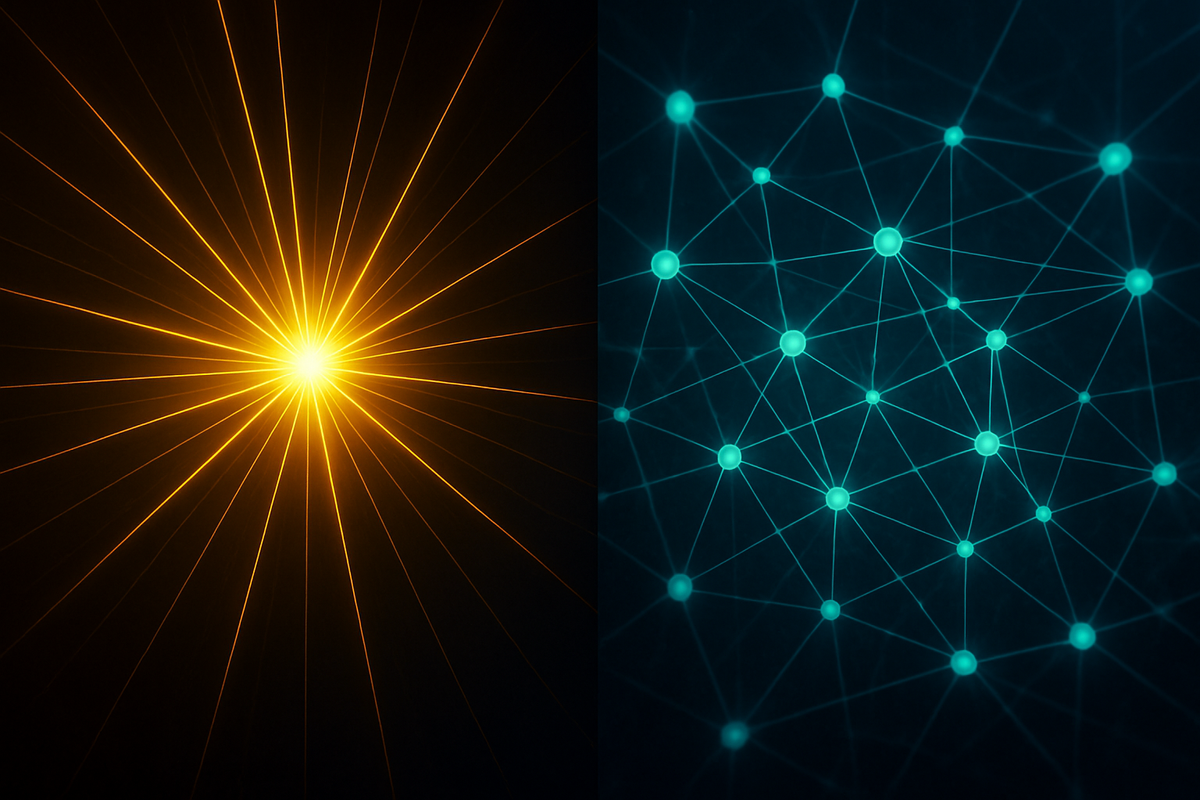
In a centralized orchestration model, a single orchestrator agent (sometimes called a planner, controller, or supervisor) sits at the top of the hierarchy. It receives the high-level goal, decomposes it into subtasks, dispatches those subtasks to specialized worker agents, collects results, evaluates progress, and decides what happens next. Think of it as a general contractor managing subcontractors: one entity holds the full project plan and issues all work orders.
Frameworks like LangGraph, CrewAI's supervisor mode, and AWS Bedrock's agent orchestration layer all implement variations of this pattern. The orchestrator typically maintains a global state object, and all agents report back to it before any next step is taken.
Where Centralized Orchestration Shines
- Auditability: Every decision flows through one node, making it straightforward to log, replay, and debug the full decision chain. Compliance teams love this.
- Coherent planning: The orchestrator has a holistic view of the task at all times, reducing the risk of agents working toward contradictory sub-goals.
- Simpler mental model: Engineers can reason about the system as a directed graph with a single root. Onboarding new team members is faster.
- Easier access control: Permissions, rate limits, and tool-use policies can be enforced at the orchestrator layer without distributing that logic across every agent.
Where Centralized Orchestration Breaks Down
The orchestrator is also the system's most dangerous single point of failure and its primary performance bottleneck. In long-horizon workflows, the compounding cost of this becomes severe:
- Latency amplification: Every inter-agent communication must route through the orchestrator. If you have five agents running in parallel, each needing to report status and receive new instructions, you're adding at minimum two round-trip LLM calls per agent per step. At GPT-4-class inference speeds in 2026 (typically 800ms to 2s per call even with optimized inference), this overhead is not trivial.
- Context window pressure: The orchestrator must track the full workflow state, all agent outputs, and the original plan simultaneously. For workflows spanning dozens of steps, this creates brutal context window pressure and increases hallucination risk in the planner itself.
- Throughput ceiling: The orchestrator becomes a serialization point. Even if your worker agents could theoretically run in parallel, the orchestrator's own inference time limits how fast you can dispatch and collect work.
- Cascading failure risk: If the orchestrator crashes or enters a bad state mid-workflow, the entire task stalls. Recovery requires replaying or reconstructing the full plan.
Architecture Two: Decentralized Mesh Coordination
How It Works
In a decentralized mesh model, agents communicate peer-to-peer (or through a lightweight message bus) without a single controlling authority. Each agent has a local view of its own task, a defined interface for publishing results and consuming inputs, and the autonomy to make local decisions within its scope. Coordination emerges from the interaction of agents following shared protocols, not from top-down commands.
This pattern draws heavily from distributed systems theory, specifically from concepts like actor models, event-driven microservices, and gossip protocols. Implementations in the agentic space often use message queues (Kafka, NATS, or purpose-built agent buses), shared memory stores (Redis, vector databases with structured metadata), or emerging agent communication protocols like Anthropic's Model Context Protocol (MCP) and the evolving Agent-to-Agent (A2A) standard that gained significant traction through late 2025 and into 2026.
Where Mesh Coordination Shines
- Horizontal scalability: Because there is no central bottleneck, you can add agents to the mesh and increase throughput nearly linearly, up to the limits of your message bus and shared state store.
- Fault isolation: A failing agent does not bring down the workflow. Other agents continue processing; the failed task can be retried or rerouted by another capable agent.
- Lower per-step latency in parallel workloads: Agents that have their inputs ready can execute immediately, without waiting for a central planner to issue an explicit dispatch instruction.
- Composability: New agent types can be added to the mesh with minimal changes to existing agents, as long as they conform to the shared protocol. This is a major operational advantage for teams iterating rapidly.
Where Mesh Coordination Breaks Down
Decentralization is not free. It trades one set of problems for another, and the new problems are often harder to debug:
- Emergent incoherence: Without a global planner, agents can pursue locally rational actions that are globally counterproductive. Two agents might redundantly call the same expensive API, or worse, take contradictory actions on shared state.
- Observability nightmare: Distributed traces across a peer-to-peer agent mesh are notoriously difficult to correlate. Identifying why a workflow produced a wrong result requires stitching together logs from multiple autonomous agents, each with its own context.
- Protocol complexity: The coordination logic that a centralized orchestrator handles explicitly must now be encoded into shared protocols, message schemas, and agent contracts. This is real engineering work that is easy to underestimate.
- State consistency hazards: Shared memory stores introduce classic distributed systems problems: race conditions, stale reads, and split-brain scenarios. Your agents are now effectively distributed processes, and you need distributed systems expertise to manage them safely.
The Head-to-Head Comparison: Metrics That Matter
Latency in Long-Horizon Workflows
This is where the architectures diverge most dramatically, and where the answer is more nuanced than most articles admit.
For sequential workflows (step B cannot start until step A is complete), centralized orchestration and mesh coordination perform comparably. The orchestrator's dispatch overhead is relatively small compared to the actual agent execution time.
For parallel or fan-out workflows (multiple independent subtasks can run simultaneously), mesh coordination wins decisively. In a centralized model, the orchestrator must serially dispatch each parallel subtask and then wait for all results before proceeding. In a mesh, agents with ready inputs begin executing immediately. For a workflow with 10 parallel subtasks, each taking 3 seconds, the centralized model might take 35 to 40 seconds (10 dispatches plus collection overhead). The mesh model can complete in as little as 4 to 5 seconds.
For deeply nested, interdependent workflows (the most common real-world shape), the answer depends on the ratio of sequential to parallel work. As a rule of thumb: if more than 40% of your workflow steps can run in parallel, mesh coordination will yield measurably lower end-to-end latency.
Operational Overhead
Centralized orchestration wins on initial setup and debugging overhead. One orchestrator to monitor, one state object to inspect, one log stream to follow. For teams new to multi-agent systems or operating with limited DevOps resources, this simplicity is genuinely valuable.
Mesh coordination wins on long-term scaling overhead. Once the protocol and message bus infrastructure are in place, adding new agents or workflow types does not require modifying the orchestrator. Teams report that after the initial investment, mesh architectures require significantly less engineering effort to extend. However, the initial investment is real: expect to spend meaningful time on schema design, dead-letter queue handling, idempotency guarantees, and distributed tracing setup.
Fault Tolerance and Recovery
Mesh coordination is the clear winner here. Individual agent failures are isolated, retryable, and do not propagate to the full workflow. Centralized orchestrators, unless carefully designed with checkpoint-and-resume logic, tend to fail catastrophically when the orchestrator itself encounters an error mid-workflow. Building robust checkpointing into a centralized orchestrator is possible, but it adds significant complexity and partially recreates the distributed state management that mesh architectures handle natively.
Coherence and Goal Alignment
Centralized orchestration wins clearly. A global planner with full workflow context is far better positioned to detect when the overall goal is drifting, resolve conflicts between subtasks, and make strategic replanning decisions. Mesh agents, operating with local context only, can produce locally correct but globally incoherent results. This is not a theoretical concern: it is one of the most common failure modes reported by engineering teams running production mesh deployments in early 2026.
The Emerging Hybrid: Hierarchical Mesh Orchestration
The most sophisticated enterprise teams in 2026 are not choosing between these two architectures. They are combining them into a hierarchical mesh pattern that captures the strengths of both.
In this model, a lightweight centralized orchestrator handles high-level goal decomposition and strategic replanning, but delegates execution to a mesh of autonomous sub-agents that coordinate peer-to-peer within their domain. The orchestrator does not micromanage individual agent steps; it sets objectives, monitors outcomes, and intervenes only when the mesh produces results that deviate from the global goal.
Think of it as the difference between a general contractor who reviews blueprints and approves major milestones versus one who personally supervises every nail being hammered. The orchestrator stays in the loop strategically, while the mesh handles tactical execution efficiently.
This pattern is sometimes called "supervisor-mesh" or "hierarchical multi-agent" architecture. It requires careful boundary definition: which decisions belong to the orchestrator, and which belong to the mesh? Getting this wrong reintroduces the bottleneck problems of pure centralization. But when tuned correctly, teams report latency profiles close to pure mesh, with coherence and auditability closer to pure centralized orchestration.
Decision Framework: Which Architecture Should You Choose?
Use this framework to guide your decision based on your specific context:
Choose Centralized Orchestration If:
- Your workflows are primarily sequential with limited parallelism
- Auditability and compliance are top priorities (financial services, healthcare, legal)
- Your team is new to multi-agent systems and values operational simplicity
- Workflow coherence is more critical than raw throughput
- You have fewer than 10 agents operating in a given workflow
Choose Decentralized Mesh Coordination If:
- Your workflows have high degrees of parallelism and independent subtasks
- Throughput and low latency are primary requirements
- You need strong fault isolation and continuous operation under partial failures
- Your team has distributed systems expertise to invest in protocol design
- You anticipate frequent addition of new agent types and workflow patterns
Choose Hierarchical Mesh If:
- You are running complex, long-horizon workflows with both sequential planning phases and parallel execution phases
- You need enterprise-grade observability without sacrificing throughput
- Your team has the engineering bandwidth to invest in a more sophisticated architecture upfront
- You expect the system to scale significantly over the next 12 to 18 months
Practical Recommendations for Backend Engineering Teams
Regardless of which architecture you choose, several practices apply universally to production multi-agent deployments in 2026:
- Instrument everything from day one. Distributed tracing (OpenTelemetry is the de facto standard) is not optional. You cannot debug a multi-agent workflow from logs alone. Trace every LLM call, every tool invocation, and every inter-agent message with a correlated workflow ID.
- Design for idempotency. Agents will be retried. Tool calls will be replayed. If your agents are not idempotent, you will produce duplicate actions and corrupted state. This is architecture-agnostic but becomes especially critical in mesh deployments.
- Define agent contracts explicitly. Whether you use a centralized or mesh model, each agent should have a formally defined input schema, output schema, and failure behavior. Implicit contracts are a maintenance disaster at scale.
- Build circuit breakers for expensive tools. Long-horizon workflows often call external APIs many times. Implement circuit breaker patterns to prevent a degraded external service from cascading failures through your entire agent pipeline.
- Test with chaos engineering principles. Randomly kill agents, inject latency, corrupt messages. Production multi-agent systems face all the failure modes of distributed systems, and you need to know how your architecture responds before your users do.
Conclusion: There Is No Universal Winner, But There Is a Right Answer for Your Team
The debate between centralized orchestration and decentralized mesh coordination is not a matter of one being objectively superior. It is a matter of matching architecture to workload shape, team capability, and operational priorities.
Centralized orchestration offers clarity, coherence, and simplicity. It is the right starting point for most teams and the right permanent choice for workflows where sequential logic and auditability dominate. Decentralized mesh coordination offers throughput, resilience, and scalability. It is the right choice for high-parallelism workloads where latency is a hard requirement and your team has the distributed systems depth to operate it responsibly.
And for the growing class of enterprise teams running genuinely complex long-horizon workflows in 2026, the hierarchical mesh pattern offers the most compelling path forward: strategic coherence at the top, tactical efficiency at the bottom, and a clear separation of concerns between the two.
The worst outcome is not choosing the wrong architecture. The worst outcome is choosing an architecture by accident, without understanding the trade-offs, and discovering its limitations only after you have built a production system on top of it. Make the choice deliberately. Then build with confidence.



