A Beginner's Guide to AI Agent Memory Architecture: How to Choose Between Context Windows, Vector Stores, and Episodic Memory Before Your First Production Deployment
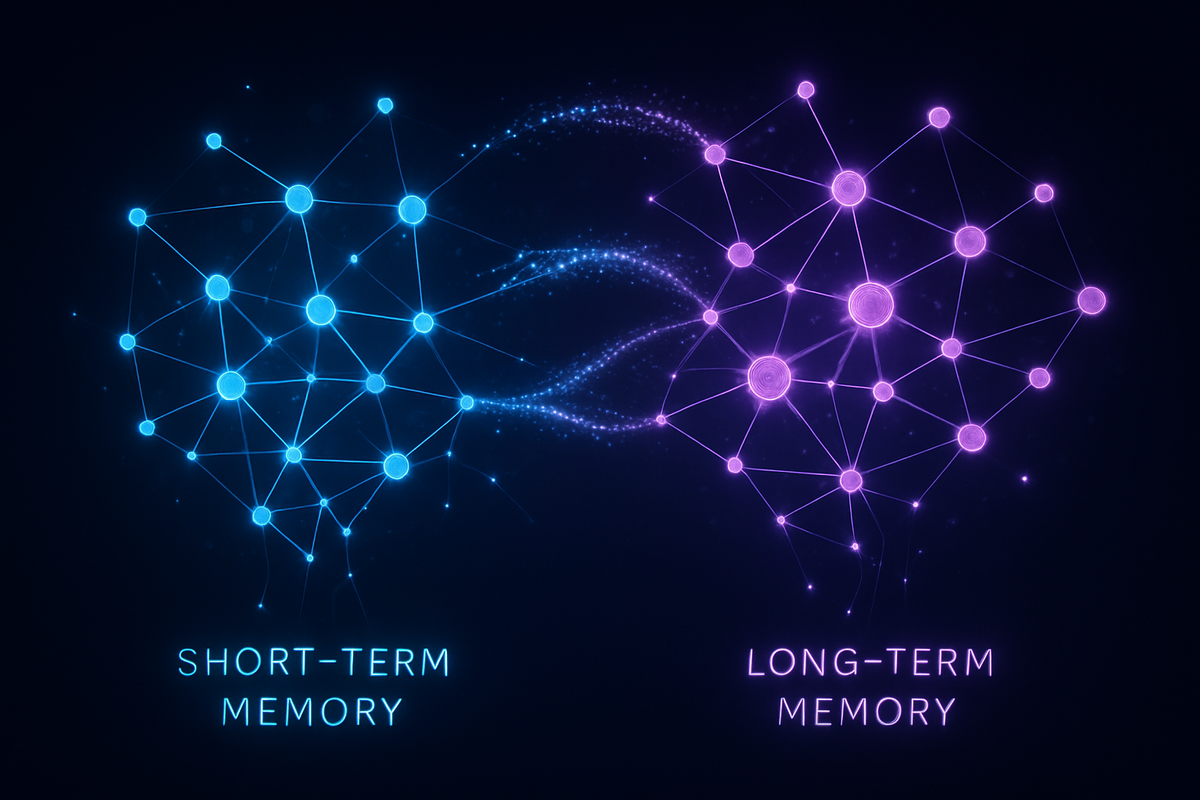
You've built your first AI agent. It answers questions, calls APIs, and chains together tool calls with impressive fluency. Then someone on your team asks: "What happens when it forgets everything between sessions?" Suddenly, the demo that wowed the boardroom starts looking fragile.
Memory is the quiet foundation that separates a convincing prototype from a production-grade AI agent. And for enterprise backend teams shipping their first real deployment in 2026, choosing the wrong memory architecture isn't just a performance problem; it's a reliability, cost, and compliance problem waiting to happen.
This guide breaks down the three primary memory systems available to AI agents today: short-term context windows, long-term vector stores, and episodic memory systems. By the end, you'll understand what each one does, where each one breaks down, and how to make a deliberate architectural choice before you write a single line of production code.
Why Memory Architecture Is Not an Afterthought
Most beginner tutorials treat memory as a feature you bolt on after the agent works. That instinct is understandable but dangerous. Here's why: the memory layer you choose dictates your token costs, your latency profile, your data privacy posture, and your agent's ability to reason coherently over time. Swapping memory systems in production is roughly as painful as swapping databases mid-flight.
Think of an AI agent's memory the same way you'd think about a human employee's memory at work. A new hire might remember everything from today's meeting (short-term), keep a searchable notebook of past project notes (long-term), and recall the specific sequence of events that led to a past decision (episodic). Each type of memory serves a different cognitive function. AI agents need the same layered thinking.
The Three Core Memory Types: A Plain-English Overview
1. Short-Term Memory: The Context Window
The context window is the most familiar memory concept for anyone who has worked with large language models. It is the active "working memory" of the agent: everything the model can see and reason over in a single inference call. In 2026, leading models offer context windows ranging from 128K tokens on standard tiers to well over 1 million tokens on specialized long-context variants.
What lives inside the context window?
- The system prompt and agent instructions
- The current conversation history
- Tool call results retrieved during the current session
- Any documents or data injected for the current task
The key characteristic of context-window memory is that it is ephemeral. When the session ends, the window is cleared. Nothing persists. For stateless tasks like one-shot document summarization or single-turn question answering, this is perfectly fine. For multi-session workflows, customer-facing agents, or any scenario where continuity matters, relying on the context window alone is a recipe for frustrating user experiences.
When to use it: Short-lived, single-session tasks. Internal tooling where each invocation is self-contained. Batch processing pipelines where each item is independent.
Watch out for: Token cost explosion when you try to compensate by stuffing entire conversation histories into the prompt. Latency spikes on long-context models. And the classic "lost in the middle" problem, where models attend poorly to information buried in the center of a very large context.
2. Long-Term Memory: Vector Stores
When your agent needs to remember things across sessions, across users, or across time, you need persistent storage. Vector stores are the most widely adopted solution for this in enterprise AI systems today.
Here's the core idea: instead of keeping all past information in the active context, you encode it into high-dimensional numerical representations called embeddings and store those in a vector database. When the agent needs to recall relevant information, it encodes the current query into the same embedding space and performs a similarity search to retrieve the most relevant chunks. Only the retrieved chunks get injected into the context window, keeping token usage manageable.
Popular vector databases in enterprise use today include Pinecone, Weaviate, Qdrant, pgvector (for teams already on PostgreSQL), and Chroma for lighter workloads. Most modern AI orchestration frameworks like LangGraph, LlamaIndex, and AutoGen have first-class integrations with these stores.
What vector stores are great at:
- Storing and retrieving large knowledge bases (product documentation, policy manuals, customer history)
- Enabling semantic search across thousands or millions of past interactions
- Powering Retrieval-Augmented Generation (RAG) pipelines, which remain a cornerstone pattern for enterprise agents in 2026
- Scaling horizontally without touching the model itself
What vector stores struggle with:
- Precise factual recall. Similarity search is probabilistic, not deterministic. The right chunk isn't always retrieved.
- Sequential or causal reasoning. Vector stores have no inherent sense of time or order. They retrieve based on semantic similarity, not narrative sequence.
- Structured queries. If you need to ask "how many times did this user report an error in the last 30 days," a vector store is the wrong tool. A relational database with a structured query is the right one.
When to use it: Customer support agents that need to recall past interactions. Knowledge management systems. Any agent that needs to search a large corpus of unstructured text. RAG pipelines where grounding responses in real documents is a priority.
3. Episodic Memory: Structured Recall of Past Experiences
Episodic memory is the most underappreciated and least understood of the three, especially among teams building their first production agent. It draws from cognitive science: episodic memory in humans is the ability to recall specific past events in their temporal and contextual sequence. "What happened during last Tuesday's incident response?" is an episodic question. "What do we generally know about incident response?" is a semantic one.
For AI agents, episodic memory systems store structured records of past agent runs: the goal, the steps taken, the tools called, the outcomes, and the context at the time. These records can be stored in a hybrid format combining structured metadata (timestamps, user IDs, task types, success/failure flags) with vector-embedded summaries of the agent's reasoning trace.
Episodic memory enables several capabilities that neither context windows nor plain vector stores can provide on their own:
- Self-improvement: Agents can review past failed attempts and adjust their strategy. This is a foundational capability for agentic systems that learn from experience without full retraining.
- Auditability: Enterprise compliance teams can inspect exactly what the agent did, in what order, and why. This is increasingly a regulatory requirement in sectors like finance and healthcare.
- Personalization over time: An agent can recall not just what a user prefers in general (semantic memory) but what happened the last three times this specific user asked a similar question (episodic memory).
- Multi-agent coordination: In systems with multiple specialized agents, episodic memory allows one agent to pick up where another left off, with full context about what was already tried.
When to use it: Long-running autonomous workflows. Agents that operate over days or weeks on complex tasks. Compliance-sensitive deployments. Multi-agent systems. Any scenario where the agent should learn from its own history.
The honest trade-off: Episodic memory systems are the most complex to implement and maintain. They require thoughtful schema design, reliable write paths from your agent's execution trace, and a retrieval strategy that blends structured filtering with semantic search. If your team is shipping its first agent, you may not need this on day one. But you should design your architecture so adding it later doesn't require a full rewrite.
How the Three Systems Work Together: A Layered Architecture
The most robust production agents don't choose one memory type; they combine all three in a layered architecture. Here's a practical mental model for how these layers interact during a single agent invocation:
- Episodic retrieval (pre-context): Before the agent begins reasoning, the system queries episodic memory for relevant past runs involving this user, task type, or domain. A structured summary is prepared.
- Semantic retrieval (pre-context): The vector store is queried for relevant knowledge chunks based on the current user intent. The top-k results are selected.
- Context assembly: The system prompt, episodic summary, retrieved semantic chunks, and current conversation turn are assembled into the active context window. The model reasons over this assembled context.
- Post-run write-back: After the agent completes its task, the run is serialized and written to the episodic store. New information surfaced during the run may be embedded and written to the vector store.
This layered approach keeps each component doing what it does best: the context window handles active reasoning, the vector store handles broad semantic recall, and the episodic store handles structured historical context.
A Decision Framework for Enterprise Backend Teams
Before your first production deployment, run your agent design through these four questions:
Question 1: Does my agent need to remember anything between sessions?
If no, a well-managed context window may be sufficient. If yes, you need at minimum a vector store for persistent memory.
Question 2: Does my agent need to recall the sequence or outcome of past actions?
If yes, you need episodic memory. Sequential and causal recall is beyond what vector similarity search can reliably provide.
Question 3: What are my compliance and auditability requirements?
If your organization operates in a regulated industry, episodic memory isn't optional; it's the mechanism that makes your agent's behavior inspectable and defensible. Design it in from day one.
Question 4: What is my token budget and latency tolerance?
More memory layers mean more retrieval latency and more tokens consumed per call. For latency-sensitive applications, profile your retrieval pipeline early. A vector store query that returns 20 large chunks can easily add 30,000 tokens to your context, which has direct cost and speed implications.
Common Mistakes to Avoid in Your First Production Deployment
- Treating the context window as a database. Appending every past message to the prompt is the most common beginner mistake. It's expensive, slow, and degrades model performance as the context grows.
- Skipping chunking strategy for your vector store. How you split documents into chunks before embedding has an enormous impact on retrieval quality. Fixed-size chunking is a starting point, not a solution. Invest time in semantic or recursive chunking strategies.
- Forgetting to version your embeddings. When you upgrade your embedding model, your stored vectors become incompatible. Build a versioning strategy into your vector store schema from the start.
- No write-back strategy for episodic memory. Many teams build the read path (retrieval) but neglect the write path (storing agent runs). Define exactly what gets written, when, and in what format before you go live.
- Ignoring data residency and PII. Vector stores and episodic memory systems persist user data. Your privacy and compliance team needs to be part of the architecture conversation, not a reviewer after the fact.
Recommended Starting Stack for Enterprise Teams in 2026
If you're a backend team shipping your first production AI agent and you want a pragmatic, proven starting point, here's a sensible baseline architecture:
- Context window management: Use a context management library (LangGraph's state management or LlamaIndex's chat engine) to handle prompt assembly, history summarization, and token budgeting automatically.
- Vector store: If you're already on PostgreSQL, start with pgvector. It reduces operational overhead dramatically and is production-proven. Graduate to a dedicated vector database like Qdrant or Weaviate when your scale demands it.
- Episodic memory: Start simple. A structured table in your existing relational database with columns for agent run ID, user ID, task type, timestamp, outcome, and a text summary of the reasoning trace is a perfectly valid episodic memory system for a first deployment. Add vector embeddings of the summary column when semantic search over past runs becomes a requirement.
- Orchestration: LangGraph remains the most mature framework for stateful, multi-step agent workflows with explicit memory integration in 2026. It gives you fine-grained control over state management without hiding the memory layer behind too much abstraction.
Conclusion: Memory Is Architecture, Not a Feature
The teams that ship reliable, production-grade AI agents in 2026 are the ones who treat memory as a first-class architectural concern, not a configuration option. The choice between context windows, vector stores, and episodic memory systems is not a technical trivia question. It determines how your agent behaves under real-world conditions: across sessions, across users, and across the messy, non-linear workflows that enterprise environments actually produce.
Start with a clear understanding of your agent's memory requirements. Design your layers deliberately. Build your write paths as carefully as your read paths. And leave room in your architecture for episodic memory, even if you don't implement it on day one, because the moment your agent needs to explain what it did and why, you'll want it there.
The good news is that the tooling has matured significantly. You don't need to build these systems from scratch. You need to understand them well enough to choose, configure, and connect them correctly. That understanding is the real prerequisite for your first production deployment.



