The Uncomfortable Truth About Autonomous Code Generation: Why Enterprise Backend Teams Must Redefine "Done"
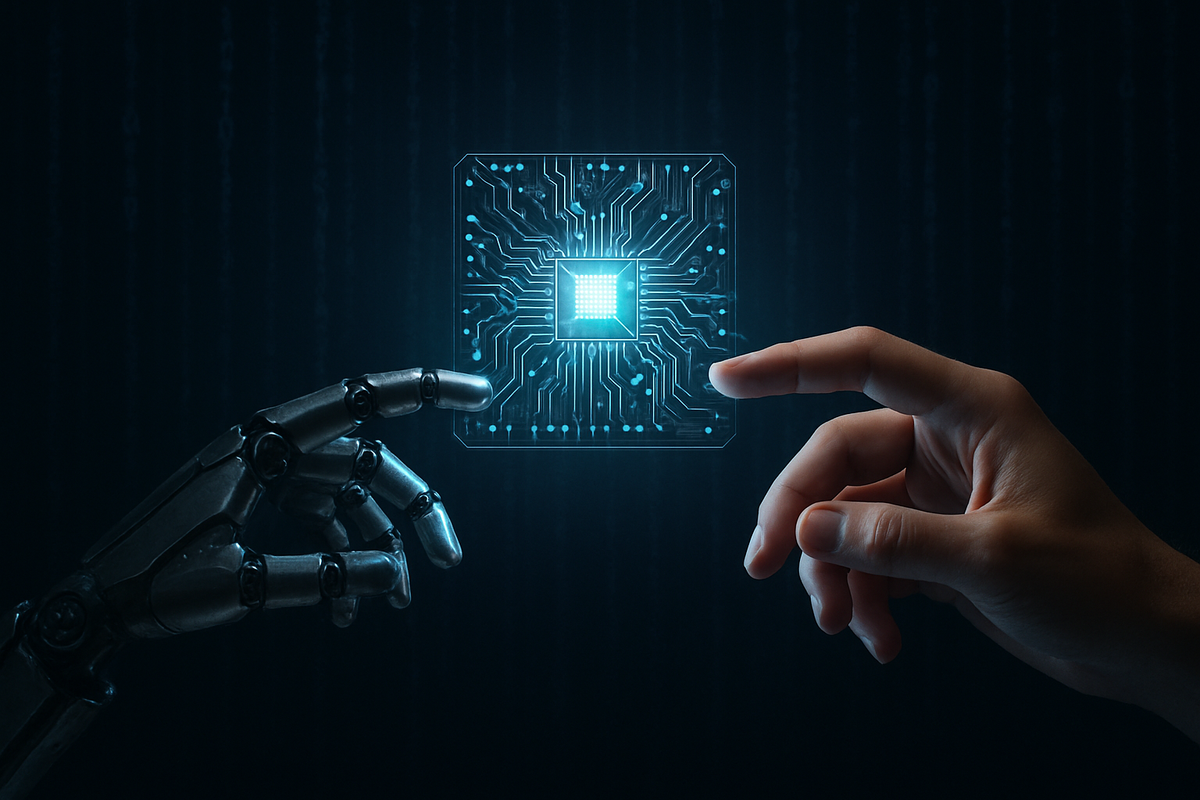
Something quietly crossed a threshold in enterprise software development over the past year, and most engineering leaders are only now beginning to reckon with what it means. AI coding agents are no longer just suggesting completions or drafting boilerplate. They are autonomously writing, testing, committing, and in a growing number of organizations, deploying backend code to production without a single human engineer ever reading a line of it.
Let that sit for a moment.
Not "a human reviewed the output and approved it." Not "a developer skimmed the diff before merging." In the most aggressive enterprise AI adoption pipelines operating right now in 2026, orchestration agents are closing tickets end-to-end: interpreting requirements, generating implementation, running automated test suites, passing CI/CD gates, and shipping. The human involvement happened at the ticket-writing stage, and then again, maybe, at the post-deployment monitoring dashboard.
This is not science fiction. It is not a startup experiment. It is happening inside Fortune 500 backend engineering organizations right now, and the industry's collective response has been, at best, inconsistent and, at worst, dangerously naive.
The uncomfortable truth is this: our entire professional definition of "done" was built around the assumption that a human being would read the code. That assumption is now broken, and we have not replaced it with anything coherent.
How We Got Here So Fast
The trajectory feels sudden, but it was entirely predictable in hindsight. The progression moved in clear stages. First came AI-assisted autocompletion, tools like early Copilot iterations that felt like a smarter IntelliSense. Then came conversational generation, where a developer could describe a function and receive a working implementation. Then came agentic scaffolding, where agents could handle entire feature branches with multi-step reasoning. And now, in 2026, we have fully orchestrated pipelines where the agent is a first-class participant in the software delivery lifecycle, not a tool a human uses but an actor that operates alongside (and increasingly ahead of) humans.
The enterprise adoption curve accelerated because the business case was irresistible. Teams reported dramatic reductions in time-to-merge for routine backend work: CRUD endpoint generation, data migration scripts, integration adapters, configuration management, test scaffolding. The ROI metrics were clean and easy to present to a CFO. What got buried in the fine print was the question nobody in the boardroom was asking: what governance model applies when the author of your production code is not a person?
The "Definition of Done" Was Always a Human Contract
In Agile and its many enterprise derivatives, the Definition of Done (DoD) is a shared agreement that describes the conditions a piece of work must meet before it is considered complete. Most DoDs in backend engineering organizations include some version of the following:
- Code has been peer-reviewed by at least one other engineer
- Unit and integration tests pass
- Code meets style and linting standards
- Security scanning has been run
- Documentation has been updated
- The feature has been tested in a staging environment
- A team lead or senior engineer has approved the merge
Notice what almost every one of these criteria implicitly assumes: a human being is the author, and another human being is the reviewer. The peer review criterion is the most obvious casualty, but it goes deeper than that. "Code meets style standards" assumes a human made stylistic choices that need to be evaluated. "Documentation has been updated" assumes a human who wrote code also understood it well enough to explain it. "A senior engineer approved the merge" assumes a human exercised professional judgment about risk and correctness.
When an AI agent is the author, every single one of these criteria becomes ambiguous at best and meaningless at worst. An agent can pass a linter. It can generate documentation. It can even write the pull request description. But the foundational act of a knowledgeable human being taking professional responsibility for this code has been quietly removed from the equation, and most DoD checklists have not been updated to reflect that seismic shift.
The Three Failure Modes Nobody Is Talking About Loudly Enough
1. Confident Incorrectness at Scale
Human developers make mistakes, obviously. But human mistakes tend to cluster around areas of genuine complexity, unfamiliarity, or time pressure. A senior engineer writing a payment processing module is unlikely to introduce a subtle off-by-one error in a loop they have written dozens of times. AI agents, by contrast, can produce confidently incorrect code in ways that are statistically distributed across the entire codebase, including in areas that appear trivially simple.
The danger is not that AI agents are bad at writing code. Many benchmarks show they are remarkably good. The danger is that their failure modes are non-obvious and non-uniform. A human reviewer reading code has an intuition built from years of experience that says "something feels off here." That intuition is a pattern-matching capability trained on real-world consequences. Automated test suites do not replicate it. A green CI pipeline does not replicate it. And when nobody is reading the code, that intuition is simply absent from the delivery pipeline.
2. Security Vulnerabilities That Pass Every Automated Gate
This is the one that should be keeping CISO offices awake at night. Automated security scanning tools, even the best static analysis and SAST platforms available in 2026, are designed to catch known vulnerability patterns. They are signature-based and heuristic-based. They are excellent at finding SQL injection patterns, known insecure dependency versions, hardcoded secrets, and common OWASP Top 10 violations.
What they are not designed to catch is novel architectural-level security decisions that are subtly wrong in context. An AI agent might generate an authentication flow that passes every automated security check and is still fundamentally flawed in the context of your specific system's trust model. It might implement a caching layer that inadvertently leaks data between tenant sessions in a multi-tenant SaaS application in a way that no scanner would flag because the logic is technically valid; it is just wrong for your architecture.
These are exactly the kinds of vulnerabilities that experienced security engineers catch during design review and code review, not during automated scanning. Remove the human reader, and you remove the only defense against this class of problem.
3. Institutional Knowledge Erosion
This failure mode operates on a longer timeline, which makes it the most insidious. When human engineers write code, they accumulate context. They learn why the previous team made certain architectural decisions. They develop an understanding of the system's historical quirks, the places where technical debt lives, the modules that are fragile and require careful handling. This knowledge lives in engineers' heads, in code review comments, in commit messages written by people who understood the tradeoffs they were making.
When AI agents write code that no human reads, that accumulation stops. The codebase grows, features ship, and the team's actual understanding of the system shrinks relative to its complexity. Engineers become operators of a system they no longer fully comprehend. When something breaks in an unexpected way, the institutional knowledge required to diagnose it quickly may simply not exist in any human on the team.
This is not hypothetical. Several engineering organizations that adopted aggressive agentic pipelines in late 2024 and 2025 are now reporting what some are calling "codebase opacity": a condition where the system works until it doesn't, and when it doesn't, nobody is quite sure why.
What "Done" Must Mean in an Agentic Pipeline
I want to be clear: I am not arguing that autonomous code generation should be rolled back or that AI agents have no place in production pipelines. That ship has sailed, and frankly, the productivity gains are real and significant. What I am arguing is that the governance model must evolve as fast as the technology, and right now it is not even close.
Here is what a modernized Definition of Done must include when AI agents are authoring production code:
Mandatory Human Comprehension Checkpoints
Not review in the traditional sense, necessarily, but a documented assertion that a qualified engineer has read, understood, and can explain the logic of the generated code. This is different from approval. It is a comprehension gate. The engineer is not certifying that the code is optimal; they are certifying that a human being with appropriate expertise has a mental model of what this code does and why. This checkpoint should be non-negotiable for any code touching security boundaries, data persistence, external integrations, or payment flows.
Architectural Boundary Enforcement
AI agents should operate within explicitly defined architectural envelopes. The DoD for agent-generated code should include a verification step confirming that the generated code did not make decisions that belong to the architectural layer: no new external dependencies introduced without human approval, no changes to authentication or authorization logic, no modifications to database schemas, no new network egress patterns. These are not just code quality concerns; they are system integrity concerns.
Behavioral Contracts, Not Just Test Coverage
Traditional test coverage metrics are insufficient for agent-generated code because the agent can write the tests too. A 95% coverage number generated by the same system that generated the implementation tells you very little about correctness. Teams need to invest in independently authored behavioral contracts: property-based tests, contract tests, and invariant specifications written by humans that agent-generated code must satisfy. The agent generates the implementation; humans define the behavioral envelope it must stay within.
Provenance Tracking and Explainability Logs
Every piece of agent-generated code that reaches production should carry metadata about how it was generated: which model version, which prompt context, which requirements artifact it was derived from, and what automated checks it passed. This is not just an audit trail for compliance purposes. It is operational intelligence. When something breaks, you need to know whether the failure originated in agent-generated code and what the generation context was. Without this, incident response becomes archaeology.
Staged Autonomy Based on Risk Classification
Not all backend code carries equal risk. A DoD for agent-generated code should explicitly classify work by risk tier and apply proportional autonomy constraints. Low-risk, high-isolation work (internal tooling, read-only reporting endpoints, test data generators) can operate with minimal human checkpoints. Medium-risk work requires comprehension gates. High-risk work (anything touching auth, payments, PII, or core business logic) requires full human authorship or, at minimum, line-by-line human review before merge, regardless of how good the agent's output looks.
The Leadership Responsibility Nobody Wants to Own
Here is the part of this conversation that makes engineering leaders visibly uncomfortable: when an AI agent ships a bug to production that causes a data breach or a financial error, who is accountable?
Right now, the answer in most organizations is: nobody has clearly defined that. The team that configured the pipeline? The vendor whose model generated the code? The product manager who wrote the ticket? The engineering director who approved the agentic workflow? Legal and compliance teams are beginning to ask these questions with increasing urgency, and the engineering organizations that do not have clear answers are going to find themselves in extraordinarily uncomfortable positions when the first major incident arrives.
Accountability does not disappear because the author was an AI. Accountability shifts, and if it is not consciously assigned to a human role with appropriate authority and oversight, it defaults to "everyone and no one," which is the organizational equivalent of no accountability at all.
Engineering leaders need to make an explicit decision: who owns the code that agents ship? That person or role needs to have the visibility, authority, and tooling to actually exercise that ownership. Anything less is organizational theater.
The Deeper Philosophical Shift We Are Avoiding
There is a harder conversation underneath all of this. For the entire history of software engineering as a profession, the craft has been defined by the act of a human being reasoning carefully about a problem and expressing that reasoning in executable form. Code was the artifact of thought. The review process was valuable not just as a quality gate but as a shared act of professional reasoning between engineers who were both trying to understand the same problem better.
When agents write code that no human reads, we are not just changing a workflow. We are changing what software engineering is. We are moving from a discipline defined by human reasoning expressed as code to a discipline defined by human judgment applied to system-level outcomes. That is a legitimate evolution. But it requires us to be honest about what we are giving up, what new skills the profession needs to develop, and what new failure modes we are accepting in exchange for the productivity gains.
The engineers who will thrive in this environment are not the ones who write the most code or who are most comfortable with AI tools. They are the ones who can reason at the system level, define precise behavioral contracts, design effective oversight architectures, and exercise the kind of contextual judgment that no agent can replicate. That is a different skill profile from what most backend engineering hiring and career development processes are currently optimizing for.
Conclusion: The Urgency Is Now
The window for getting this right is narrowing. Agentic pipelines are already in production. The velocity of adoption is increasing, not decreasing. Every quarter that engineering organizations operate with a DoD designed for human authors but applied to agent-generated code is a quarter of accumulated risk: security risk, reliability risk, compliance risk, and the slow-burning risk of a team that no longer truly understands the system it is responsible for.
Redefining "done" is not a bureaucratic exercise. It is an act of professional integrity. It is the engineering organization saying: we understand that the nature of our work has changed, and we are taking deliberate responsibility for the new risks that change introduces.
The AI agents are not going to slow down and wait for governance to catch up. That means the urgency of building the right oversight model is entirely on us. And the first step is being honest about the fact that shipping code nobody read is not "done." It is a bet. And right now, most enterprise backend teams are placing that bet without fully understanding the odds.
The question is not whether your organization will face consequences from unreviewed agent-generated code in production. The question is whether you will have the governance architecture in place to catch the problem before it catches you.



