The SLA Time Bomb: Why Enterprise Backend Teams That Skipped Formal SLA Definition for Agentic Workflows Are Now Facing Contractual Liability
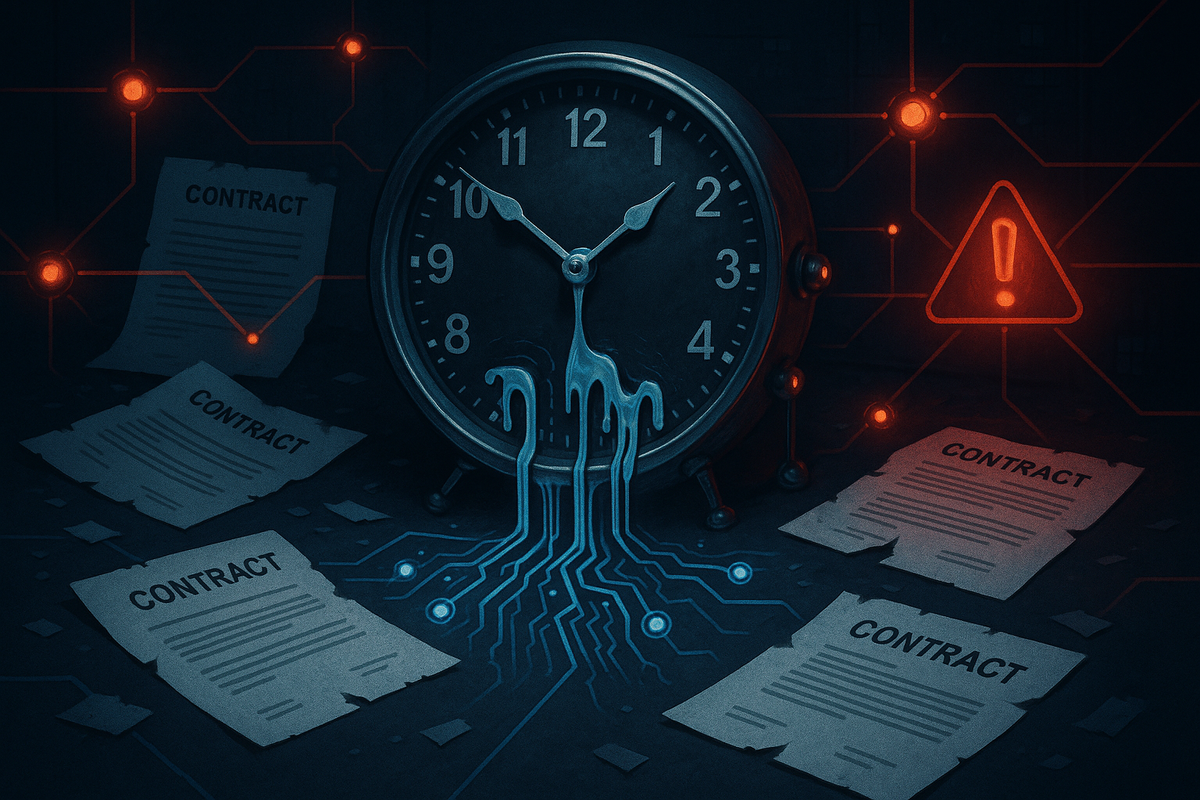
There is a quiet crisis unfolding inside enterprise legal and engineering departments right now, and most backend teams are only discovering it after the damage is done. For the better part of the last two years, organizations raced to deploy multi-agent AI systems. The pitch was irresistible: automate complex workflows, reduce operational overhead, and let orchestrated AI agents handle the messy middle layers of business logic. Internal productivity soared. Demos impressed the C-suite. Roadmaps accelerated.
Then something shifted. Those same agentic workflows, once safely tucked behind internal tooling walls, began touching customers directly. An AI agent that once summarized tickets for support staff now responds to customers. An orchestration layer that once routed internal procurement requests now fulfills vendor-facing purchase orders. A multi-agent pipeline that once generated internal risk reports now feeds data directly into client-facing dashboards covered by contractual data freshness guarantees.
And almost universally, the service level agreements governing those customer-facing obligations were written before anyone thought to ask: what happens when an AI agent is the system responsible for meeting them?
This is not a hypothetical risk. In 2026, it is an active, measurable liability problem, and backend engineering teams are at the center of it.
How We Got Here: The Internal Tool Loophole
To understand the contractual exposure, you first need to understand the architectural journey most enterprises took to get here. When agentic frameworks like LangGraph, AutoGen, and proprietary orchestration layers first matured into production-grade tooling, procurement and legal teams treated them the way they treated any internal automation: as infrastructure, not as a service delivery mechanism.
This classification mattered enormously. Internal tools exist in a different contractual universe than customer-facing services. An internal tool can have a 97% uptime and nobody files a breach-of-contract claim. An internal tool can occasionally return a malformed output and a human catches it before it propagates. An internal tool can take 45 seconds to complete a complex reasoning chain and the only person annoyed is the engineer waiting on the result.
SLA definitions, historically, were written for APIs, databases, and compute infrastructure. They specified things like:
- Response latency thresholds (e.g., p99 under 500ms)
- Availability windows (e.g., 99.9% uptime per calendar month)
- Data consistency guarantees (e.g., eventual consistency within 30 seconds)
- Error rate ceilings (e.g., fewer than 0.1% of requests returning 5xx)
None of these definitions were designed with agentic behavior in mind. An agent is not an API endpoint. It is a decision-making process with variable latency, probabilistic outputs, tool-calling side effects, and emergent failure modes that do not map cleanly onto traditional HTTP status codes. When enterprises copy-pasted their existing SLA frameworks onto agentic workflows, they created a definitional vacuum, and that vacuum is now being filled by lawyers.
The Threshold Moment: When Internal Becomes Customer-Facing
The transition from internal tool to customer-facing obligation rarely happens with a formal announcement. It happens incrementally, through a series of individually reasonable product decisions that collectively cross a legal threshold nobody was watching.
Here is a pattern that backend teams across financial services, logistics, healthcare technology, and enterprise SaaS are reporting in 2026:
Stage 1: The Pilot Expansion
An agentic workflow is built for internal use. It works well. A product manager suggests exposing a subset of its outputs to a customer portal, framed as a "beta feature." Legal reviews the portal terms of service, notes the beta disclaimer, and approves. No SLA is written because it is a beta.
Stage 2: The Quiet Graduation
The beta label is removed, usually six to twelve months later, without a corresponding legal review. The feature is now a standard product offering. Existing customer contracts, which contain SLA schedules covering "the platform and all its features," now technically encompass this agentic workflow. Nobody updated the SLA schedule. Nobody defined what "availability" or "accuracy" means for an agent-driven feature.
Stage 3: The Incident
The multi-agent pipeline fails. Not catastrophically, but materially. An orchestration loop stalls. A tool-calling agent receives a malformed response from a downstream model API and enters a retry spiral. A reasoning step produces an output that is confidently wrong, and that output propagates to a customer-facing report before a human reviewer catches it. The customer notices. The customer's legal team references the SLA schedule in the master service agreement.
Stage 4: The Discovery Problem
Legal asks engineering: "Was the SLA breached?" Engineering looks at the monitoring dashboards. The underlying infrastructure was 100% available. The API gateway returned 200 status codes throughout. By every traditional metric, the system was "up." But the agent produced incorrect outputs for three hours, and the customer's business decisions during that window were based on those outputs. Was that an SLA breach? The contract does not say. The silence is expensive.
Why Agentic Systems Break Traditional SLA Definitions
This is the technical core of the problem, and it deserves careful unpacking. Traditional SLA frameworks are built around a set of assumptions that agentic systems violate at nearly every layer.
Assumption 1: Determinism
Traditional services are deterministic or near-deterministic. Given the same input, a database query returns the same rows. A REST API applies the same business logic. SLAs can therefore define "correctness" implicitly: if the system is up and responding, it is assumed to be correct.
Agentic systems are probabilistic. The same prompt, sent to the same model, with the same tools available, can produce meaningfully different outputs across invocations. "Correctness" is not binary. It exists on a spectrum, and that spectrum is not captured anywhere in a standard SLA schedule.
Assumption 2: Bounded Latency
Traditional SLAs define latency in milliseconds or seconds because traditional services complete discrete, bounded operations. An agentic workflow has no natural completion boundary. A multi-agent pipeline might spin up sub-agents, call external tools, perform iterative self-correction, and loop through planning cycles. Its latency is not just variable; it is architecturally unbounded unless explicit limits are engineered into the orchestration layer.
Most early agentic deployments did not engineer those limits. They were internal tools. Who cared if a workflow took 12 seconds instead of 3? Now those same workflows are serving customer-facing features, and the customer's contract says "response within 5 seconds" because that clause was written for the old deterministic API the agent replaced.
Assumption 3: Atomic Failure
When a traditional service fails, it fails atomically and observably. A 500 error is a 500 error. An SLA breach is detectable by monitoring infrastructure. Agentic failures are frequently silent and distributed. A sub-agent in a pipeline can fail softly, returning a plausible-looking but incorrect output. The orchestrator, seeing no error signal, continues. The pipeline completes successfully by every observable metric. The customer receives a wrong answer. The SLA monitoring system records a successful request.
This is the most dangerous failure mode, and it is the one least covered by existing contractual language.
Assumption 4: Clear Ownership
A traditional SLA covers a service owned by a single vendor. In a multi-agent architecture, the pipeline may invoke agents that call third-party model APIs, external data providers, and partner microservices. When the pipeline fails, ownership of that failure is distributed across multiple vendors, each with their own SLA. The enterprise customer does not care about the internal supply chain of the AI pipeline. Their contract is with the enterprise. The enterprise is liable for the aggregate behavior of a system it only partially controls.
The Contractual Liability Landscape in 2026
The legal exposure is materializing along several distinct vectors, and understanding each one is critical for backend teams trying to assess their organization's risk posture.
Vector 1: Output Quality as a Deliverable
Enterprise contracts in sectors like financial services, legal technology, and healthcare increasingly contain language around "data accuracy," "report integrity," or "decision support reliability." These clauses were written with deterministic data pipelines in mind. When an agentic workflow becomes the system generating those outputs, every probabilistic error is potentially a breach of a quality-of-deliverable clause.
Legal teams are now arguing, with increasing success, that a clause guaranteeing "accurate portfolio risk summaries" covers the outputs of an AI agent tasked with generating those summaries, regardless of whether the contract mentions AI at all. The obligation is to the output, not to the mechanism.
Vector 2: Availability Redefined
When a multi-agent system is "available" but producing degraded outputs due to an upstream model provider's quality regression, is the enterprise in breach? Courts and arbitration panels are beginning to answer this question, and the answers are not uniformly favorable to enterprises. Several high-profile B2B disputes in early 2026 have centered on exactly this question, with customers arguing that "availability" implies functional availability, not merely infrastructural availability.
Vector 3: Audit Trail Obligations
Many enterprise contracts, particularly in regulated industries, require that automated decisions be explainable and auditable. Agentic reasoning chains are notoriously difficult to audit. The chain-of-thought that led an agent to a particular output may span multiple model invocations, tool calls, and intermediate reasoning steps, none of which are preserved in a format that satisfies regulatory or contractual audit requirements. This is not just a compliance problem; it is a contractual one, because the obligation to provide audit trails was accepted without the capability to fulfill it.
Vector 4: Cascading SLA Failures
In a multi-agent architecture, one agent's output is often another agent's input. A quality degradation at step one of a pipeline propagates and potentially amplifies through subsequent steps. An SLA breach at the input layer may cause breaches across multiple downstream customer-facing services simultaneously. Backend teams that deployed tightly coupled multi-agent pipelines without circuit breakers or quality gates are discovering that a single model regression can trigger SLA breach conditions across dozens of customer contracts at once.
What Proper SLA Definition for Agentic Workflows Actually Looks Like
The good news is that this problem is solvable. It requires a fundamental rethinking of SLA architecture for AI-native systems, but the building blocks exist. Here is what backend and platform engineering teams need to build, and what legal teams need to codify.
1. Define Output Quality Tiers, Not Just Availability
Agentic SLAs need a quality dimension that traditional SLAs lack. This means defining, contractually and technically, what constitutes a "degraded output" versus a "failed output" versus an "acceptable output." This requires collaboration between engineering, product, and legal to establish measurable proxies for quality, such as confidence score thresholds, human-in-the-loop validation rates, or structured output schema conformance rates.
A well-constructed agentic SLA might read: "The system guarantees that no fewer than 99.5% of agent-generated outputs will conform to the defined output schema, and that outputs flagged by the quality gate as low-confidence will be escalated to human review within 15 minutes." This is a contractually meaningful and technically measurable commitment.
2. Introduce Latency Budgets at the Orchestration Layer
Every multi-agent pipeline needs an explicit latency budget enforced at the orchestration layer, not just monitored after the fact. This means setting hard timeouts on sub-agent invocations, defining fallback behaviors when timeouts are exceeded, and ensuring that the fallback behavior itself is covered by the SLA. "The system will return a cached result within 5 seconds if the live agent pipeline does not complete within the latency budget" is a contractually defensible commitment. "The agent will eventually finish" is not.
3. Separate Infrastructure SLAs from Agent Behavior SLAs
Backend teams need to stop using infrastructure uptime metrics as proxies for agent service quality. These are different things and they need to be tracked, reported, and contracted separately. Infrastructure SLAs cover availability of the compute, networking, and storage layers. Agent behavior SLAs cover the quality, latency, and consistency of the reasoning outputs. Both need to appear in the contract, and both need dedicated monitoring instrumentation.
4. Build Contractual Carve-Outs for Third-Party Model Dependencies
If your agentic pipeline depends on third-party model APIs, your customer contracts need explicit language acknowledging that dependency and defining how model provider outages or quality regressions affect your SLA obligations. This is not a way to escape liability; it is a way to define liability fairly. Customers deserve to know that their AI-powered service depends on an upstream model provider, and contracts should reflect the actual risk architecture of the system.
5. Instrument for Contractual Observability, Not Just Operational Observability
Most agentic workflow monitoring is designed to help engineers debug problems. It is not designed to generate the kind of evidence needed to defend or dispute a contractual claim. Backend teams need to invest in what might be called "contractual observability": logging and telemetry specifically designed to answer the question "did we meet our SLA?" for every agent invocation, in a format that is legally admissible and auditable by third parties.
This means structured, tamper-evident logs of agent reasoning steps, tool call outcomes, output quality scores, and latency measurements, retained for the duration required by the relevant contracts and regulations.
The Organizational Gap: Why This Keeps Happening
It would be easy to frame this as purely a legal or engineering failure. The deeper problem is organizational. Backend teams and legal teams exist in separate worlds, and the speed of agentic AI deployment in 2024 and 2025 massively outpaced the speed at which cross-functional governance processes could adapt.
Engineering teams were incentivized to ship. Legal teams were not included in architecture reviews. Product teams made customer-facing decisions about AI features without triggering the contract review processes that would have surfaced the SLA gap. And nobody in the organization had the explicit responsibility to ask: "Has the SLA been updated to cover this agent's behavior?"
In 2026, the organizations that are navigating this best have made one structural change: they have embedded what some are calling an "AI contract readiness" checkpoint into their deployment pipeline. Before any agentic workflow is exposed to customer-facing surfaces, a cross-functional review confirms that the relevant customer contracts have been reviewed for SLA coverage, that monitoring instrumentation meets contractual observability requirements, and that fallback and escalation behaviors are defined and tested.
This is not bureaucracy for its own sake. It is the minimum viable governance for a class of systems that can create contractual liability at the speed of a deployment pipeline.
The Path Forward for Backend Teams
If you are a backend engineer, architect, or engineering leader reading this, the immediate action items are clear:
- Audit your current agentic deployments against your customer-facing SLA schedules. Identify every place where an agent is in the delivery path of a contractually covered service.
- Review your monitoring instrumentation and ask honestly whether it can answer the question "did the agent meet the SLA?" for any given time window.
- Work with legal to add agent-specific SLA language to new and renewing contracts before the next incident forces the conversation.
- Implement quality gates at the output layer of every customer-facing agentic pipeline, with defined behaviors for outputs that fall below quality thresholds.
- Document your third-party model dependencies and ensure your upstream vendor SLAs are reflected in your downstream customer commitments.
Conclusion: The Invisible Contract You Already Signed
The most dangerous contract is the one you did not realize you were signing. When enterprise backend teams deployed agentic workflows as internal tools and then quietly allowed them to become the engines behind customer-facing services, they did not sign a new contract. They inherited an old one, written without any consideration of probabilistic reasoning chains, variable latency, or silent failure modes.
The legal and financial consequences of that inheritance are becoming concrete in 2026. The enterprises that act now, rebuilding their SLA frameworks around the actual behavioral characteristics of multi-agent systems, will be the ones that capture the productivity benefits of agentic AI without absorbing the contractual liability that currently accompanies it.
The threshold between internal tool and customer-facing obligation has already been crossed by most organizations deploying agentic workflows at scale. The question is no longer whether your AI agents are covered by your SLAs. The question is whether your SLAs were designed to cover them.
For most backend teams, the honest answer is no. And the clock to fix that is running.