The Agentic SLA Blind Spot: Why Engineering Alone Can't Define What "Good Enough" Means When Your AI Agents Start Making Consequential Decisions
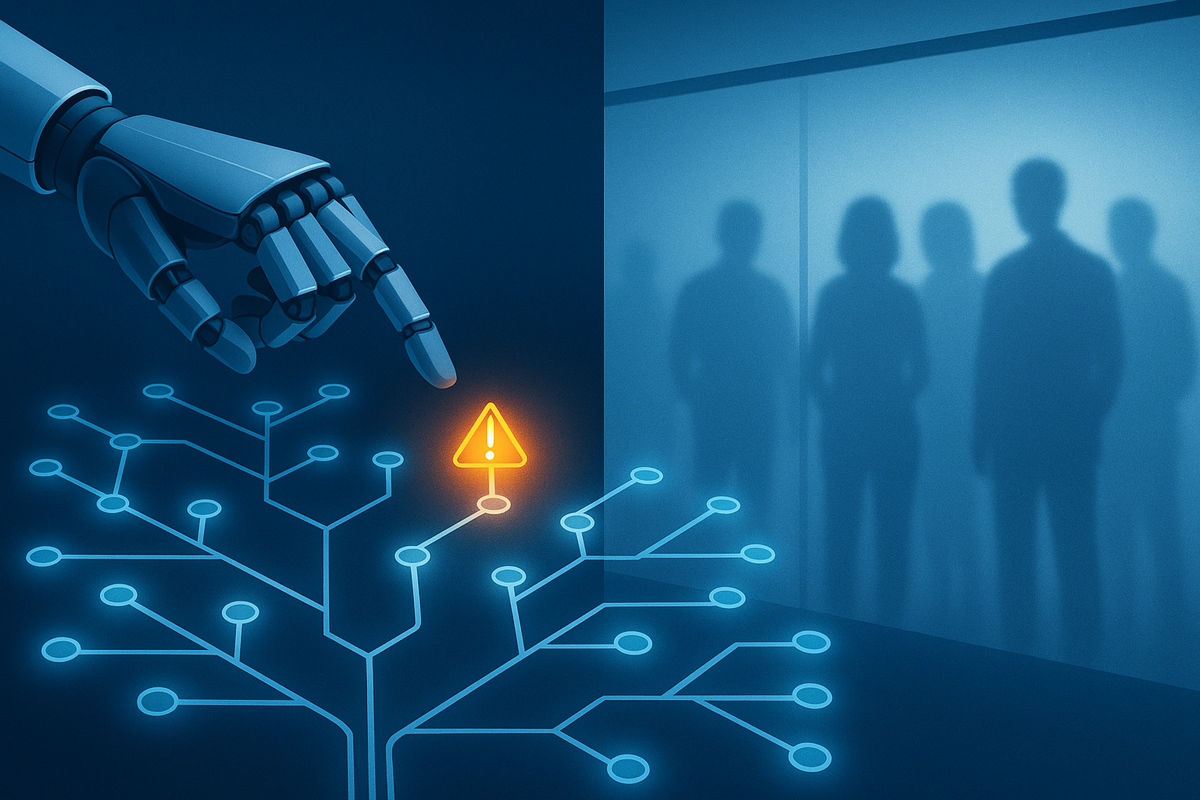
There is a meeting happening right now in hundreds of enterprise engineering organizations. A backend architect is standing at a whiteboard, drawing boxes and arrows that represent a multi-agent AI system. The boxes have labels like "Orchestrator Agent," "Data Retrieval Agent," "Approval Agent," and "Execution Agent." The arrows have latency budgets next to them. Someone in the room is asking about p99 response times. Someone else is debating retry logic and circuit breaker thresholds.
Nobody from Legal is in that room. Nobody from Finance. Nobody from Operations or Compliance. They will be invited later, the team assumes, once the system is "ready to review." That assumption is one of the most expensive mistakes the modern enterprise is making with agentic AI, and the bill is only just beginning to arrive.
This is an opinion piece, and I want to be direct: treating agentic SLA design as a purely engineering problem is not just incomplete, it is structurally dangerous. The reason is not philosophical. It is deeply practical. And the organizations that figure this out before their first multi-agent breach will have a significant competitive and legal advantage over those that figure it out after.
What Makes Agentic SLAs Fundamentally Different
Traditional SLAs are, at their core, performance contracts. They answer questions like: How available is the system? How fast does it respond? What is the acceptable error rate? These are measurable, bounded, and primarily technical in nature. A 99.9% uptime commitment is something an engineering team can define, instrument, and defend in isolation. The blast radius of a failure is well-understood.
Agentic systems break every one of these assumptions simultaneously.
When you deploy a multi-agent architecture, you are no longer deploying a deterministic service. You are deploying a system capable of autonomous decision-making across a chain of interdependent actors. Each agent in that chain can invoke tools, call external APIs, write to databases, trigger financial transactions, send communications, and escalate or de-escalate its own permissions, sometimes all within a single workflow execution that completes in under three seconds.
In this context, "availability" is no longer just about uptime. It is about whether the agent was available to make the right kind of decision under the right constraints. "Latency" is no longer just about response time. It is about whether the agent had enough time to consult the right guardrails before acting. "Error rate" is no longer just about HTTP 500s. It is about whether an agent took an action that was technically successful but operationally, legally, or financially incorrect.
These are not engineering metrics. They are organizational risk metrics wearing engineering clothing.
The Compounding Problem of Agent-to-Agent Trust
Here is where things get genuinely complex in ways that most SLA frameworks are not equipped to handle. In a multi-agent system, agents delegate to other agents. An orchestrator agent may spin up a sub-agent with a subset of its permissions, or it may grant a downstream agent broader access than a human reviewer would have approved if asked explicitly.
This creates what I call the trust compounding problem: each hop in the agent chain introduces a new layer of assumed authorization that was never explicitly granted by a human, never reviewed by Legal for liability exposure, never stress-tested by Finance for financial risk, and never mapped by Operations against existing approval workflows.
When that chain eventually produces an outcome that causes harm, whether that is a misconfigured data access that violates a customer's privacy rights, an automated procurement action that bypasses a spending threshold, or a customer-facing communication that contradicts a regulatory disclosure requirement, the question of accountability becomes genuinely unanswerable with the tools engineering built the SLA around.
Who is responsible? The agent that acted? The orchestrator that delegated? The team that wrote the system prompt? The platform that hosted the model? The SLA document that never defined what "correct behavior" meant in the first place?
This is not a hypothetical. As of early 2026, legal and compliance teams at several large financial institutions and healthcare organizations are actively working through exactly these questions following internal agentic system incidents that their engineering SLAs flagged as "within acceptable parameters" while their legal and operations teams were simultaneously dealing with the real-world fallout.
What Happens When Legal Is Left Out Until After the Breach
The pattern is consistent enough to describe as a failure mode. It goes like this:
- Engineering designs the agentic system with SLAs focused on performance, reliability, and task completion rate.
- The system goes to production with Legal and Compliance signing off on a high-level architecture review that did not include the SLA document, because nobody thought the SLA document was a legal artifact.
- The system performs well by every metric the engineering team defined. Task completion is high. Latency is within budget. Error rates are low.
- An agent takes an action that is technically within its defined parameters but operationally catastrophic: a contract clause gets auto-accepted that should have required human sign-off, a customer account gets modified in a way that violates a consent agreement, a financial reconciliation agent flags and resolves a discrepancy in a way that misclassifies revenue.
- Legal is brought in and immediately asks: "What does the SLA say about authorization boundaries?" The answer is that it does not say anything about authorization boundaries, because that was not seen as an SLA concern.
- The post-mortem reveals that the SLA was never a governance document. It was a performance document. And nobody thought to write the governance document.
The cost of this failure mode is not just the immediate incident. It is the retroactive legal exposure, the regulatory scrutiny, the customer trust damage, and the internal organizational friction that follows when Legal, Finance, and Operations suddenly demand to be involved in every future AI deployment at a level of detail that slows everything down by months.
The irony is that involving them earlier would have been faster and cheaper by a wide margin.
What a Cross-Functional Agentic SLA Actually Looks Like
I want to be constructive here, not just critical. So let me outline what a properly designed agentic SLA looks like when the right stakeholders are in the room from the beginning.
1. Authorization Boundary Definitions (Legal and Compliance)
Every agent in the system needs a clearly documented authorization envelope: what it can do, what it cannot do, and under what conditions it must pause and escalate to a human. These are not just system prompt instructions. They are legal commitments that need to be reviewed and signed off by Legal the same way a vendor contract is reviewed. The SLA must define what happens when an agent operates outside its authorization envelope, including incident classification, notification timelines, and remediation obligations.
2. Financial Exposure Thresholds (Finance)
Any agentic system that can trigger financial transactions, approve expenditures, modify pricing, or affect revenue recognition needs explicit financial guardrails that Finance has reviewed and approved. These thresholds need to be part of the SLA, not just the system configuration. If an agent can autonomously approve a purchase order up to $10,000, that limit is a financial governance decision, not an engineering decision. Finance needs to own it, audit it, and be alerted when it is approached or breached.
3. Operational Handoff Protocols (Operations)
Multi-agent systems will fail. Agents will get stuck, produce ambiguous outputs, or encounter scenarios outside their training distribution. The SLA must define exactly how and when the system hands off to a human operator, what information is surfaced at handoff, what the human's decision window is, and what happens if no human responds within that window. Operations needs to design these protocols because they are the ones who will execute them at 2 a.m. on a Sunday.
4. Audit Trail and Explainability Commitments (Compliance and Legal)
Every consequential action taken by an agent in the system must be logged in a way that is legally defensible. This means not just logging what the agent did, but logging why it believed it was authorized to do it, what context it was operating under, and what alternatives it considered. Compliance teams need to define what "legally defensible" means in your specific regulatory context. Engineers cannot make that determination alone.
5. Breach Classification and Escalation (All Stakeholders)
The SLA must define what constitutes a breach in terms that all stakeholders recognize. An engineering breach (p99 latency exceeded) is categorically different from a legal breach (agent acted outside its authorization envelope) or a financial breach (agent exceeded spending authority). Each breach type needs its own classification, escalation path, notification requirement, and remediation standard. Conflating them into a single SLA tier system is a recipe for the wrong people being notified about the wrong things.
The Organizational Culture Problem Underneath the Technical One
None of the above is technically difficult to implement. The hard part is organizational. Backend engineering teams have historically owned SLA design because SLAs were historically engineering documents. That ownership made sense when the systems being described were stateless APIs and data pipelines. It no longer makes sense when the systems being described are autonomous decision-making agents with real-world consequences.
The resistance to cross-functional SLA design tends to come from two directions. Engineers often feel that non-technical stakeholders will slow down development with excessive caution and that Legal and Finance "don't understand the system well enough to define its constraints." Legal and Finance, for their part, often feel that AI systems are "IT's problem" until something goes wrong, at which point they become everyone's problem simultaneously.
Both of these postures need to change. Agentic systems are not IT systems with a smarter API. They are organizational decision-making systems that happen to run on infrastructure. That distinction changes who needs to be in the room, what documents need to be produced, and who has signing authority over what.
The engineering teams that recognize this earliest will not be the ones who slow down. They will be the ones who build agentic systems that actually survive contact with the enterprise at scale, because they will have built the governance scaffolding that allows those systems to be trusted, audited, extended, and defended.
A Word to the CTOs and VPs of Engineering Reading This
If your backend teams are currently designing agentic SLAs without Legal, Finance, and Operations in the room, you have a structural gap in your AI governance posture. The question is not whether that gap will be exposed. It is whether it will be exposed on your terms, through a proactive governance review, or on the market's terms, through an incident that forces the conversation under the worst possible conditions.
The organizations getting this right in 2026 are treating agentic SLA design the way they treat financial controls design: as a cross-functional, legally reviewed, operationally validated artifact that engineering implements but does not solely define. That shift is not a bureaucratic burden. It is a competitive moat, because it allows them to deploy agentic systems faster and with more confidence than competitors who are still treating every deployment as a pure engineering exercise.
The whiteboard with the boxes and arrows is a starting point. It is not a governance document. And in the age of agentic AI, the gap between those two things is where the real risk lives.
Conclusion: The Room Has to Get Bigger
The enterprise backend engineering community is extraordinarily good at solving hard technical problems. Multi-agent orchestration, context window management, tool-use reliability, latency optimization across agent chains: these are genuinely difficult challenges, and the progress made on them over the past few years has been remarkable.
But the hardest problem in agentic AI deployment is not technical. It is organizational. It is the problem of building systems that make consequential decisions at machine speed within a legal, financial, and operational context that was designed for human-speed decision-making. Solving that problem requires more than better engineering. It requires a fundamentally different model of who owns SLA design and what an SLA is actually supposed to guarantee.
The room has to get bigger. Legal needs a chair. Finance needs a chair. Operations needs a chair. And the conversation needs to happen before the first agent takes its first consequential action, not after the first breach makes it unavoidable.
Because by then, the most important decisions will already have been made. Just not by you.



