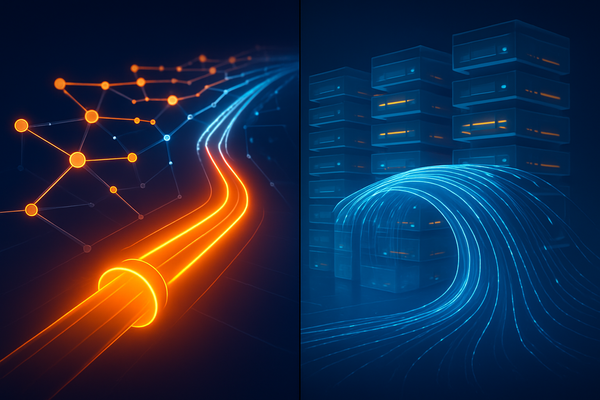
Multi-Tenant Architecture

The Edge Is Coming for Your Agentic Platform: What Backend Engineers Building Multi-Tenant LLM Systems Must Do Right Now

Agentic AI

The Edge Is Coming for Your Agentic Platform: What Backend Engineers Building Multi-Tenant LLM Systems Must Do Right Now

There is a quiet disruption building at the infrastructure layer of every multi-tenant agentic platform, and most backend engineers are not watching it closely enough. While the industry's collective attention has been fixed on orchestration frameworks, tool-calling reliability, and context window sizes, a fundamentally different compute model has

By Scott Miller
FAQ: Why Backend Engineers Building Multi-Tenant AI Agent Platforms in 2026 Must Stop Treating Secrets Rotation as a One-Time Provisioning Step

AI Security

FAQ: Why Backend Engineers Building Multi-Tenant AI Agent Platforms in 2026 Must Stop Treating Secrets Rotation as a One-Time Provisioning Step

If you are building a multi-tenant AI agent platform in 2026, you are operating at the intersection of two of the most demanding engineering disciplines: large-scale SaaS infrastructure and autonomous AI orchestration. The stakes have never been higher. Enterprises are now trusting these platforms with sensitive credentials, customer data, and

By Scott Miller
How Multi-Tenant AI Agent Pipelines Break Under Concurrent Long-Running Tool Calls: A Deep Dive Into Async Timeout Budgeting and Per-Tenant Deadline Propagation

AI Agents

How Multi-Tenant AI Agent Pipelines Break Under Concurrent Long-Running Tool Calls: A Deep Dive Into Async Timeout Budgeting and Per-Tenant Deadline Propagation

You ship a beautiful multi-tenant AI agent platform. Dozens of enterprise customers run their workflows through it simultaneously. Everything looks fine in staging. Then, on a Tuesday afternoon with peak load, a single slow third-party API call from one tenant silently bleeds into another tenant's deadline budget, a

By Scott Miller
Beginner's Guide to AI Agent Deployment Rollback Strategies: How Backend Engineers Can Build Automated Version Reversion Pipelines That Protect Multi-Tenant Stability

AI deployment

Beginner's Guide to AI Agent Deployment Rollback Strategies: How Backend Engineers Can Build Automated Version Reversion Pipelines That Protect Multi-Tenant Stability

It is March 2026, and the AI model release cadence has never been more relentless. In the past twelve months alone, major labs and cloud providers have shipped hundreds of foundational model updates, fine-tuned variants, and agent framework versions into production environments. For backend engineers managing multi-tenant platforms, this surge

By Scott Miller
7 Ways Backend Engineers Are Mistakenly Treating AI Agent Rate Limit Handling as a Simple Retry Problem (And Why Naive Exponential Backoff Is Quietly Starving High-Priority Tenants in Multi-Tenant LLM Pipelines)

AI Engineering

7 Ways Backend Engineers Are Mistakenly Treating AI Agent Rate Limit Handling as a Simple Retry Problem (And Why Naive Exponential Backoff Is Quietly Starving High-Priority Tenants in Multi-Tenant LLM Pipelines)

There is a quiet crisis unfolding inside production LLM pipelines right now, and most backend engineers are not even aware they are causing it. As AI agent architectures have matured through 2025 and into 2026, teams have scaled their systems from single-tenant prototypes into complex, multi-tenant platforms serving dozens or

By Scott Miller
7 Ways Backend Engineers Are Mistakenly Treating AI Agent Dependency Version Pinning as a DevOps Afterthought (And Why Unpinned LLM SDK Releases Are Silently Breaking Multi-Tenant Tool-Call Contracts in 2026)

AI Agents

7 Ways Backend Engineers Are Mistakenly Treating AI Agent Dependency Version Pinning as a DevOps Afterthought (And Why Unpinned LLM SDK Releases Are Silently Breaking Multi-Tenant Tool-Call Contracts in 2026)

There is a quiet crisis unfolding inside production AI systems right now, and most backend engineers do not even know it is happening. Somewhere between the excitement of shipping agentic features and the operational reality of maintaining them, a dangerous assumption took root: that managing LLM SDK dependencies is someone

By Scott Miller
7 Ways Backend Engineers Are Misconfiguring AI Agent State Synchronization Across Distributed Worker Pools (And Why Stale Shared Context Is Quietly Corrupting Multi-Tenant Workflow Outputs in 2026)

AI Agents

7 Ways Backend Engineers Are Misconfiguring AI Agent State Synchronization Across Distributed Worker Pools (And Why Stale Shared Context Is Quietly Corrupting Multi-Tenant Workflow Outputs in 2026)

There is a class of production bug that does not crash your system. It does not trigger an alert. It does not show up in your p99 latency dashboards. It just quietly, persistently, and invisibly corrupts the outputs of your AI-powered workflows, one tenant at a time. Welcome to the

By Scott Miller