AI pipelines

5 Dangerous Myths Enterprise Backend Teams Still Believe About Multi-Agent Pipeline Observability (And Why They Lead to Silent Production Disasters)

multi-agent AI

5 Dangerous Myths Enterprise Backend Teams Still Believe About Multi-Agent Pipeline Observability (And Why They Lead to Silent Production Disasters)

It starts quietly. A customer support agent returns subtly wrong answers for three days. A data enrichment pipeline silently truncates records. A code-generation agent hallucinates a dependency that slips past review and lands in a release branch. Nobody sets off an alarm. Nobody files a ticket. And then, one Thursday

By Scott Miller
Event-Driven vs. Request-Response Agent Coordination: Which Multi-Agent Pipeline Pattern Actually Survives the Q3 2026 Stateful Migration Wave?

Multi-Agent Systems

Event-Driven vs. Request-Response Agent Coordination: Which Multi-Agent Pipeline Pattern Actually Survives the Q3 2026 Stateful Migration Wave?

Something quietly shifted in enterprise backend engineering conversations between late 2025 and the first half of 2026. The question used to be whether to adopt multi-agent AI pipelines. Now the question is how to wire them together when the workloads being migrated are stateful, long-running, and deeply embedded in production

By Scott Miller
Centralized Agent Registry vs. Decentralized Service Mesh Discovery: Which Multi-Agent Pipeline Topology Actually Survives Enterprise Zero-Trust Mandates in Q4 2026?

multi-agent AI

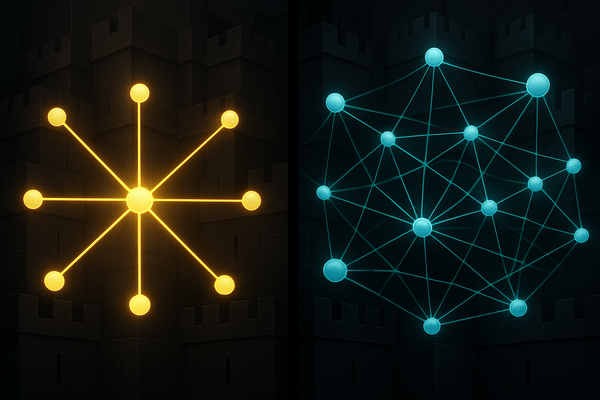
Centralized Agent Registry vs. Decentralized Service Mesh Discovery: Which Multi-Agent Pipeline Topology Actually Survives Enterprise Zero-Trust Mandates in Q4 2026?

There is a question quietly tearing apart architecture review boards at Fortune 500 companies right now: when your zero-trust mandate finally reaches the on-premises AI cluster, which multi-agent pipeline topology do you keep? The one that is elegant and centrally governed, or the one that is resilient and self-discovering? This

By Scott Miller
5 Dangerous Myths Enterprise Backend Teams Believe About Multi-Agent Pipeline Compute Scaling (And Why the 2026 Datacenter Boom Didn't Fix Them)

multi-agent AI

5 Dangerous Myths Enterprise Backend Teams Believe About Multi-Agent Pipeline Compute Scaling (And Why the 2026 Datacenter Boom Didn't Fix Them)

The announcements came fast and loud. Through the first half of 2026, hyperscalers and sovereign cloud providers rolled out some of the most aggressive datacenter expansion commitments in history. New gigawatt-class AI campuses broke ground across the American Southwest, Northern Europe, and Southeast Asia. GPU cluster availability, once a source

By Scott Miller
FAQ: What Enterprise Backend Teams Must Know About Designing Multi-Agent Pipeline Graceful Degradation Strategies When Foundation Model Providers Issue Unplanned Capability Deprecations Mid-Contract in H2 2026

multi-agent AI

FAQ: What Enterprise Backend Teams Must Know About Designing Multi-Agent Pipeline Graceful Degradation Strategies When Foundation Model Providers Issue Unplanned Capability Deprecations Mid-Contract in H2 2026

It is H2 2026, and the enterprise AI landscape has never moved faster or been more fragile. Backend teams that spent the first half of this year carefully wiring together multi-agent pipelines now face a new class of operational nightmare: unplanned capability deprecations from foundation model providers. Whether it is

By Scott Miller
How to Build a Multi-Agent Pipeline Token Budget Enforcement System That Automatically Throttles Runaway Agents Before They Exhaust Monthly Foundation Model API Quotas Mid-Sprint

multi-agent AI

How to Build a Multi-Agent Pipeline Token Budget Enforcement System That Automatically Throttles Runaway Agents Before They Exhaust Monthly Foundation Model API Quotas Mid-Sprint

It happens to nearly every engineering team running multi-agent AI systems at scale: you are three weeks into a four-week sprint, your agents are humming along, and then suddenly the CI pipeline goes red. Not because of a bug. Not because of a bad deployment. Because your team just burned

By Scott Miller
5 Dangerous Myths Enterprise Backend Teams Believe About Multi-Agent Pipeline Secrets Management That Will Expose Sensitive Credentials Across Distributed Agent Runtimes

Secrets Management

5 Dangerous Myths Enterprise Backend Teams Believe About Multi-Agent Pipeline Secrets Management That Will Expose Sensitive Credentials Across Distributed Agent Runtimes

The shift toward multi-agent AI pipelines in enterprise environments has been one of the most defining architectural movements of the past two years. Orchestrators spawn sub-agents. Sub-agents call tools. Tools authenticate against APIs, databases, and internal services. And somewhere in that chain, credentials are flowing, often in ways that no

By Scott Miller
5 Dangerous Myths Enterprise Backend Teams Believe About Multi-Agent Pipeline Memory Architecture That Will Cause Silent Data Poisoning Across Long-Running Agentic Workflows in 2026

multi-agent AI

5 Dangerous Myths Enterprise Backend Teams Believe About Multi-Agent Pipeline Memory Architecture That Will Cause Silent Data Poisoning Across Long-Running Agentic Workflows in 2026

Your production agentic system has been running for six weeks. The orchestrator agent is coordinating three specialized sub-agents. Logs look clean. Latency is nominal. Stakeholders are happy. And somewhere deep inside your shared vector memory store, a corrupted context fragment from Week Two is quietly warping every downstream decision your

By Scott Miller
The Clock Is Ticking: How Enterprise Backend Teams Must Redesign API Key Lifecycle Management for Multi-Agent AI Pipelines Before Short-Lived Credentials Become the Default

multi-agent AI

The Clock Is Ticking: How Enterprise Backend Teams Must Redesign API Key Lifecycle Management for Multi-Agent AI Pipelines Before Short-Lived Credentials Become the Default

There is a quiet deadline approaching that most enterprise backend teams are not ready for. Sometime in late 2026, the major foundation model providers, including the hyperscaler-hosted model APIs and the leading independent LLM platforms, are expected to converge on short-lived, time-bound credential standards as the default authentication mechanism for

By Scott Miller
Synchronous RPC vs. Async Event Streaming for Enterprise Multi-Agent Pipelines: Which Architecture Survives Unpredictable Foundation Model Latency?

multi-agent AI

Synchronous RPC vs. Async Event Streaming for Enterprise Multi-Agent Pipelines: Which Architecture Survives Unpredictable Foundation Model Latency?

There is a quiet crisis unfolding inside enterprise AI infrastructure teams right now. As Q3 2026 consumption-based pricing models from major foundation model providers continue to reshape budget planning, a latency problem that was once academic has become brutally operational: your inter-agent communication architecture is either absorbing the shock of

By Scott Miller