Synchronous Human Review vs. Asynchronous Audit Trails: Which Multi-Agent Pipeline Accountability Model Satisfies EU AI Act High-Risk Requirements Without Destroying Throughput
The clock is ticking. With the EU AI Act's August 2026 deadline for high-risk system registration rapidly approaching, engineering teams building multi-agent AI pipelines are facing a dilemma that sits squarely at the intersection of legal compliance and operational reality: how do you maintain meaningful human accountability over autonomous agent chains without grinding your throughput to a halt?
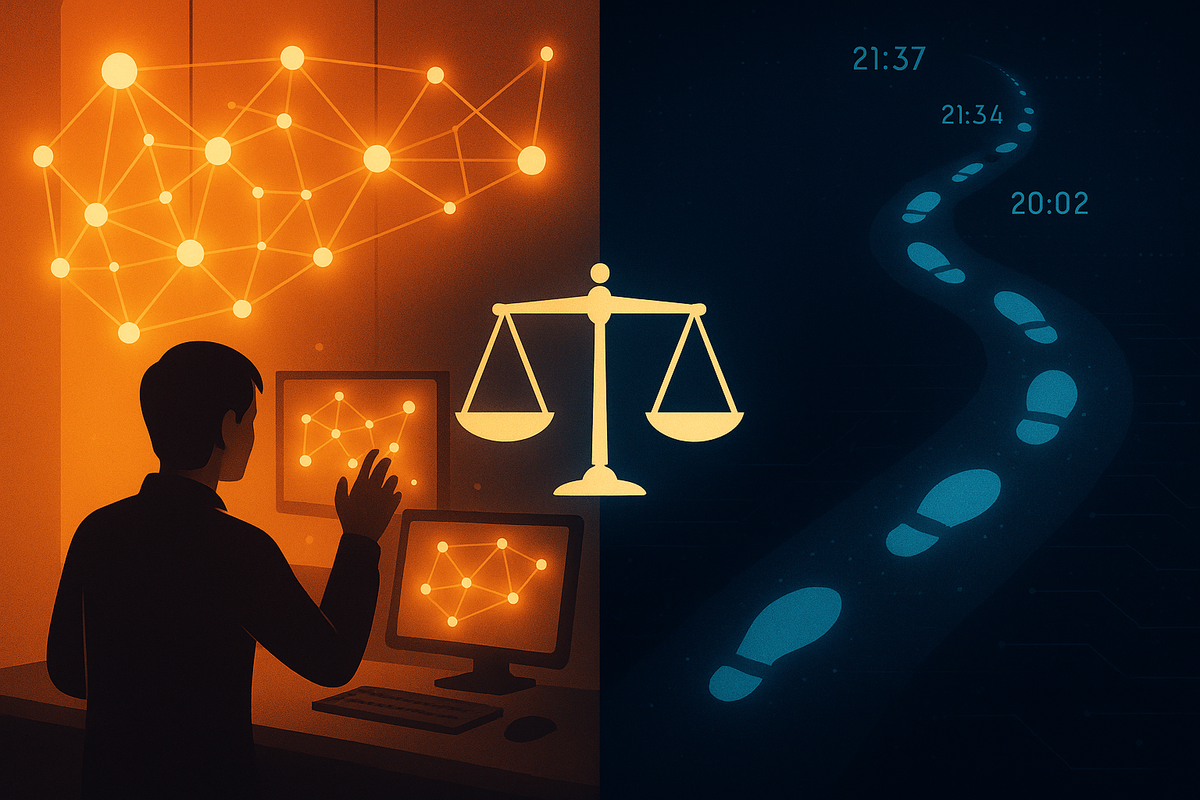
Two competing architectural philosophies have emerged as the front-runners for satisfying Article 14's human oversight requirements and the broader high-risk system obligations under Annex III. The first is synchronous human review, where a human approves, validates, or intervenes at defined checkpoints before the pipeline advances. The second is asynchronous audit trails, where the pipeline runs at full speed and humans review a structured, immutable log of decisions after the fact, with the ability to trigger rollbacks or corrections.
Neither model is universally correct. But depending on your system's risk profile, latency tolerance, and the specific Annex III category you fall under, one will almost certainly serve you better than the other. This article breaks down both models in detail, maps them against the actual regulatory text, and gives you a practical framework for choosing before the registration window closes.
Understanding What the EU AI Act Actually Demands from High-Risk Systems
Before comparing architectures, it is worth being precise about what the regulation requires. The EU AI Act classifies high-risk AI systems under Annex III, covering domains such as critical infrastructure, employment and worker management, access to essential private and public services, law enforcement, migration and border control, and administration of justice. If your multi-agent pipeline touches any of these verticals, you are operating in high-risk territory.
The core human oversight obligations come from Article 14, which requires that high-risk AI systems be designed and developed in such a way that they can be effectively overseen by natural persons during the period in which the AI system is in use. Specifically, the system must:
- Allow designated persons to fully understand the system's capacities and limitations
- Enable oversight persons to monitor operation and detect anomalies, dysfunctions, and unexpected performance
- Allow designated persons to intervene in or interrupt the system through a "stop" button or similar procedure
- Ensure that oversight persons can interpret outputs before acting on them
Critically, Article 14 does not mandate that a human approve every individual output in real time. It mandates that meaningful oversight is possible and effective. This distinction is the entire hinge point of the synchronous vs. asynchronous debate.
Additionally, Article 12 requires logging capabilities that enable post-deployment monitoring and auditing, and Article 9 demands a continuous risk management system. Together, these articles create a compliance surface that both architectural models must satisfy, but they satisfy it in very different ways.
Model 1: Synchronous Human Review
How It Works
In a synchronous review model, the multi-agent pipeline pauses at one or more defined human-in-the-loop (HITL) checkpoints before proceeding. A human reviewer receives a summary of the agent's reasoning, proposed action, and confidence level, then approves, rejects, or modifies the output before the next agent in the chain receives it as input.
Think of it as a series of gates. Agent A completes its task, the output lands in a review queue, a human signs off, and only then does Agent B begin. In more sophisticated implementations, the checkpoint is risk-stratified: low-confidence outputs or outputs above a certain impact threshold trigger a human gate, while routine, high-confidence outputs pass through automatically.
Where Synchronous Review Excels
Synchronous review has one undeniable advantage: it is the most defensible compliance posture you can adopt. When an EU AI Act auditor or national market surveillance authority asks "how do you ensure human oversight," you can point to a timestamped, reviewer-identified gate that was traversed before consequential action was taken. This is especially powerful for systems operating in law enforcement analytics, credit scoring, or employment screening, where a single erroneous output can have severe, irreversible consequences for an individual.
It also aligns cleanly with the spirit of Recital 48, which emphasizes that human oversight should be "effective" and not merely nominal. A rubber-stamp asynchronous review process is far more vulnerable to regulatory challenge than a synchronous gate that demonstrably paused the pipeline.
The Throughput Problem
The liability is equally obvious. Synchronous review introduces human latency into the critical path. For pipelines processing thousands of decisions per hour, requiring even a 2-minute human review per output creates a queue that no team can realistically staff. The math is brutal: at 5,000 decisions per hour with a 2-minute review time, you need approximately 167 concurrent reviewers just to keep pace. That is not a compliance strategy; it is a staffing crisis.
This is why pure synchronous review is largely impractical for high-volume pipelines. The teams that make it work do so through intelligent triage: using a classifier or risk-scoring model to route only the highest-risk outputs to human review, while lower-risk outputs proceed with enhanced logging. This hybrid approach is viable, but it introduces a new compliance question: is the triage classifier itself a high-risk AI system that requires its own oversight framework?
Model 2: Asynchronous Audit Trails
How It Works
In the asynchronous model, the pipeline runs at full speed. Every agent action, input, output, intermediate reasoning step, confidence score, tool call, and environmental state is captured in a structured, immutable, cryptographically signed log. Human reviewers work through this log on a separate timeline, flagging anomalies, triggering rollbacks where the system allows, and feeding findings back into the risk management process under Article 9.
The pipeline never waits for a human. The human review is a continuous, parallel workstream rather than a gate in the critical path. Modern implementations use vector-indexed log stores, semantic search over agent reasoning chains, and anomaly detection models to surface the most review-worthy events automatically, making human time far more efficient.
Where Asynchronous Audit Trails Excel
The throughput advantage is self-evident, but the compliance advantages are less obvious and worth articulating carefully. A well-designed asynchronous audit trail can actually produce richer oversight evidence than a synchronous checkpoint. A human reviewer at a synchronous gate sees a snapshot; an asynchronous reviewer sees the full chain of reasoning, every tool call, every intermediate state, and every alternative the agent considered before reaching its conclusion.
This depth of record satisfies Article 12's logging requirements comprehensively. It also supports the post-market monitoring obligations under Article 72, which require providers of high-risk systems to actively collect and review data on system performance after deployment. An asynchronous audit infrastructure built for compliance is, almost by definition, a post-market monitoring system as well.
For systems registered under Annex III categories where decisions are inherently reviewable before they produce real-world effects (such as a job application scoring system where a human hiring manager still makes the final call), asynchronous review can satisfy Article 14 cleanly. The AI system's output is logged before it influences any human decision, and the oversight person has full visibility into how that output was generated.
The Compliance Risk
The weakness of the asynchronous model is the gap between action and review. If an agent in your pipeline takes a consequential action and a human reviewer only sees it three hours later, the harm may already be done and irreversible. This is the scenario that Article 14's intervention and "stop" capability requirement is designed to prevent.
Regulators, particularly those in the French CNIL and the German BNetzA who have been most active in early AI Act enforcement discussions, have signaled skepticism toward compliance models where human review is entirely decoupled from action. An asynchronous model that cannot demonstrate a credible rollback or correction mechanism tied to the review process will struggle under scrutiny.
Head-to-Head Comparison: The Five Dimensions That Matter
1. Regulatory Defensibility
Synchronous review wins on pure defensibility, particularly for Annex III categories with high individual impact. However, a well-documented asynchronous model with a credible correction mechanism can be defensible for categories where downstream human decision-makers remain in the loop.
2. Throughput and Latency
Asynchronous audit trails win decisively. There is no contest here. Any synchronous gate introduces human latency into the critical path. For pipelines processing more than a few hundred decisions per hour, synchronous review at scale requires either massive staffing or aggressive triage logic, both of which introduce their own complexity and cost.
3. Audit Evidence Quality
Asynchronous audit trails win, provided the logging infrastructure is well-designed. Full reasoning chain capture, tool call logs, and intermediate state snapshots provide far richer evidence than a reviewer's approval timestamp at a synchronous gate.
4. Rollback and Intervention Capability
Synchronous review wins for systems where actions are irreversible once taken. If your pipeline's agents are executing transactions, modifying records, or triggering real-world processes, the ability to stop before action is taken is qualitatively different from the ability to roll back after.
5. Operational Complexity and Cost
This one is context-dependent. Synchronous review is operationally simple to explain but expensive to staff at scale. Asynchronous audit infrastructure requires significant upfront engineering investment in log architecture, anomaly detection, and reviewer tooling, but amortizes that cost across high volumes efficiently.
The Practical Answer: A Tiered Hybrid Architecture
The most defensible and operationally viable approach for most high-risk multi-agent pipelines heading into the August 2026 registration deadline is neither pure model. It is a tiered hybrid that uses action reversibility and impact magnitude as the primary routing dimensions.
Here is how to think about structuring it:
- Tier 1 (Synchronous Gate Required): Any agent action that is irreversible and directly consequential to an individual covered under an Annex III category. Examples include initiating a denial of service, flagging a person for law enforcement escalation, or executing a financial transaction above a defined threshold. These actions must pass through a synchronous human gate, full stop.
- Tier 2 (Asynchronous with Bounded Review Window): Actions that are reversible within a defined time window (say, 4 hours) and have moderate individual impact. These proceed immediately but are flagged for priority asynchronous review. The system must have a credible rollback mechanism that can be triggered within the review window. This satisfies Article 14's intervention requirement without blocking the pipeline.
- Tier 3 (Asynchronous with Statistical Sampling): Routine, low-impact, high-confidence outputs where the downstream human decision-maker retains effective control. Full logging applies, but human review is conducted on a statistically significant sample rather than every record. This is appropriate for outputs that inform rather than determine a consequential decision.
The critical compliance engineering task is building the triage classifier that routes outputs to the correct tier. This classifier must itself be documented, tested, and subject to the risk management process under Article 9. Its false-negative rate (incorrectly routing a Tier 1 action to Tier 3) is your primary compliance risk surface.
What You Need to Document Before August 2026
Regardless of which model you choose, the registration process requires you to have the following documentation ready for submission to your national competent authority and for entry into the EU AI Act database:
- A technical specification describing your human oversight mechanism, including which agents in the pipeline are subject to which tier of review
- A risk management system record under Article 9 that identifies the residual risks associated with your chosen oversight model and the mitigations in place
- Logging architecture documentation demonstrating compliance with Article 12, including log retention periods, access controls, and integrity verification
- Evidence of human reviewer training and qualification under Article 14(4), showing that designated oversight persons understand the system's capabilities and limitations
- A documented incident response and rollback procedure that maps to your tier architecture
Conclusion: The Compliance Question Is Really an Architecture Question
The synchronous vs. asynchronous debate is ultimately not a legal question with a single right answer. It is an architecture question that the law has made consequential. The EU AI Act's human oversight requirements are written with enough flexibility to accommodate both models, but not with enough flexibility to excuse sloppy implementations of either.
Pure synchronous review at scale is a staffing fantasy for most high-volume pipelines. Pure asynchronous review without a credible intervention mechanism is a compliance liability waiting to be tested by an enforcement action. The tiered hybrid, built around action reversibility and impact magnitude, is where serious engineering teams are landing in early 2026.
With the August 2026 registration deadline now months away rather than years away, the time for architectural debate is narrowing fast. The teams that will navigate this well are the ones that treat their oversight model as a first-class engineering artifact, not an afterthought bolted onto a pipeline that was designed without compliance in mind. Build the triage logic, instrument the logs, define the rollback procedures, and document everything. The auditors are coming, and "we move fast" is not an Article 14 defense.



