Synchronous AI Agent Orchestration vs. Event-Driven Agent Choreography: Which Multi-Agent Coordination Model Should Enterprise Backend Teams Choose in H2 2026?
By mid-2026, the question is no longer whether your enterprise backend will run multi-agent AI workflows. It is how those agents will coordinate with each other when things get complicated. And things always get complicated.
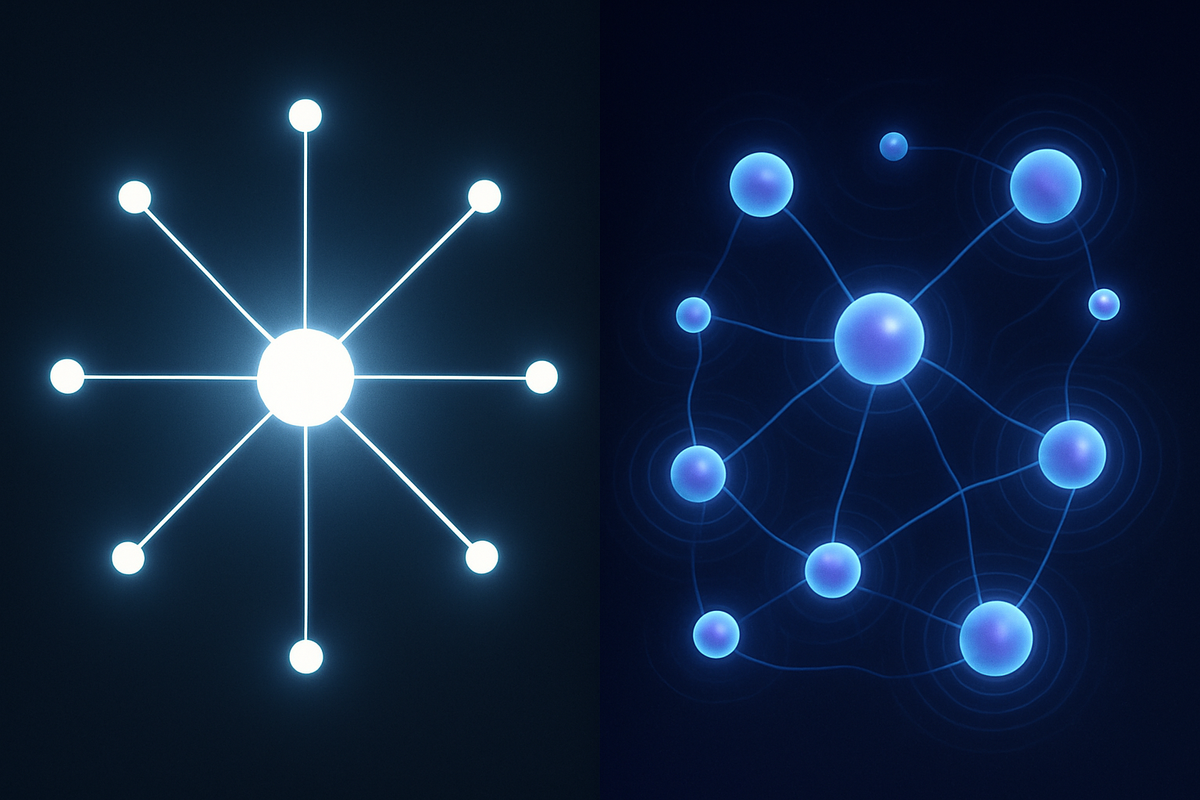
Two architectural philosophies have emerged as the dominant contenders for enterprise-grade multi-agent systems: synchronous orchestration, where a central controller agent directs subordinate agents in a defined sequence, and event-driven choreography, where agents react autonomously to events on a shared message bus with no single point of command. Both models work. Both have been deployed in production. And both will fail you in spectacular ways if you choose the wrong one for the wrong context.
This article cuts through the framework marketing and the conference-talk abstractions to give enterprise backend teams a concrete, decision-ready comparison. We will examine latency tolerance, fault isolation, observability, developer experience, and operational cost, because in H2 2026, the stakes of getting this wrong are not just architectural. They are directly tied to revenue, compliance, and competitive positioning.
Setting the Stage: Why This Decision Matters More Now Than It Did a Year Ago
Throughout 2025, most enterprise teams were still experimenting with single-agent pipelines or simple two-agent handoffs. The tooling was immature, the patterns were borrowed from microservices, and the failure modes were poorly understood. That era is over.
In H2 2026, enterprise backend teams are deploying multi-agent systems with anywhere from four to forty specialized agents handling tasks like document analysis, compliance checking, customer intent resolution, financial reconciliation, and real-time fraud scoring. The coordination layer between those agents is no longer a footnote in the architecture diagram. It is the architecture.
Frameworks like LangGraph, AutoGen 2.x, CrewAI Enterprise, and the emerging open standard around the Agent Communication Protocol (ACP) have all taken strong stances on coordination models. But frameworks are not strategies. Your team still has to choose, and the choice has real engineering consequences.
Understanding the Two Models
Synchronous Orchestration: The Central Commander
In a synchronous orchestration model, a designated orchestrator agent holds the execution plan. It calls sub-agents in sequence or in parallel, waits for their responses, evaluates results, and decides what happens next. The orchestrator is the single source of truth for workflow state at any given moment.
Think of it like a general contractor on a job site. The contractor calls the electrician, waits for the wiring to be done, inspects it, and only then calls the plumber. Nothing happens without the contractor's explicit direction.
Key structural characteristics of synchronous orchestration include:
- Request-response communication: Each agent call blocks until a result is returned or a timeout is triggered.
- Centralized state management: The orchestrator owns the workflow context, making it easy to reason about current progress.
- Explicit control flow: Branching, retries, and conditional logic live in one place, typically in the orchestrator's planning layer or a defined graph structure.
- Tight coupling on the happy path: When everything works, the workflow is predictable and traceable end-to-end.
Event-Driven Choreography: The Autonomous Ensemble
In an event-driven choreography model, there is no central commander. Instead, agents subscribe to event streams or message queues, react to specific event types, perform their work, and emit new events that other agents may consume. The workflow emerges from the collective behavior of independently operating agents.
Think of it like a jazz ensemble. Each musician listens to the others, responds to what they hear, and contributes their part without a conductor dictating every note. The music coheres because each player understands the shared structure, not because someone is issuing instructions.
Key structural characteristics of event-driven choreography include:
- Asynchronous, non-blocking communication: Agents publish and consume events without waiting for downstream acknowledgment.
- Decentralized state: Each agent manages its own state slice; global workflow state must be reconstructed from the event log.
- Loose coupling: Agents do not know about each other directly; they only know about event schemas.
- Emergent control flow: The overall workflow behavior is a product of agent subscriptions and reactions rather than explicit programming in one place.
The Core Tension: Latency Tolerance vs. Fault Isolation
Here is where the real engineering trade-off lives. Most architecture comparisons treat latency and fault isolation as separate concerns. In multi-agent systems, they are deeply entangled, and understanding that entanglement is the key to making the right choice.
Latency Tolerance in Orchestration
Synchronous orchestration accumulates latency. If your orchestrator calls Agent A, waits 800ms, then calls Agent B, waits 1.2 seconds, then calls Agent C, the total workflow latency is at minimum the sum of those waits plus orchestrator processing time. In a five-agent sequential pipeline, you can easily hit 5 to 8 seconds of wall-clock time before a user or downstream system sees a result.
This is acceptable, even desirable, in workflows where correctness and sequence matter more than speed. Legal document review, multi-step financial approval, and compliance audit workflows are good examples. These are low-latency-tolerance workflows, meaning the business can tolerate higher latency in exchange for guaranteed sequential integrity.
Where synchronous orchestration breaks down is in high-throughput, latency-sensitive contexts: real-time customer support routing, live pricing engines, or streaming fraud detection. In these scenarios, the blocking nature of synchronous calls creates head-of-line blocking, where one slow agent stalls the entire pipeline.
Latency Tolerance in Choreography
Event-driven choreography decouples latency from workflow progress. An agent that publishes an event and moves on does not wait for the downstream agent to process it. This means individual agent response times do not add up in the same way. A choreography-based system can process multiple workflow branches simultaneously with no single agent acting as a bottleneck.
The trade-off is result latency vs. throughput latency. Choreography systems can process enormous volumes of work concurrently, but if you need a single workflow's final result quickly and deterministically, the asynchronous nature introduces its own delays: message queue lag, consumer polling intervals, and the overhead of event correlation when aggregating results from multiple agents.
Fault Isolation in Orchestration
This is where synchronous orchestration shows its most significant weakness in enterprise deployments. When a sub-agent fails or times out, the orchestrator must handle that failure explicitly. If it does not, the entire workflow halts. The orchestrator becomes a single point of failure amplifier: not only does it fail itself, but it propagates that failure to every workflow it is currently managing.
Retry logic, circuit breakers, and fallback agents can mitigate this, but they add complexity to the orchestrator, which is already the most complex component in the system. Teams often underestimate how much defensive code accumulates in an orchestrator over time as edge cases are discovered in production.
Fault Isolation in Choreography
Event-driven choreography provides natural fault isolation by design. If Agent B fails while processing an event, the event remains in the queue (or dead-letter queue) and other agents are completely unaffected. Agent A has already published its event and moved on. Agent C, which depends on Agent B's output, will simply not receive the downstream event until Agent B recovers and reprocesses.
This is a fundamentally more resilient model for enterprise systems that must maintain partial availability under failure conditions. However, it introduces a different class of problem: silent workflow stalls. In a choreography system, a failed agent does not loudly crash the orchestrator. It quietly stops emitting events, and unless you have robust monitoring on event lag and dead-letter queue depth, you may not notice for minutes or hours that a critical workflow branch has stalled.
Head-to-Head Comparison Across Key Enterprise Dimensions
1. Observability and Debugging
Orchestration wins here, clearly. Because the orchestrator holds workflow state and controls execution, distributed tracing is straightforward. A single trace ID flows through the orchestrator's call stack, and tools like OpenTelemetry with LLM-aware instrumentation can give you a complete picture of what happened, when, and why.
In choreography systems, reconstructing a workflow's execution history requires correlating events across multiple agents using a shared correlation ID. When something goes wrong, you are essentially doing forensic archaeology across your event log. This is solvable with good tooling (Apache Kafka's audit log capabilities and purpose-built agent observability platforms have improved significantly in 2026), but it requires deliberate investment that orchestration gives you almost for free.
2. Developer Experience and Cognitive Load
Orchestration is easier to reason about initially. New team members can read the orchestrator's logic and understand the entire workflow. The control flow is explicit, the dependencies are obvious, and testing is more straightforward because you can mock sub-agents and drive the orchestrator through its decision tree.
Choreography has a steeper learning curve. Understanding the system requires understanding every agent's subscription list, every event schema, and every possible reaction chain. The system behavior is emergent, which means it can surprise even experienced engineers. That said, once the team internalizes the event-driven mental model, individual agents become significantly easier to develop, test, and deploy in isolation.
3. Scalability Under Load
Choreography wins decisively at scale. Because agents are decoupled and communicate through durable message queues, you can scale individual agents independently based on their queue depth. If your document-parsing agent is the bottleneck, you spin up more instances of that agent without touching anything else in the system.
Orchestration systems scale horizontally too, but the orchestrator itself becomes a scaling challenge. Stateful orchestrators are hard to scale horizontally because workflow state is typically tied to a specific orchestrator instance. Solutions like distributed workflow state stores (Temporal, Conductor, and similar tools have added strong multi-agent support in 2026) help, but they add operational complexity.
4. Compliance and Auditability
This one is nuanced and often overlooked. In regulated industries (financial services, healthcare, legal tech), you need to prove exactly what decision was made, by which agent, based on what input, at what time. Orchestration's centralized state makes this audit trail easier to produce. The orchestrator's execution log is essentially a compliance record.
Choreography's event log is actually a richer audit trail in theory, because every event is a timestamped, immutable record of what happened. In practice, however, correlating those events into a coherent compliance narrative requires tooling that many enterprises are still building out. If your compliance team needs to pull an audit report today, orchestration will serve them better. If you are building for the next three years, a well-implemented event log is a more powerful compliance foundation.
5. Change Management and Agent Evolution
Choreography wins for long-term maintainability. Adding a new agent to a choreography system means subscribing it to relevant events and publishing new ones. Existing agents do not need to change. You can introduce new capabilities into the system with zero downtime and minimal risk to existing workflows.
In an orchestration system, adding a new agent typically means modifying the orchestrator's logic, which touches the most critical and complex component in the system. Every orchestrator change carries risk of regressions across all workflows it manages.
The Decision Framework: A Practical Guide for Enterprise Backend Teams
Rather than declaring a universal winner, here is a decision framework based on the specific requirements that matter most to your team in H2 2026.
Choose Synchronous Orchestration When:
- Your workflows are sequential and correctness-dependent: each step must validate before the next begins.
- You need sub-5-second end-to-end latency for individual workflow completions (not throughput).
- Your team is early in multi-agent adoption and needs to move fast with high observability.
- Your compliance requirements demand an easily auditable, centralized execution log.
- The number of agents in your system is relatively small (under ten) and unlikely to grow rapidly.
- Your failure model tolerates workflow-level failures as long as they are loud and fast to detect.
Choose Event-Driven Choreography When:
- Your system processes high volumes of concurrent workflows where throughput matters more than individual latency.
- You need partial availability: the system must keep processing what it can even when individual agents fail.
- Your agent ecosystem is large or growing rapidly, and you need to add capabilities without touching existing components.
- Different agents are owned by different teams and must evolve independently.
- Your workflows are naturally asynchronous: the business process does not require an immediate end-to-end result.
- You have or are building robust event monitoring infrastructure to compensate for reduced native observability.
The Hybrid Approach: What Leading Enterprise Teams Are Actually Doing in 2026
The most sophisticated enterprise backend teams in 2026 are not picking one model and applying it everywhere. They are using orchestration within bounded workflow domains and choreography between those domains.
For example: a financial services platform might use a synchronous orchestrator to manage the five-step loan pre-approval workflow (where sequential correctness is non-negotiable), but connect that orchestrator to a broader event-driven system where the "pre-approval completed" event triggers downstream agents for document collection, credit bureau integration, and compliance flagging, all running independently.
This hybrid model gives you the debuggability and correctness guarantees of orchestration where you need them, and the resilience and scalability of choreography where volume and fault isolation matter most. The key engineering discipline is defining clear domain boundaries and treating the event bus as the contract between orchestrated domains rather than letting the two models bleed into each other in uncontrolled ways.
What to Watch in H2 2026
Several developments are actively reshaping this decision space and deserve attention from enterprise backend teams:
- Agent Communication Protocol (ACP) standardization: As ACP matures toward a stable 1.0 specification, the tooling gap between orchestration and choreography is narrowing. Frameworks that support both models under a unified agent interface are becoming viable, reducing lock-in risk.
- Stateful streaming platforms: Apache Flink and its successors have added first-class support for stateful AI agent workflows, making event-driven choreography significantly easier to implement with strong consistency guarantees.
- Orchestrator-as-Agent patterns: The line between orchestrator and agent is blurring. Modern frameworks are treating the orchestrator itself as a reasoning agent that can dynamically replan workflows, which changes the fault isolation calculus considerably.
- Cost per token at scale: As inference costs continue to drop through H2 2026, the economic argument for aggressive parallelism (a choreography strength) is becoming more nuanced. Teams should revisit their cost models as pricing evolves.
Conclusion: The Right Model Is the One That Matches Your Failure Tolerance
The synchronous orchestration vs. event-driven choreography debate does not have a universal answer, and any vendor or framework that tells you otherwise is selling you something. The right coordination model for your enterprise backend is the one that aligns with how your business tolerates failure, how your team reasons about complexity, and how your workflows behave under realistic production load.
If your workflows are sequential, compliance-heavy, and relatively contained, synchronous orchestration will serve you well and keep your debugging sessions short. If your system is high-throughput, multi-team, and must remain partially available under agent failures, event-driven choreography is worth the upfront investment in tooling and mental model shift.
And if you are building something that genuinely spans both requirements, do not be afraid of the hybrid. The best enterprise architectures in H2 2026 are not ideologically pure. They are pragmatically correct: using the right coordination model in the right place, connected by well-defined event contracts, and monitored with the kind of rigor that turns multi-agent complexity from a liability into a competitive advantage.
The agents are ready. The real question is: are you orchestrating them, or are you trusting them to find their own harmony?



