RAG vs. Fine-Tuning for Enterprise Multi-Agent Pipelines in 2026: Which Approach Actually Wins When Your Domain Knowledge Changes Faster Than Your Retraining Budget?
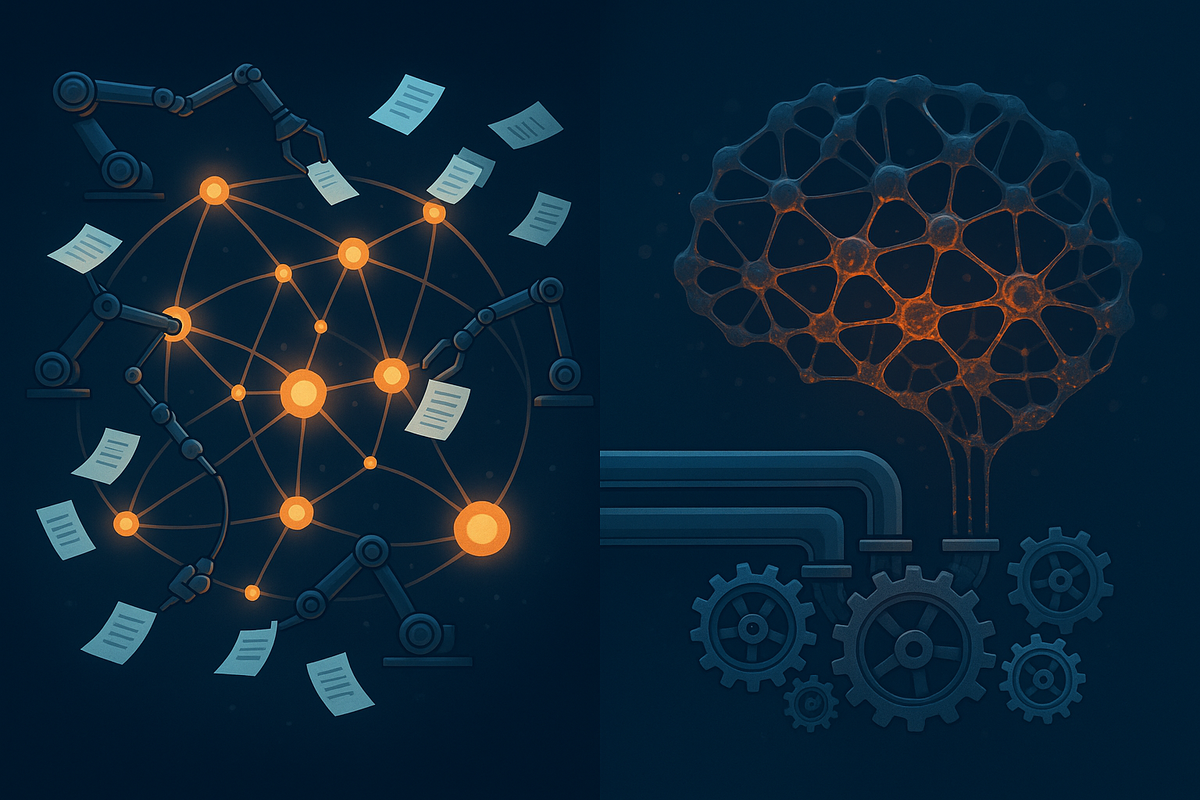
Here is a scenario that should sound familiar to any enterprise AI architect working in 2026: your legal team updates compliance policies every six weeks, your product catalog turns over 30% of its SKUs each quarter, and your internal knowledge base grows by hundreds of documents a month. Meanwhile, your AI budget committee approved exactly two full model retraining cycles per year. Something has to give.
The tension between Retrieval-Augmented Generation (RAG) and fine-tuning has been debated since large language models first entered enterprise workflows. But in 2026, the conversation has matured considerably. We are no longer asking which technique is "better" in the abstract. We are asking something far more operationally honest: which approach survives contact with a real enterprise environment where domain knowledge is a moving target?
This article breaks down both strategies across the dimensions that actually matter for multi-agent pipelines: knowledge freshness, cost structure, latency, reasoning depth, and maintainability. By the end, you will have a decision framework you can take directly into your next architecture review.
Setting the Stage: What Multi-Agent Pipelines Actually Demand
Before comparing RAG and fine-tuning, it is worth being precise about the environment we are designing for. A modern enterprise multi-agent pipeline is not a single chatbot. It is an orchestrated network of specialized agents, each responsible for a discrete task: one agent retrieves and ranks documents, another synthesizes regulatory context, another drafts output, and a supervisor agent coordinates handoffs and resolves conflicts.
This architecture places unique demands on knowledge management that a single-agent deployment simply does not face:
- Consistency across agents: If Agent A and Agent B draw on different versions of the same policy document, the pipeline produces contradictory outputs. Downstream, that is a compliance nightmare.
- Latency budgets per hop: Every agent-to-agent call adds latency. A retrieval step that takes 400ms is tolerable in isolation but catastrophic when multiplied across six sequential agents.
- Auditability: Regulated industries need to trace exactly which piece of knowledge drove a specific decision. "The model was trained on it" is not an audit trail. A retrieved document chunk with a timestamp and source URL is.
- Specialization without silos: Each agent may need deep domain knowledge in its lane while still sharing a coherent world model with the rest of the pipeline.
Keep these constraints in mind as we evaluate each approach. They will be decisive.
The Case for RAG: Knowledge That Moves as Fast as Your Business
Retrieval-Augmented Generation works by keeping the base model's weights largely static and instead injecting relevant, up-to-date context into the prompt at inference time. The model reasons over retrieved chunks rather than relying solely on what was baked into its parameters during training.
Where RAG Genuinely Wins
Knowledge freshness without retraining costs. This is RAG's headline advantage, and in 2026 it is more compelling than ever. With vector database infrastructure now commoditized across platforms like Weaviate, Qdrant, and the managed offerings from major cloud providers, updating your enterprise knowledge base is an indexing operation, not a training job. You ingest a new document, chunk it, embed it, and it is queryable within minutes. For organizations in fast-moving sectors like financial services, pharmaceuticals, or cybersecurity, this is not a nice-to-have. It is a survival requirement.
Auditability and explainability. In a multi-agent pipeline, every retrieved chunk can be logged with its source, version, and retrieval score. When a compliance agent cites a regulation, you can point to the exact document, the exact paragraph, and the exact timestamp of its last update. This is the kind of paper trail that satisfies both internal audit teams and external regulators. Fine-tuning cannot offer this level of provenance by design.
Lower total cost of ownership for volatile knowledge. A full fine-tuning run on a frontier-class model in 2026 still costs anywhere from tens of thousands to hundreds of thousands of dollars when you factor in compute, data preparation, evaluation, and red-teaming. For knowledge that changes monthly or quarterly, amortizing that cost across a short shelf life is fiscally indefensible. RAG lets you separate the cost of "knowing how to reason" (the base model, updated infrequently) from the cost of "knowing what is true right now" (the retrieval index, updated continuously).
Composability across agents. Different agents in a pipeline can query different retrieval indexes without requiring separate fine-tuned model variants. Your contracts agent queries the legal corpus; your pricing agent queries the product database; your customer history agent queries the CRM vector store. All of them run on the same underlying model. This is architecturally elegant and operationally sane.
Where RAG Struggles
RAG is not without its failure modes, and being honest about them is what separates a good architecture decision from a naive one.
Retrieval quality is a hard ceiling on output quality. If your retrieval step returns the wrong chunks, the model will reason confidently over the wrong information. Garbage in, garbage out, but with a veneer of authority. In multi-agent pipelines, this problem compounds: a retrieval failure in Agent 2 can corrupt every downstream agent that depends on its output. Robust re-ranking, hybrid search (dense plus sparse), and retrieval evaluation pipelines are non-negotiable, not optional extras.
Latency accumulates. Each retrieval hop adds network I/O, embedding computation, and vector search time. In a six-agent pipeline where three agents perform retrieval, you can easily add 1 to 2 seconds of end-to-end latency compared to a purely parametric approach. For synchronous user-facing workflows, this matters. For asynchronous batch pipelines, it often does not.
Implicit knowledge is hard to retrieve. RAG excels at explicit, document-able facts. It struggles with the kind of tacit, procedural knowledge that lives in how an expert thinks rather than what they have written down. If your domain expertise is primarily encoded in behavioral patterns rather than documents, retrieval has nothing to grab onto.
The Case for Fine-Tuning: When You Need the Model to Think Like Your Domain Expert
Fine-tuning modifies the model's weights directly, training it on domain-specific data so that the knowledge and reasoning style become intrinsic to the model rather than externally supplied at inference time.
Where Fine-Tuning Genuinely Wins
Reasoning style and tone adaptation. This is fine-tuning's most underappreciated advantage. When you need a model that does not just know your domain's facts but thinks in your domain's logic, fine-tuning is the right tool. A model fine-tuned on decades of case law does not just retrieve relevant precedents; it reasons about them the way a seasoned attorney would. A model fine-tuned on your engineering runbooks does not just surface relevant procedures; it prioritizes and sequences them the way your senior SRE would. That reasoning style cannot be injected through a prompt.
Reduced prompt overhead and lower inference cost. A fine-tuned model requires far less context stuffing at inference time. You are not prepending 3,000 tokens of retrieved context to every call. For high-throughput pipelines processing millions of requests per day, this translates directly into lower inference costs and faster response times. At scale, the economics can flip decisively in fine-tuning's favor.
Stable, predictable behavior. A fine-tuned model produces more consistent outputs because its knowledge and style are baked in. RAG-based pipelines can exhibit subtle behavioral drift when the retrieval index changes, because the model is reasoning over different context from one day to the next. For use cases where output consistency is paramount, such as regulated document generation or standardized risk scoring, fine-tuning offers a more controlled surface.
Handling tasks with no good document corpus. Some enterprise knowledge is inherently non-documentary. Complex judgment calls, nuanced prioritization heuristics, and expert intuitions are better encoded through fine-tuning on labeled examples of expert behavior than through retrieval of documents that only partially capture that expertise.
Where Fine-Tuning Struggles
Catastrophic staleness. This is the killer in fast-moving domains. A fine-tuned model trained on your Q1 product catalog will confidently describe products that were discontinued in Q2. Worse, it will do so without any signal to the pipeline that something is wrong. At least a RAG system that fails to retrieve a document can return a "no relevant context found" signal. A stale fine-tuned model just hallucinates with conviction.
The retraining treadmill. In domains where knowledge changes faster than your retraining budget allows, fine-tuning creates a permanent state of technical debt. You are always running a model that is slightly behind reality. The faster your domain evolves, the more pronounced this lag becomes, and the more your fine-tuned model becomes a liability rather than an asset.
Multi-agent specialization costs multiply quickly. If each agent in your pipeline requires its own fine-tuned variant to handle its specialized domain, you are now maintaining a fleet of models, each with its own retraining schedule, evaluation suite, and deployment pipeline. The operational overhead can easily exceed the value delivered.
Head-to-Head: The Decision Matrix
Rather than declaring a universal winner, here is a practical decision matrix for enterprise architects evaluating both approaches across the dimensions that matter most in 2026:
- Knowledge update frequency: Weekly or more often? RAG wins clearly. Quarterly or less? Fine-tuning becomes viable.
- Auditability requirements: Regulated industry with source traceability mandates? RAG is the only defensible choice. Internal tooling with relaxed audit requirements? Fine-tuning is acceptable.
- Reasoning depth vs. fact retrieval: Need expert-level reasoning style and judgment? Fine-tuning earns its cost. Need accurate, current factual grounding? RAG is more reliable.
- Pipeline throughput: Millions of daily requests with tight cost constraints? Fine-tuning's lower inference overhead pays off. Moderate throughput with freshness requirements? RAG's economics are favorable.
- Number of specialized agents: Large fleet of specialized agents? A single well-indexed RAG system serving all agents is far more maintainable than a fleet of fine-tuned models.
- Latency sensitivity: Synchronous, user-facing, sub-second SLA? Fine-tuning reduces retrieval latency risk. Async batch processing? RAG latency is largely irrelevant.
The 2026 Consensus: Hybrid Architecture Is Not a Cop-Out, It Is the Answer
If you were hoping for a clean knockout, here is the honest truth from the field: the most robust enterprise multi-agent pipelines deployed in 2026 use both techniques in a deliberate, layered architecture. This is not fence-sitting. It is engineering pragmatism applied correctly.
The pattern that has emerged as a production standard looks roughly like this:
Layer 1: A Lightly Fine-Tuned Base Model
The foundation model is fine-tuned once (or infrequently) on domain-specific reasoning patterns, tone, output format conventions, and stable procedural knowledge. This tuning run is expensive but rare, perhaps once or twice a year. It gives the pipeline its "personality" and reasoning style without encoding any facts that are likely to change.
Layer 2: Dynamic RAG for All Volatile Knowledge
Every piece of knowledge with a meaningful shelf life, including policies, prices, personnel, regulations, product specs, and case statuses, lives in continuously updated retrieval indexes. Agents query these indexes at inference time. The retrieval layer is the living, breathing knowledge system. The model is the stable reasoning engine.
Layer 3: Agent-Level Retrieval Specialization
Each agent in the pipeline is configured to query the retrieval index or indexes most relevant to its function. A contracts agent has access to the legal corpus and nothing else. A customer success agent queries CRM data and product documentation. This scoping reduces retrieval noise, improves precision, and limits the blast radius of any index quality issues.
Layer 4: A Supervisor Agent with Meta-Retrieval
The orchestrating supervisor agent maintains a lightweight index of agent capabilities and recent pipeline state, enabling it to route tasks intelligently, detect contradictions between agent outputs (often a symptom of retrieval inconsistency), and escalate to human review when confidence thresholds are not met.
This four-layer hybrid approach gives you the reasoning depth of fine-tuning, the knowledge freshness of RAG, the auditability that regulators demand, and the operational maintainability that your engineering team can actually sustain.
Practical Recommendations for Enterprise Architects
If you are designing or redesigning a multi-agent pipeline right now, here are the concrete steps that separate good architecture from great architecture:
- Classify your knowledge by half-life before you choose a storage strategy. Stable procedural knowledge and reasoning patterns belong in model weights. Facts with a shelf life of less than six months belong in retrieval indexes. This classification exercise alone will clarify 80% of your architecture decisions.
- Invest in retrieval quality infrastructure as seriously as you invest in model selection. Re-ranking models, hybrid search pipelines, and automated retrieval evaluation are not optional extras. They are the difference between a RAG system that works and one that quietly poisons your pipeline.
- Build knowledge provenance into your pipeline from day one. Every agent output should carry metadata about which retrieved chunks (or which fine-tuning dataset version) informed it. Retrofitting auditability is painful and expensive.
- Treat fine-tuning runs as infrastructure releases, not model experiments. Apply the same versioning, rollback capability, and canary deployment discipline to fine-tuned model releases that you would apply to a major software release.
- Benchmark retrieval latency at the pipeline level, not the component level. A retrieval step that performs acceptably in isolation may create unacceptable cumulative latency across a six-agent chain. Always profile end-to-end.
Conclusion: The Real Question Was Never "Which One?"
The RAG versus fine-tuning debate was always a false binary, but in 2026, the enterprise multi-agent context makes that especially clear. The question was never which technique wins. The question is which technique owns which layer of your knowledge architecture, and whether your organization has the discipline to maintain that separation over time.
For enterprises where domain knowledge changes faster than retraining budgets allow, which is most enterprises in most industries today, RAG is the non-negotiable foundation. It is the only mechanism that keeps your pipeline grounded in current reality without requiring a budget approval every time your world changes. Fine-tuning remains powerful, but its power is concentrated in the domain of reasoning style and stable procedural knowledge, not volatile facts.
Build your pipeline to treat the model as a reasoning engine and your retrieval indexes as a living knowledge system. Keep them separate, keep them both excellent, and you will have an architecture that survives not just this year's knowledge churn but next year's as well.
Are you navigating RAG and fine-tuning decisions for an enterprise multi-agent deployment? Drop your architecture questions in the comments below. The edge cases are where the most interesting engineering happens.



