Latest

5 Dangerous Myths Enterprise Backend Teams Still Believe About AI Agent State Persistence That Are Silently Corrupting Long-Running Multi-Agent Workflow Outputs in H2 2026

AI Agents

5 Dangerous Myths Enterprise Backend Teams Still Believe About AI Agent State Persistence That Are Silently Corrupting Long-Running Multi-Agent Workflow Outputs in H2 2026

There is a quiet crisis unfolding inside enterprise AI stacks right now. Not the dramatic, headline-grabbing kind where a model hallucinates a legal brief or a chatbot goes off the rails. This one is far more insidious: long-running multi-agent workflows are producing subtly wrong outputs, and most backend teams have

By Scott Miller
How to Build an AI Agent Circuit Breaker Pattern That Automatically Isolates Failing Foundation Model Endpoints Before Cascading Failures Corrupt Downstream Multi-Agent Workflow State in H2 2026

AI Agents

How to Build an AI Agent Circuit Breaker Pattern That Automatically Isolates Failing Foundation Model Endpoints Before Cascading Failures Corrupt Downstream Multi-Agent Workflow State in H2 2026

Multi-agent systems running on top of foundation model endpoints are the backbone of production AI workloads in 2026. Orchestrators fan out tasks to specialized sub-agents, each of which calls one or more model endpoints, writes intermediate results to shared state stores, and hands off context to the next agent in

By Scott Miller
A Beginner's Guide to AI Agent Rate Limit Architecture: What Enterprise Backend Teams Need to Know Before API Throttling Silently Starves Your Multi-Agent Workflows

AI Agents

A Beginner's Guide to AI Agent Rate Limit Architecture: What Enterprise Backend Teams Need to Know Before API Throttling Silently Starves Your Multi-Agent Workflows

Picture this: your multi-agent AI pipeline has been running beautifully in staging. Agents orchestrate each other, tools get called, reasoning chains complete, and your team is ready to flip the switch for H2 2026 production rollout. Then, three days after go-live, everything slows to a crawl. Latencies spike. Outputs start

By Scott Miller
A Beginner's Guide to AI Agent Task Queue Architecture: What Enterprise Backend Teams Need to Know Before Backpressure Breaks Your Multi-Agent Workflow

AI Agents

A Beginner's Guide to AI Agent Task Queue Architecture: What Enterprise Backend Teams Need to Know Before Backpressure Breaks Your Multi-Agent Workflow

Somewhere in a mid-sized fintech company right now, a backend team is celebrating. Their first multi-agent AI workflow just went live. One agent scrapes regulatory documents, another summarizes them, a third cross-references internal policy, and a fourth drafts a compliance report. It's elegant. It's fast. It

By Scott Miller
When Your AI Agents Disagree: How Enterprise Backend Teams Must Rebuild Consensus Layers for Multi-Agent Conflict Resolution in H2 2026

AI Agents

When Your AI Agents Disagree: How Enterprise Backend Teams Must Rebuild Consensus Layers for Multi-Agent Conflict Resolution in H2 2026

Imagine your enterprise has deployed a sophisticated AI workflow to manage supply chain decisions. One specialized sub-agent, trained on logistics data, recommends accelerating a shipment. A second sub-agent, focused on financial risk, flags that the supplier's credit profile has deteriorated and recommends a hold. A third sub-agent, monitoring

By Scott Miller
How One Enterprise Logistics Team Rebuilt Their AI Agent Workflow Versioning Pipeline After a Silent Schema Migration Broke 31 Multi-Agent Shipment Tracking Workflows

AI Agents

How One Enterprise Logistics Team Rebuilt Their AI Agent Workflow Versioning Pipeline After a Silent Schema Migration Broke 31 Multi-Agent Shipment Tracking Workflows

In the summer of 2026, a mid-sized third-party logistics provider (3PL) operating across North America and the EU learned one of the most expensive lessons in modern agentic AI deployment: a schema change that nobody officially announced can silently corrupt every downstream workflow that trusted the old contract. No alarms

By Scott Miller
7 Ways Enterprise Backend Teams Must Redesign AI Agent Data Lineage Tracking Pipelines as Synthetic Training Data Regulations Force Provenance Audits Across Every Multi-Agent Workflow Output in H2 2026

AI Data Lineage

7 Ways Enterprise Backend Teams Must Redesign AI Agent Data Lineage Tracking Pipelines as Synthetic Training Data Regulations Force Provenance Audits Across Every Multi-Agent Workflow Output in H2 2026

Something seismic is happening in enterprise AI compliance right now, and most backend engineering teams are not ready for it. As we move deeper into H2 2026, a converging wave of regulatory frameworks, including the EU AI Act's expanded enforcement clauses, the US AI Accountability Framework updates, and

By Scott Miller
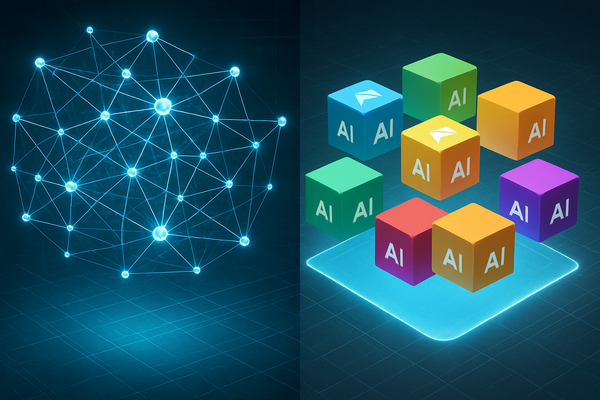
Centralized vs. Decentralized AI Agent Orchestration: Which Architecture Survives at 100+ Concurrent Agents?

AI Agents

Centralized vs. Decentralized AI Agent Orchestration: Which Architecture Survives at 100+ Concurrent Agents?

Picture this: it is Q3 2026, and your enterprise multi-agent workflow is humming along beautifully. Forty agents are summarizing contracts, thirty are cross-referencing compliance databases, and another thirty are generating customer-facing reports. Then the orchestrator goes down. In seconds, 100 concurrent agents freeze mid-task, queues pile up, and an entire

By Scott Miller
7 Ways Enterprise Backend Teams Must Redesign AI Agent Cold Start Initialization Sequences as Containerized Multi-Agent Runtimes Expose Catastrophic Latency Spikes During Auto-Scaling Events in H2 2026

AI Agents

7 Ways Enterprise Backend Teams Must Redesign AI Agent Cold Start Initialization Sequences as Containerized Multi-Agent Runtimes Expose Catastrophic Latency Spikes During Auto-Scaling Events in H2 2026

It was supposed to be a quiet Tuesday morning in production. Then the auto-scaler fired. Within seconds, a cascade of newly provisioned containers began spinning up across a Kubernetes cluster, each one hosting a freshly initialized AI agent runtime. Response times ballooned from 120ms to over 14 seconds. Downstream orchestration

By Scott Miller