How One Warehouse Robotics Team Rewrote Their Multi-Agent Traffic Arbitration Logic After MIT's Scheduling Model Exposed Critical Architecture Gaps
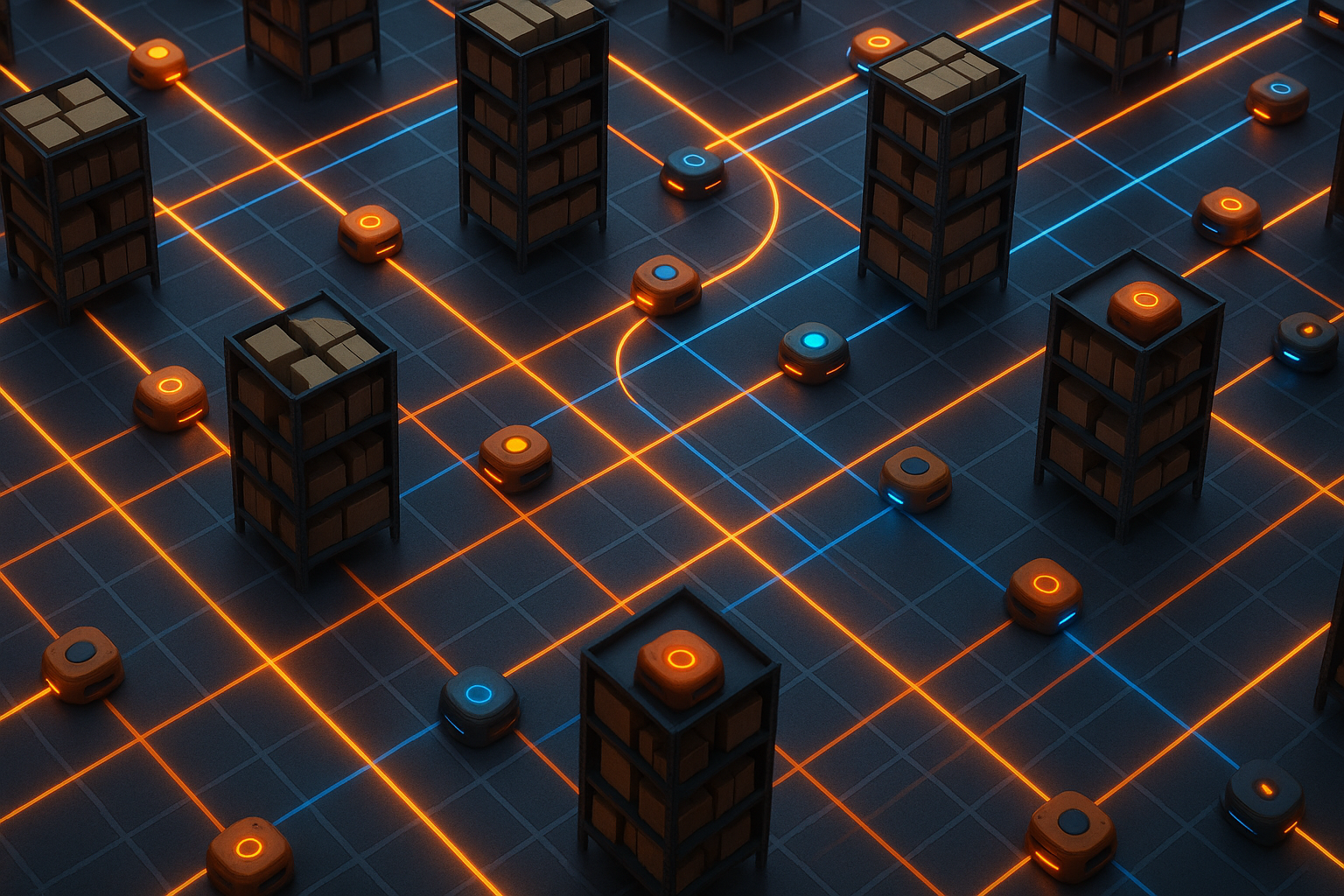
At 2:47 AM on a Tuesday in late 2025, a fulfillment center outside Columbus, Ohio ground to a near-complete operational halt. Forty-three autonomous mobile robots (AMRs) had converged on three intersecting aisle corridors and entered a state that the platform team's monitoring dashboard labeled, with maddening understatement, as a "priority resolution delay." In plain English: a deadlock. Not a full freeze, but a cascading, self-reinforcing traffic jam that took 22 minutes to resolve and cost the shift an estimated $34,000 in delayed throughput.
What made this incident remarkable was not the deadlock itself. Deadlocks in multi-agent robotic systems are a known, studied, and partially solved problem. What made it remarkable was why it happened. The platform team, a group of eight engineers at a mid-sized robotics software company called Vektor Logistics Systems (a composite name used here to protect proprietary details), had built what they genuinely believed was a robust priority queue architecture. Each robot carried its own weighted priority score. A central arbiter resolved conflicts. The system had run for 14 months without a critical incident.
Then a senior engineer named Priya Nandakumar read a paper.
The Paper That Started Everything
The research in question came out of MIT's Computer Science and Artificial Intelligence Laboratory (CSAIL) in mid-2025. The paper, titled "Right-of-Way Scheduling in Dense Multi-Agent Navigation: A Graph-Theoretic Approach to Conflict Arbitration", proposed a fundamentally different mental model for how autonomous agents should negotiate access to shared physical space. Instead of treating priority as a property of individual agents (a per-robot score that the central arbiter would compare pairwise), the MIT model treated priority as a property of conflict zones and the directed graphs formed by agent movement intentions.
The core insight was deceptively simple: in a dense environment, the right question is not "which robot has higher priority?" but rather "which ordering of agents through this conflict zone minimizes downstream conflict propagation across the entire graph?" The distinction sounds academic. It turned out to be the difference between a system that works and one that fails catastrophically at scale.
Priya flagged the paper in the team's internal Slack on a Friday afternoon. By Monday morning, the team had a whiteboard covered in diagrams and a growing sense of unease.
Diagnosing the Per-Robot Priority Queue Architecture
To understand what the MIT model exposed, it helps to understand exactly how Vektor's original architecture was structured. The system was built around three core components:
- The Priority Score Engine: Each AMR was assigned a dynamic priority score based on a weighted combination of factors including task urgency, battery level, payload weight, time-in-queue, and SLA deadline proximity. Scores were recomputed every 500 milliseconds.
- The Central Conflict Arbiter (CCA): A single service that monitored robot position telemetry and projected 8-second movement trajectories. When two or more projected paths intersected within a defined conflict zone, the CCA would compare priority scores and issue a right-of-way token to the highest-scoring robot. All others received a hold instruction.
- The Hold-and-Retry Loop: Robots receiving a hold instruction would pause, wait a configurable interval (default: 1.2 seconds), then re-request arbitration. If their score had changed sufficiently, they might win the next round.
On paper, this is reasonable. In practice, it worked well under moderate traffic density. But the MIT paper gave the Vektor team a precise vocabulary for describing what it could not handle: convoy starvation cascades and priority inversion under graph contention.
The Convoy Starvation Problem
Imagine three robots: Robot A has a priority score of 92, Robot B has 78, and Robot C has 81. They are approaching a three-way intersection from different aisle directions. The CCA grants right-of-way to Robot A. Robots B and C hold. While they hold, two new robots (D with score 88, and E with score 85) arrive at adjacent conflict zones that share a boundary with the first intersection. The CCA now evaluates those conflicts. Robot D wins its arbitration. But Robot D's movement path, once executed, creates a new projected conflict with Robot C's updated trajectory. Robot C holds again.
In the per-robot priority model, this sequence is perfectly correct at every individual step. Every decision the CCA made was locally optimal. But the cumulative effect was that Robot C, despite having a perfectly reasonable priority score, had now been held for 6.8 seconds across three consecutive arbitration cycles. Its score was climbing due to the time-in-queue weighting, but not fast enough to beat the stream of arriving robots with initially higher scores. This is textbook priority inversion, and it was happening not just to one robot but to clusters of robots simultaneously.
The MIT model identified this failure mode with a specific term: a right-of-way debt accumulation in the conflict graph. The graph was accumulating "owed" passages that the per-robot arbiter had no mechanism to recognize or discharge.
The Graph Contention Amplifier
The second, more dangerous failure mode was what the MIT researchers called topological contention amplification. In a warehouse grid layout, conflict zones are not isolated. They form a network. When the CCA resolved conflicts locally and independently, it had no model of how its decisions in Zone 7 would affect the conflict state in Zones 8, 9, and 12 two seconds later.
In the Columbus incident, the team's post-mortem reconstruction showed that the CCA had made 217 individually correct arbitration decisions in the 90 seconds before the deadlock. Each decision was locally optimal. But the collective effect of those 217 decisions was to funnel robot movement intentions into a topological configuration from which no locally optimal exit existed. The system had optimized itself into a corner.
"We had been thinking about this as a traffic light problem," Priya said in the team's internal incident review. "The MIT paper made us realize it was actually a graph coloring problem. Those are not the same thing, and the solutions are not the same thing."
The Rewrite: From Per-Robot Scores to Zone-Graph Arbitration
The team spent three weeks in design before writing a single line of production code. The new architecture, which they internally called ZETA (Zone-Embedded Traffic Arbitration), was built around four foundational changes.
1. Replacing the Priority Score with an Intention Graph
Instead of maintaining a priority score per robot, ZETA maintains a live directed intention graph across all active conflict zones. Each node in the graph represents a conflict zone. Each directed edge represents a robot's intended traversal from one zone to the next. Edge weights encode urgency, deadline proximity, and battery state, but these weights are evaluated at the graph level, not the robot level.
The key difference: the arbiter no longer asks "what is Robot C's priority?" It asks "what is the minimum-cost topological ordering of all agents currently represented in this subgraph?" This is computationally heavier, but the team found that in practice, the relevant subgraphs rarely exceeded 12 to 15 nodes, keeping solve times well under 40 milliseconds.
2. Introducing Right-of-Way Debt Tokens
Directly inspired by the MIT paper's concept of right-of-way debt, ZETA introduces a debt token system. Every time a robot is held at a conflict zone boundary, it accumulates a debt token. Debt tokens are zone-specific: a robot accumulates debt relative to a particular zone, not globally. When the graph solver evaluates orderings, it treats accumulated debt tokens as a hard constraint modifier. A robot that has accumulated three or more debt tokens for a specific zone is elevated to a debt-priority agent whose passage through that zone becomes a scheduling constraint rather than a variable.
This elegantly solves the convoy starvation problem. No robot can be indefinitely deferred at a specific zone, regardless of how many higher-scored robots arrive. The debt mechanism creates a form of fairness guarantee that the original system entirely lacked.
3. Predictive Graph Pre-Coloring
One of the most impactful changes was moving from reactive arbitration (resolving conflicts as they are detected) to predictive pre-coloring. ZETA extends the trajectory projection window from 8 seconds to 22 seconds and uses the intention graph to pre-assign provisional right-of-way orderings for projected conflicts before they become active.
This is analogous to how air traffic control assigns approach sequences to aircraft well before they reach the runway threshold. Robots receive provisional movement clearances that are updated continuously, rather than waiting to request arbitration at the conflict zone boundary. The result is a dramatic reduction in the number of hard stops, because most ordering decisions are made while robots are still in transit and can adjust speed to naturally space their arrivals.
4. Decomposing the Monolithic CCA into Zone Cluster Arbiters
The original Central Conflict Arbiter was a single service. This created both a performance bottleneck and a single point of failure. ZETA replaces it with a set of Zone Cluster Arbiters (ZCAs), each responsible for a topologically connected subgraph of conflict zones. ZCAs communicate via an event bus to propagate graph state changes across cluster boundaries.
This decomposition also made the system far more resilient. A ZCA failure now affects only its cluster. Robots in unaffected clusters continue operating normally. The original CCA failure would have halted arbitration warehouse-wide.
Implementation Challenges: The Messy Reality
The rewrite was not smooth. Three specific challenges nearly derailed the project.
The Solver Latency Spike Problem
The graph ordering solver, initially implemented using a standard minimum-weight topological sort, produced unacceptable latency spikes when subgraphs temporarily grew beyond 18 nodes during peak shift transitions. The team solved this by implementing a hierarchical decomposition heuristic: the solver first partitions the subgraph into strongly connected components, resolves ordering within each component independently, then stitches the component orderings together. This reduced worst-case solve time from 180 milliseconds to 31 milliseconds.
Debt Token Calibration
The initial debt token threshold of three holds before debt-priority elevation was too aggressive. In early simulation testing, it caused its own form of disruption: robots achieving debt-priority status were essentially given a hard pass through their zone, which sometimes created downstream conflicts that propagated more total delay than the original starvation would have caused. The team ran 14 rounds of simulation tuning before settling on a dynamic threshold that scales with current traffic density in the relevant zone cluster. At low density, the threshold is two holds. At high density, it rises to five, giving the graph solver more flexibility to find efficient orderings before the hard constraint kicks in.
The Legacy Robot Firmware Interface
Approximately 30% of the AMRs in the Columbus facility were running firmware that did not support the richer telemetry format ZETA required for intention graph construction. The team had to build a telemetry inference layer that reconstructed probable movement intentions from legacy position and velocity data using a lightweight LSTM model. This added an unexpected three weeks to the project timeline and introduced a small but non-zero error rate in intention inference for legacy robots, which required additional conservative safety margins in the pre-coloring logic.
Results: Six Months Post-Deployment
ZETA went live in the Columbus facility in January 2026, with a phased rollout that ran shadow mode for four weeks before full cutover. The results after six months of production operation are striking.
- Hard stop frequency reduced by 71%: The predictive pre-coloring and debt token system together eliminated the vast majority of reactive hold events. Robots now slow and space themselves rather than stopping entirely.
- Average task completion time improved by 18%: Fewer stops and smoother flow through high-density zones translated directly into throughput. The facility processed a record shift volume in March 2026 without a single priority resolution delay event.
- Zero critical deadlocks since deployment: The Columbus 2:47 AM incident remains the last critical deadlock the facility has experienced. The post-mortem reconstruction team ran the original CCA against simulated versions of 11 subsequent high-density traffic scenarios. It deadlocked in 8 of them. ZETA resolved all 11 without incident.
- CCA single-point-of-failure eliminated: The ZCA cluster architecture has experienced two partial failures in six months, both due to infrastructure issues unrelated to the arbitration logic. In both cases, the affected cluster degraded gracefully while unaffected clusters continued at full performance.
The Broader Lesson: Local Optimality Is Not Global Safety
The most important takeaway from the Vektor case study is not about any specific algorithm or data structure. It is about a deeper architectural assumption that is surprisingly common in multi-agent systems: the belief that a system built from locally correct decisions will produce globally correct behavior.
It will not. Not reliably. Not in dense, tightly coupled physical environments where agent decisions have cascading spatial and temporal dependencies. The per-robot priority queue architecture was not poorly engineered. It was engineered to answer the wrong question.
The MIT right-of-way scheduling model provided something invaluable: a formal framework that made the wrong question visible. It gave Priya's team the conceptual tools to look at 217 individually correct decisions and understand, precisely and rigorously, why they had produced a collective catastrophe.
This is what good academic research does for practitioners. It does not always provide a drop-in solution. It provides a new way of seeing. The ZETA architecture is not a direct implementation of the MIT paper. It is what happened when a team of engineers took that new way of seeing and applied it to the specific, messy, legacy-constrained reality of a production warehouse system.
What Other Teams Should Take From This
If your multi-agent system uses per-agent priority scores resolved by a central arbiter, here are the diagnostic questions worth asking before your own 2:47 AM moment:
- Does your arbiter model conflict zones as a graph, or as isolated pairwise comparisons? If the latter, you have no mechanism to detect or prevent topological contention amplification.
- Does your system have any fairness guarantee? A pure priority score system with no debt or aging mechanism can starve agents indefinitely under certain traffic patterns. This is not a theoretical risk; it is a production risk.
- How far ahead does your trajectory projection extend? Reactive arbitration at the conflict boundary is always playing catch-up. Predictive pre-coloring buys you the time to make better decisions.
- Is your arbiter a single point of failure? In a monolithic CCA architecture, an arbiter failure is a warehouse failure. Decomposition into cluster arbiters is not just a performance optimization; it is a resilience requirement.
- Are you reading the research? The Columbus deadlock was preventable with knowledge that existed in the literature before the system was built. Closing the gap between academic multi-agent systems research and production robotics engineering is not someone else's job. It is the platform team's job.
Conclusion
The story of Vektor's ZETA rewrite is, at its core, a story about the limits of local reasoning in globally coupled systems. It is also a story about intellectual honesty: the willingness to look at an architecture that had worked for 14 months and ask whether "worked so far" and "works correctly" are actually the same thing.
They are not. And in warehouse robotics, where the cost of a 22-minute deadlock is measured in tens of thousands of dollars and where the density of AMR deployments is increasing every quarter, the gap between those two things is widening fast.
The MIT paper did not save the Columbus facility. Priya reading it did. That distinction matters. The research exists. The question is whether the engineers closest to the problem are engaging with it.
In 2026, with AMR fleet sizes scaling into the hundreds per facility and multi-facility orchestration becoming standard, that engagement is no longer optional. It is the baseline requirement for building systems that do not fail at 2:47 AM.