How One Enterprise Backend Team Rebuilt Their Agentic Deployment Pipeline After a Cascading Rollback Failure
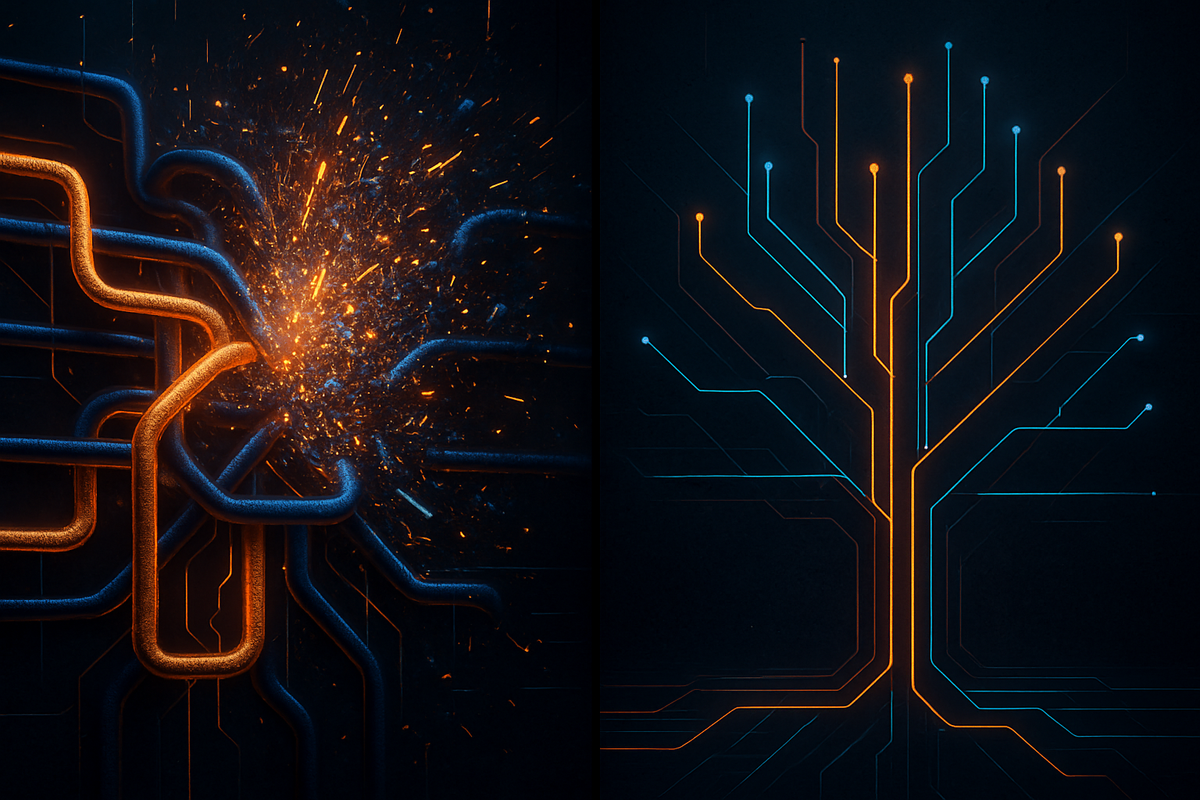
At 2:17 AM on a Tuesday in January 2026, the on-call engineer at a mid-sized fintech platform called Vantrel Financial watched in real time as seven interconnected AI agents began contradicting each other in production. One agent was rolling back. Another was pushing forward. A third was querying a state store that had already been wiped by the first. Within eleven minutes, three downstream services were returning stale financial summaries to end users, and the incident response Slack channel had 140 unread messages.
The root cause was not a bad model. It was not a flawed prompt. It was something far more mundane and far more dangerous: the team had deployed their multi-agent system the same way they deployed a Node.js microservice.
This is the story of what went wrong, why it was almost inevitable given how most engineering teams think about agentic releases, and how Vantrel's backend team spent the next six weeks rebuilding a deployment architecture that actually accounts for the deeply non-linear nature of multi-agent version coordination.
The Setup: A "Modern" Agentic Stack That Looked Fine on Paper
Vantrel had been running a production agentic system since mid-2025. By early 2026, their backend consisted of seven specialized agents operating within a shared orchestration layer:
- IngestionAgent: Pulled and normalized market data feeds
- RiskScoringAgent: Evaluated portfolio exposure in near real-time
- ReportComposerAgent: Assembled natural-language summaries for advisors
- AuditTrailAgent: Logged agent decisions to a compliance-grade ledger
- AlertDispatchAgent: Triggered notifications based on threshold logic
- ReconciliationAgent: Cross-checked outputs for consistency across agents
- OrchestratorAgent: Managed task routing, retries, and inter-agent messaging
Each agent had its own versioned container image, its own prompt configuration stored in a separate config repo, and its own set of tool bindings. The team used a standard GitOps workflow: merge to main, trigger a GitHub Actions pipeline, push the new image to their registry, and roll it out via Kubernetes with a rolling deployment strategy.
It worked beautifully in staging. It worked well enough in production for months. Until it didn't.
The Incident: What Actually Happened on That Tuesday Morning
The team had shipped what they internally called a "minor release." The RiskScoringAgent had been updated with a revised scoring schema that changed how it encoded confidence intervals in its output payload. The change was documented. The PR was reviewed. Tests passed.
What nobody accounted for was the temporal gap in the rolling deployment.
Because Vantrel used a standard Kubernetes rolling update, new pods replaced old pods gradually over roughly four minutes. During that window, the following happened simultaneously:
- Some instances of RiskScoringAgent were running v2.4.1 (new schema)
- Other instances were still running v2.4.0 (old schema)
- ReconciliationAgent, which compared outputs across RiskScoringAgent instances, received structurally inconsistent payloads and flagged a critical discrepancy
- OrchestratorAgent interpreted the reconciliation flag as a data integrity failure and triggered an automatic rollback signal
- The rollback signal caused AuditTrailAgent to begin writing rollback events to the compliance ledger
- Meanwhile, AlertDispatchAgent had already consumed the v2.4.1 output and sent threshold alerts to advisors based on the new schema's values
By the time the rollback completed, the system had sent alerts based on data it had simultaneously declared invalid. The compliance ledger contained a partial rollback record with no corresponding forward-deploy record. The ReportComposerAgent, which had cached a mix of v2.4.0 and v2.4.1 risk scores, was generating summaries that were internally inconsistent.
The system had not crashed. No exceptions were thrown at the infrastructure level. Every individual component had behaved exactly as it was designed to behave. The failure was entirely emergent.
The Core Misunderstanding: Why Traditional CI/CD Is the Wrong Mental Model
To understand why this failure was so difficult to anticipate, you need to understand the fundamental assumption baked into traditional CI/CD pipelines: services are stateless consumers of well-defined interfaces.
In a traditional microservices deployment, you version your API contract, you maintain backward compatibility during transition windows, and you accept that a brief period of mixed-version traffic is a manageable, well-understood risk. The rollback story is clean: if the new version fails, you revert the image and traffic returns to the old behavior.
Multi-agent systems break every one of these assumptions:
1. Agents Are Not Stateless
Agents carry working memory, cached context, and in-flight task state. When you roll back an agent mid-execution, you are not just reverting code. You are abandoning tasks that may have already produced side effects in other agents, external APIs, or persistent stores. The "rollback" does not undo what the agent already did.
2. Inter-Agent Contracts Are Implicit and Behavioral
In microservices, contracts are explicit: OpenAPI specs, Protobuf schemas, event schemas. In multi-agent systems, the "contract" between agents often includes behavioral expectations: how an agent sequences its tool calls, what it does when it receives ambiguous input, how it signals uncertainty. A new model version or revised prompt can change this behavioral contract without changing the payload schema at all. Standard contract testing does not catch this.
3. Rollback Signals Become Agent Inputs
This is the most dangerous and underappreciated risk. In a traditional pipeline, a rollback is an infrastructure operation. In an agentic system, a rollback signal can be observed and acted upon by agents themselves. If your orchestration layer is agentic, the rollback is not just a deployment event. It is a semantic event that agents will reason about, log, and potentially respond to in ways you did not anticipate.
4. Time Is a First-Class Variable
Agents operate asynchronously, maintain context across turns, and may have long-running tasks in flight. The "deployment window" is not a neutral period of transition. It is a period during which agents with different versions of reality are actively collaborating. The longer that window, the more damage an emergent inconsistency can cause.
The Rebuild: Six Weeks, Four Core Changes
Vantrel's backend team, led by principal engineer Dara Okonkwo, spent the six weeks following the incident designing what they now call their Agentic Release Coordination Protocol (ARCP). Here is what they built:
Change 1: Atomic Fleet Versioning with a Coordination Epoch
The team abandoned per-agent rolling deployments entirely for any release that touched inter-agent contracts. Instead, they introduced the concept of a coordination epoch: a named, versioned snapshot of the entire agent fleet's configuration, including model versions, prompt configs, tool bindings, and schema definitions.
Before any deployment begins, the orchestration layer broadcasts an epoch transition signal. All agents complete their current in-flight tasks, drain their queues, and enter a brief quiescent state (typically 30 to 90 seconds for their workload). Only once all agents confirm quiescence does the deployment proceed, swapping all agents simultaneously rather than rolling them one by one.
For minor, non-contract-breaking changes (infrastructure patches, logging improvements), rolling updates were still permitted under a separate "safe update" classification. But any change touching agent outputs, tool behavior, or inter-agent messaging required an epoch transition.
Change 2: Behavioral Contract Tests Between Agent Pairs
The team introduced a new test layer they called agent pair contracts. For every producer-consumer relationship in their agent graph, they wrote tests that validated not just schema compatibility but behavioral compatibility: what happens when the producer sends ambiguous output? What happens when the consumer receives a confidence interval it has never seen before? What does the consumer do when the producer takes longer than expected?
These tests ran in a sandboxed multi-agent environment in CI, using lightweight model stubs that replicated the behavioral signatures of their production models without the cost of full inference. Crucially, these tests included mixed-version scenarios where one agent was on the new version and its counterpart was on the old version, specifically to catch the class of failure that had burned them.
Change 3: Rollback Quarantine and Human-in-the-Loop Gates
The team removed the ability for the OrchestratorAgent to autonomously trigger a full fleet rollback. Instead, rollback signals now flow to a deployment control plane that is explicitly outside the agent graph. When a critical inconsistency is detected, the system enters a degraded-safe mode: agents stop processing new tasks, in-flight tasks are checkpointed, and a human operator receives a rollback authorization request with a full context dump.
This was a controversial decision internally. The original autonomous rollback had been a feature, not a bug. The team valued the self-healing capability. But after the incident, they recognized that autonomous rollback in a stateful multi-agent system can cause more damage than the original failure it is responding to. The new model accepts a slightly slower mean time to recovery in exchange for a dramatically lower blast radius.
Change 4: A Versioned Agent State Ledger
Perhaps the most technically interesting addition was the agent state ledger: a lightweight, append-only log that records every agent's active version, current task context, and last-known output hash at five-second intervals. This ledger serves three purposes:
- Pre-deployment audit: Before any epoch transition, the system checks the ledger to confirm all agents are in a known-good state with no orphaned tasks
- Post-incident forensics: After any anomaly, engineers can reconstruct exactly which version of which agent produced which output at any point in time, down to the task level
- Rollback targeting: If a rollback is authorized, the ledger provides the exact checkpoint state to restore, rather than simply reverting image versions and hoping in-flight state is recoverable
The Results: Three Months After the Rebuild
By the time this case study was written in March 2026, Vantrel had completed eleven production deployments under the new ARCP framework. Here is what the data showed:
- Zero cascading rollback failures in eleven deployments, compared to three in the prior six-month period
- Average quiescence window: 47 seconds, which the team considers an acceptable trade-off for the consistency guarantees it provides
- Deployment frequency: Slightly reduced from daily to roughly every two to three days, due to the overhead of epoch coordination. However, the team reports that this reduction has been offset by a significant drop in incident-related engineering time
- Mean time to recovery (MTTR): Increased from 8 minutes (autonomous rollback) to 19 minutes (human-gated rollback), but the team notes that the previous 8-minute figure was misleading because autonomous rollbacks were often making things worse before making them better
- Behavioral contract test coverage: 23 agent-pair relationships now have explicit behavioral contracts, covering 100% of their production inter-agent communication paths
What the Broader Industry Needs to Learn From This
Vantrel's experience is not unique. As agentic systems move from experimental sidecars to core production infrastructure across the enterprise software landscape in 2026, the gap between how teams think about deployments and how agentic deployments actually behave is becoming one of the most consequential blind spots in modern software engineering.
The CI/CD tooling ecosystem has not caught up. Most pipeline tools still treat an "agent" as just another container. Most rollback strategies still assume that reverting an image reverts behavior. Most observability platforms still report on infrastructure health rather than agent behavioral health.
The teams that will navigate this well are the ones that internalize a simple but profound shift: deploying a new version of an agent is not a software release. It is a behavioral change to an autonomous actor that is actively collaborating with other autonomous actors. The deployment strategy has to account for that.
That means thinking about agent deployments more like you would think about rolling out a new policy to a team of employees than like pushing a Docker image. You would not replace half your risk analysts with people trained on a different methodology in the middle of a trading day and expect consistent output. You would coordinate the transition, communicate the change, and create a clean handoff.
Key Takeaways for Engineering Teams Building Agentic Systems
- Classify your changes before you deploy them. Not all agent updates are equal. Changes to output schemas, tool bindings, or behavioral logic require a fundamentally different deployment strategy than infrastructure patches.
- Build behavioral contract tests, not just schema tests. The most dangerous incompatibilities between agent versions are behavioral, not structural. Your test suite needs to reflect that.
- Make rollback a human decision in stateful systems. Autonomous rollback is a liability when agents have already produced side effects. Design your rollback path to be deliberate, not reflexive.
- Treat the deployment window as a threat surface. The time between the first agent updating and the last agent updating is a period of active risk. Minimize it or eliminate it for contract-breaking changes.
- Invest in agent state observability before you need it. You cannot debug a cascading failure in a multi-agent system without knowing exactly what each agent was doing and what version it was running at the moment things went wrong.
Conclusion
The 2:17 AM incident at Vantrel Financial was, in retrospect, an entirely predictable failure. Not because the engineers were careless, but because they were applying a mental model that was perfectly suited to the systems they had built before and completely mismatched to the system they were building now.
The most valuable thing Dara Okonkwo's team produced in those six weeks was not the ARCP framework itself. It was the shared language and shared understanding of why agentic deployments are categorically different. Once the team internalized that difference, the technical solutions followed naturally.
As agentic systems become the backbone of enterprise software in 2026 and beyond, the engineering discipline around deploying, versioning, and rolling back these systems will need to mature just as rapidly as the systems themselves. The teams that build that discipline now, before the 2:17 AM call, will have a significant advantage over the ones that build it after.
The pipeline that broke Vantrel's system was not a bad pipeline. It was the right pipeline for the wrong kind of system. Knowing the difference is where the real engineering begins.



