Centralized Orchestration vs. Decentralized Mesh Topology for Multi-Tenant AI Agent Pipelines: Choose Before Isolation Failures Choose for You
There is a quiet crisis brewing inside the infrastructure of companies that scaled their AI agent platforms too fast. Engineers who built multi-tenant AI pipelines in 2024 and 2025 by defaulting to whatever orchestration pattern felt familiar are now hitting walls: one tenant's runaway agent loop throttles another tenant's latency-sensitive workflow; a shared context store leaks reasoning state across organizational boundaries; a single orchestrator node becomes the blast radius for every downstream failure. The architecture decision they skipped at the start is now making itself for them, in production, at the worst possible time.
This article is for backend engineers who are either building a multi-tenant AI agent platform from scratch in 2026 or who are staring down a growing list of incidents and wondering whether their current control architecture can survive another order of magnitude of tenant growth. The choice between centralized orchestration and a decentralized mesh topology is not a theoretical preference. It is a structural commitment with cascading consequences for tenant isolation, observability, fault tolerance, and cost attribution. Let's break it down honestly.
Why the Control Architecture Decision Is More Urgent Than Ever in 2026
Multi-agent AI systems have crossed a maturity threshold. Frameworks for building autonomous agent pipelines have stabilized considerably, and enterprises are no longer running single-agent demos. They are running fleets: dozens to hundreds of specialized agents per tenant, coordinating across tool-use cycles, retrieval-augmented generation steps, long-horizon planning loops, and inter-agent delegation chains. The operational complexity of these systems has outpaced the architectural thinking behind them.
The specific pressures that make the control architecture decision critical right now include:
- Tenant count scaling: SaaS platforms built on AI agents are routinely onboarding hundreds of enterprise tenants, each with distinct workload profiles, SLA requirements, and compliance mandates.
- Agent autonomy depth: Modern agents don't just call APIs; they spawn subagents, maintain working memory across sessions, and execute multi-step plans that can run for minutes or hours. Shared infrastructure amplifies the blast radius of any one agent's misbehavior.
- Regulatory exposure: Data residency laws, SOC 2 Type II requirements, and emerging AI governance frameworks in the EU and US are forcing engineering teams to demonstrate hard isolation guarantees, not just logical separation.
- Cost attribution pressure: Finance and product teams now demand per-tenant token usage, compute cost, and tool-call billing data. Architectures that blur tenant boundaries make this nearly impossible to produce accurately.
Against this backdrop, the choice between a centralized orchestrator and a mesh topology is not just about elegance. It is about survivability at scale.
Centralized Orchestration: The Control Tower Model
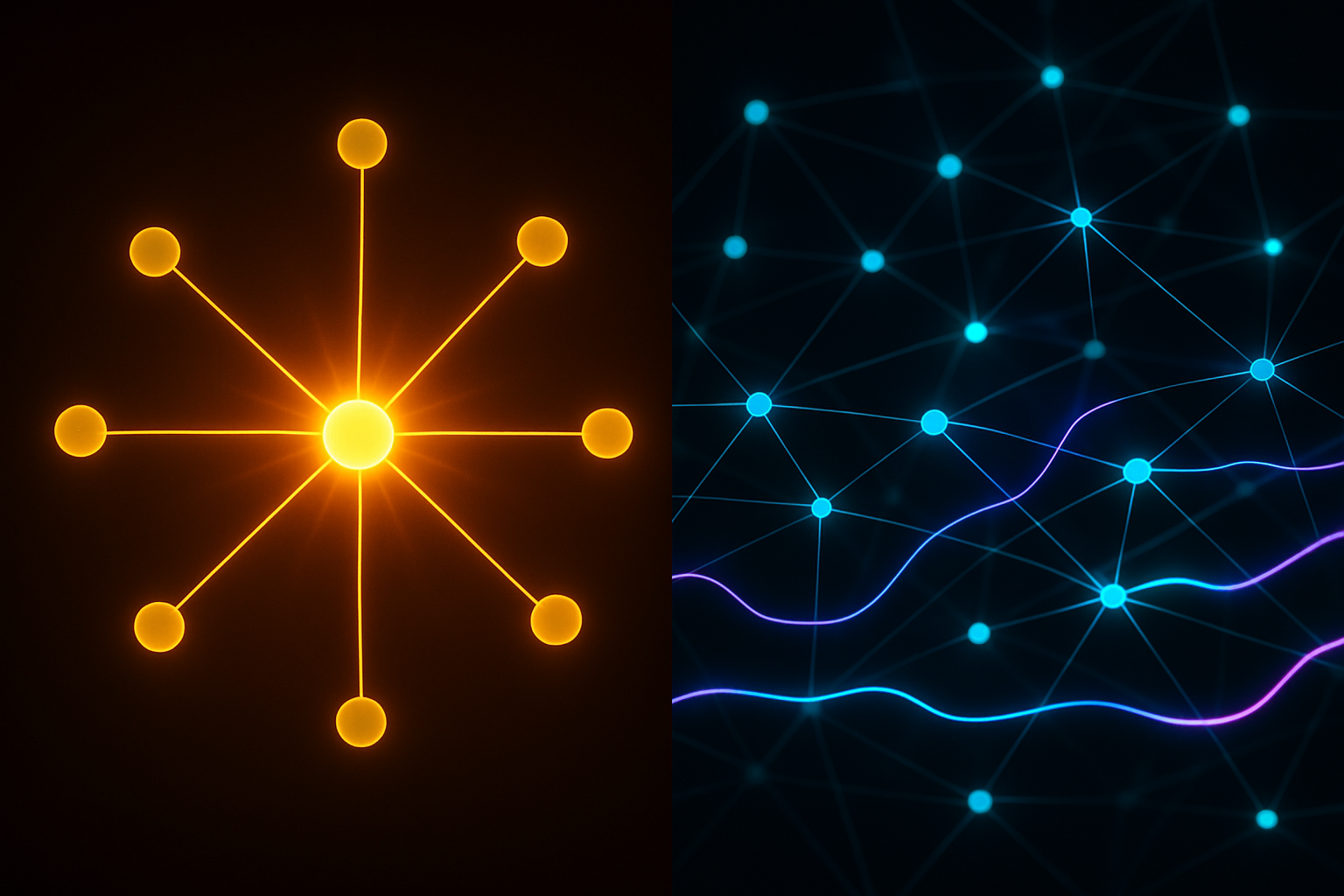
In a centralized orchestration architecture, a single orchestrator service (or a small cluster of stateful orchestrator replicas) is responsible for scheduling, routing, and coordinating all agent tasks across all tenants. Think of it as an air traffic control tower: every agent checks in, receives instructions, reports status, and hands off work through one authoritative control plane.
How It Works in Practice
The central orchestrator typically maintains a global task queue, a routing registry that maps task types to available agent pools, and a state store that tracks in-flight pipeline execution graphs. When a tenant triggers a workflow, the orchestrator decomposes it into a directed acyclic graph (DAG) of agent tasks, dispatches them to workers, collects results, resolves dependencies, and manages retries. Popular implementations in 2026 use event-driven backbones (Kafka, Pulsar, or cloud-native equivalents) to decouple the orchestrator's scheduling logic from the actual agent execution runtime.
The Real Strengths of Centralized Orchestration
- Global visibility: A centralized control plane gives you a single source of truth for pipeline state. Debugging a stuck workflow means querying one system, not reconstructing a distributed trace across a mesh of autonomous agents.
- Policy enforcement: Rate limits, cost caps, content safety guardrails, and tenant-level quotas are trivially enforced at one chokepoint. You write the policy once and it applies universally.
- Simpler mental model: For teams that are still growing their AI infrastructure maturity, centralized orchestration is dramatically easier to reason about, onboard engineers to, and audit.
- Deterministic routing: The orchestrator can make globally optimal scheduling decisions because it sees the full picture of available agent capacity, tenant priority tiers, and current queue depths.
Where Centralized Orchestration Breaks Down
The failure modes of centralized orchestration are well-understood in distributed systems theory, but they hit differently when the workload is AI agents rather than conventional microservices. Here is why:
- The orchestrator becomes a noisy neighbor amplifier: When Tenant A's complex planning agent triggers a cascade of subagent spawns, the orchestrator's scheduling loop slows down for everyone. Unlike a stateless API gateway, orchestrator state is expensive to shard cleanly.
- Context bleed risk at the state store: A shared state store is the most dangerous single point of tenant isolation failure. A bug in serialization, a misconfigured cache TTL, or an OOM-induced eviction policy can surface one tenant's working memory in another tenant's agent context. This is not hypothetical; it is a class of incident that has hit multiple AI SaaS platforms in the past 18 months.
- Horizontal scaling is architecturally awkward: Scaling a stateful orchestrator horizontally requires careful partitioning strategies. Naive horizontal scaling introduces split-brain scenarios where two orchestrator nodes disagree about the state of a long-running pipeline.
- Latency coupling: A tenant with a latency-sensitive use case (real-time customer-facing agent) shares orchestrator bandwidth with a tenant running a batch document processing pipeline. Without extremely careful priority queue design, the batch workload degrades the interactive workload.
Decentralized Mesh Topology: The Autonomous Colony Model
In a decentralized mesh topology, there is no single orchestrator. Instead, agents and agent pipelines communicate directly with each other through a shared messaging fabric, a service mesh, or a combination of both. Each tenant's pipeline is essentially an independent graph of cooperating agents that self-coordinate using well-defined protocols. The "orchestration" is emergent rather than commanded.
How It Works in Practice
In a mesh topology, each agent is a self-contained service with its own input queue, output queue, and local state store. Coordination between agents happens through message passing, event subscriptions, or direct service-to-service calls over a service mesh (Istio, Linkerd, or purpose-built AI-native variants that have emerged in 2025 and 2026). Tenant isolation is enforced at the infrastructure layer: each tenant gets a logically (or physically) isolated set of queues, namespaces, and network policies, rather than relying on a shared orchestrator to enforce boundaries at runtime.
The Real Strengths of Decentralized Mesh
- Hard tenant isolation by default: When isolation is structural rather than logical, the blast radius of a tenant-level failure is bounded by construction. One tenant's agent loop running wild cannot affect another tenant's pipeline because they do not share a scheduling layer.
- Independent scalability: Each tenant's agent graph scales independently. A high-volume tenant can have their agent pool scaled to 200 replicas without affecting the resource allocation of a small tenant running 3 agents.
- Resilience through decoupling: There is no single orchestrator to kill. The failure of any individual agent or agent cluster is localized. The rest of the mesh continues operating normally.
- Compliance-friendly by design: Tenant data never transits through a shared control plane. For tenants with strict data residency or sovereignty requirements, this is a significant architectural advantage that can directly accelerate enterprise sales cycles.
Where Decentralized Mesh Breaks Down
The mesh is not a free lunch. Its failure modes are subtler and harder to detect before they cause damage:
- Observability becomes a first-class engineering problem: Distributed tracing across a mesh of autonomous agents requires serious investment. Without a centralized control plane, reconstructing the execution history of a multi-agent pipeline means correlating traces across dozens of independent services. This is solvable, but it demands OpenTelemetry discipline and a mature trace aggregation layer from day one.
- Policy enforcement is fragmented: Enforcing a new rate limit or content safety policy across a mesh requires pushing that policy to every agent service. In a large mesh, this creates a policy propagation lag window during which some agents are running under old rules.
- Emergent deadlocks: Without a global scheduler, circular dependencies between agents can produce deadlocks that no single component detects. An agent waiting for a response from Agent B, which is waiting for Agent C, which is waiting for Agent A, will simply stall silently unless you have explicit timeout and circuit-breaker logic at every hop.
- Operational overhead: Running isolated infrastructure per tenant is significantly more expensive in both compute cost and operational complexity at low tenant counts. The break-even point where mesh topology's isolation benefits outweigh its overhead typically arrives somewhere between 50 and 150 tenants, depending on workload density.
The Side-by-Side Comparison: Eight Dimensions That Matter
Rather than a vague "it depends," here is a concrete comparison across the dimensions that backend engineers actually need to evaluate:
- Tenant Isolation Strength: Centralized orchestration provides logical isolation (enforced by code, breakable by bugs). Mesh topology provides structural isolation (enforced by infrastructure, breakable only by misconfiguration at the network or namespace layer).
- Operational Complexity at Low Tenant Count (under 50): Centralized wins decisively. One orchestrator to deploy, monitor, and debug.
- Operational Complexity at High Tenant Count (500+): Mesh wins. The per-tenant overhead of centralized state management becomes untenable; the mesh's per-tenant cost amortizes across independent scaling units.
- Debugging and Observability: Centralized wins. A global execution log is invaluable. Mesh requires significant investment to reach equivalent debuggability.
- Latency Isolation: Mesh wins. Tenants cannot interfere with each other's latency profiles by design.
- Policy Enforcement Speed: Centralized wins. New policies propagate instantly through one control point.
- Compliance and Data Sovereignty: Mesh wins, often decisively for regulated industries.
- Cost Attribution Accuracy: Roughly equal if implemented carefully, but mesh makes it structurally easier since resource consumption is already partitioned by tenant.
The Hybrid Path: Federated Orchestration with Mesh Boundaries
The most sophisticated AI platform teams in 2026 are not choosing one model exclusively. They are converging on a federated orchestration pattern that captures the best properties of both approaches. The architecture looks like this:
Each tenant gets a dedicated lightweight orchestrator (often a stateless or near-stateless scheduling process) that manages only that tenant's agent pipeline. These per-tenant orchestrators communicate with agents through tenant-scoped queues and state stores. A thin global control plane sits above this layer but handles only cross-cutting concerns: tenant provisioning, global quota enforcement, health monitoring, and policy distribution. It does not touch agent execution state.
This pattern gives you:
- Hard isolation at the execution layer (each tenant's orchestrator is an independent failure domain)
- Centralized visibility for the operations team without centralized execution risk
- Policy enforcement that propagates through the global plane without requiring every agent to be individually updated
- A natural scaling unit: adding a tenant means provisioning a new orchestrator instance, not resizing a shared monolith
The trade-off is provisioning complexity. You need robust tenant lifecycle management (automated provisioning, scaling, and deprovisioning of per-tenant orchestrators) and a well-designed global control plane API. Teams that have invested in solid Kubernetes operator patterns or platform engineering tooling find this transition manageable. Teams without that foundation often underestimate the operational lift.
Decision Framework: Which Architecture Should You Choose?
Use this framework to guide the decision for your specific context:
Choose Centralized Orchestration if:
- You have fewer than 50 tenants and near-term growth is modest
- Your tenants have similar workload profiles and comparable SLA tiers
- Your engineering team is small and cannot afford the operational overhead of a mesh
- You are in an early product phase where iteration speed matters more than isolation guarantees
- Your compliance requirements are manageable through logical separation and strong access controls
Choose Decentralized Mesh if:
- You are building for regulated industries (finance, healthcare, government) where data sovereignty is non-negotiable
- Your tenant base includes a mix of high-volume and low-volume customers with very different latency profiles
- You are targeting 200+ tenants within 12 to 18 months
- Tenant churn and isolation failures are already showing up in your incident log
- You have the platform engineering maturity to invest in distributed observability from the start
Choose Federated Orchestration if:
- You are scaling past 50 tenants and starting to see noisy-neighbor effects
- You need the operational simplicity of centralized policy management but cannot accept shared execution risk
- You have a platform engineering team capable of building and maintaining tenant lifecycle automation
- You want a path that can evolve toward full mesh as your tenant count grows without a full rewrite
The Isolation Failure You Cannot Afford to Learn From in Production
It is worth being direct about what happens when this decision is deferred until it is forced. Tenant isolation failures in AI agent pipelines are not like a slow database query or a misconfigured load balancer. They can surface as:
- One tenant's proprietary business logic becoming visible in another tenant's agent reasoning output (a confidentiality breach with legal consequences)
- A runaway agent loop in one tenant's pipeline consuming the entire token budget allocated to the platform, causing complete service degradation for all tenants
- Long-running agent state from a deprovisioned tenant persisting in a shared context store and influencing active tenants' workflows
- Audit logs that cannot definitively attribute an action to a specific tenant because execution state was commingled
None of these failure modes are recoverable with a hotfix. They require architectural remediation under pressure, which is the worst possible context for making structural decisions.
Conclusion: Architecture as a Pre-Commitment Device
The reason to choose your control architecture deliberately, before you hit scale, is that the choice functions as a pre-commitment device. A centralized orchestrator pre-commits you to investing in its isolation and scaling mechanisms. A mesh topology pre-commits you to investing in distributed observability and policy propagation. A federated model pre-commits you to platform engineering maturity. There is no architecture that avoids the investment; there is only the question of whether you make it on your own schedule or under incident pressure.
Backend engineers building multi-tenant AI agent platforms in 2026 are operating in an environment where the stakes of getting this wrong are higher than they were for conventional microservices. The autonomy, statefulness, and cross-tenant resource contention of modern AI agents amplify every architectural weakness. The good news is that the patterns are well-understood. The federated orchestration model, in particular, offers a pragmatic middle path that most scaling teams can execute without a greenfield rewrite.
Pick your architecture. Document the trade-offs you accepted. Build the isolation guarantees your tenants are implicitly trusting you to provide. The alternative is letting your incident log make the architectural decisions for you, and that is a much more expensive way to learn.