Centralized Orchestration vs. Decentralized Agent Mesh: Which Multi-Agent Architecture Survives EU AI Act Compliance Audits?
Picture this: your enterprise has spent eighteen months building a sophisticated multi-agent AI pipeline. It routes customer decisions, flags credit risk, automates hiring screens, and manages supply chain exceptions. Then a compliance audit arrives under the EU AI Act's high-risk system provisions, and your legal team asks a deceptively simple question: "Can you show us exactly which agent made which decision, why, and what data it used?"
If your architecture cannot answer that question cleanly, you are not just facing a fine. You are facing a potential suspension order, mandatory third-party conformity assessments, and the kind of reputational damage that makes enterprise procurement teams very nervous. As of 2026, with the EU AI Act's high-risk system obligations now fully in force for most large enterprise deployments, this is no longer a theoretical concern. It is a live audit risk.
This article puts two dominant multi-agent pipeline architectures head-to-head: Centralized Orchestration and Decentralized Agent Mesh. We will evaluate both through the specific lens of EU AI Act traceability, logging, human oversight, and conformity requirements. By the end, you will have a clear architectural decision framework, not just a list of pros and cons.
Understanding the EU AI Act's Traceability Demands for High-Risk Systems
Before we compare architectures, we need to anchor the conversation in the actual regulatory requirements. The EU AI Act classifies AI systems into risk tiers, and high-risk systems (those operating in domains like employment, credit, critical infrastructure, education, law enforcement, and essential services) carry the heaviest compliance obligations. For multi-agent pipelines deployed in enterprise contexts, it is remarkably easy to fall into the high-risk category without realizing it.
The key traceability and auditability obligations for high-risk systems include:
- Article 12 (Record-keeping): High-risk AI systems must automatically log events throughout their lifecycle with sufficient granularity to enable post-hoc traceability of decisions. Logs must be retained for a defined period and be accessible to national competent authorities.
- Article 13 (Transparency and Provision of Information): Systems must be sufficiently transparent so that deployers can interpret outputs and understand the system's intended purpose and limitations.
- Article 14 (Human Oversight): High-risk systems must be designed to allow natural persons to effectively oversee operation, intervene, interrupt, or override the system during deployment.
- Article 17 (Quality Management System): Providers must maintain documented processes covering data governance, design choices, monitoring, and corrective action, all of which require a traceable record of agent behavior.
- Article 9 (Risk Management System): Continuous risk identification and mitigation must be demonstrable, meaning you need to show regulators not just that risks were identified, but that the system's behavior can be correlated with specific risk events.
The critical insight here is that the EU AI Act does not care about your internal architecture per se. It cares about outcomes: can you produce a complete, tamper-evident, human-readable audit trail of every decision a high-risk AI system made? That outcome requirement maps very differently onto centralized versus decentralized architectures.
Architecture 1: Centralized Orchestration
How It Works
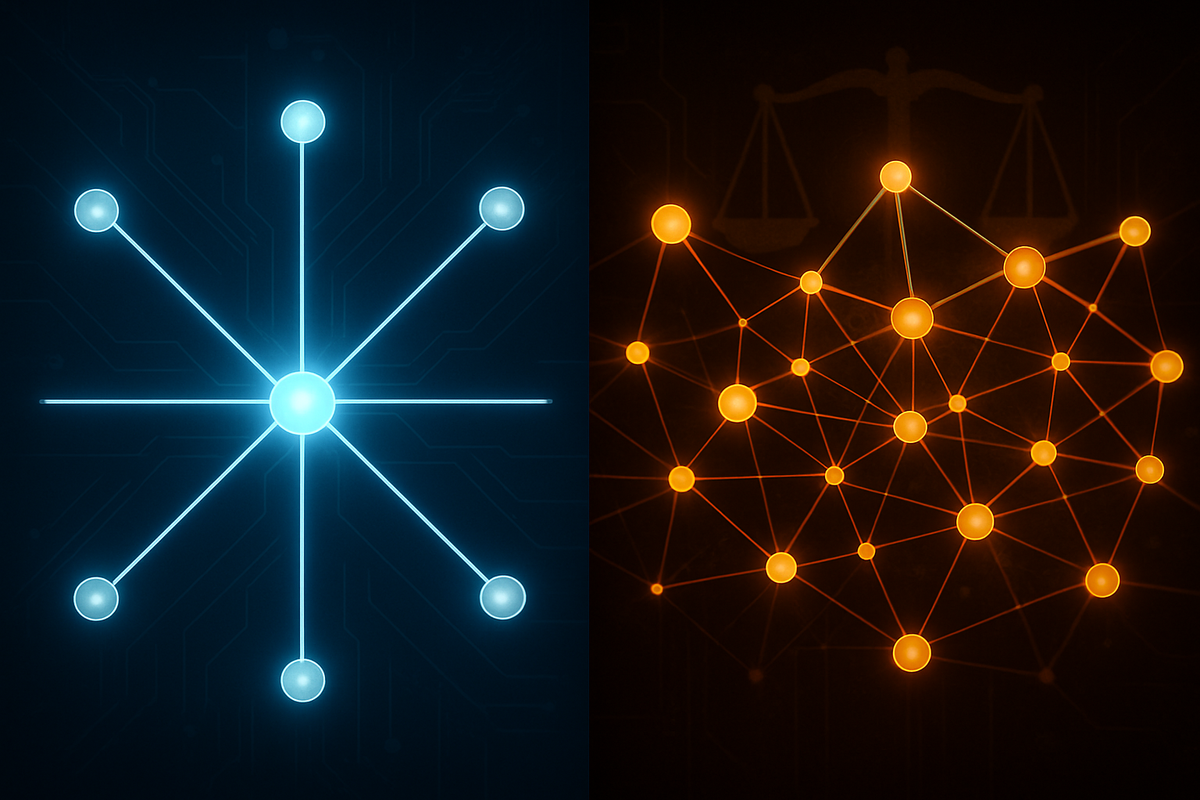
In a centralized orchestration model, a single orchestrator component (often called a "planner," "controller," or "supervisor agent") owns the full execution graph. It receives the top-level task, decomposes it into subtasks, dispatches those subtasks to specialized worker agents, collects their outputs, and synthesizes the final result. All agent-to-agent communication is routed through or at minimum registered with the orchestrator.
Think of it as a hub-and-spoke model. The orchestrator is the hub; every worker agent is a spoke. Popular implementations in 2026 include patterns built on frameworks like LangGraph's stateful graph execution, Microsoft's AutoGen with a GroupChat controller, and custom orchestration layers built on top of OpenAI's Assistants API with tool-calling chains.
Compliance Strengths
Centralized orchestration has a structural advantage when it comes to EU AI Act compliance, and it comes down to one word: chokepoint. Because all significant decisions and inter-agent communications flow through or are registered by the orchestrator, you have a natural single point of logging. Every subtask dispatch, every agent response, every synthesis step can be captured in one place with a consistent schema.
- Unified audit trail: The orchestrator's execution log is, by design, a near-complete record of the system's reasoning chain. Correlating a final output back to the specific agent invocations, tool calls, and data inputs that produced it is straightforward.
- Deterministic intervention points: Human oversight (Article 14) is structurally easier to implement. You can insert a human-in-the-loop checkpoint at the orchestrator level without retrofitting every individual agent. A single "pause and await approval" gate at the orchestrator covers the entire downstream agent graph.
- Consistent data governance: Because all inputs and outputs pass through a central point, enforcing data handling policies (e.g., ensuring personal data is pseudonymized before being passed to a third-party agent) is architecturally clean.
- Simpler conformity documentation: Article 17's quality management system requirement asks providers to document design choices and monitoring processes. With centralized orchestration, the system's behavior is largely described by the orchestrator's logic, which is a single, auditable codebase.
Compliance Weaknesses
Centralized orchestration is not without compliance risk. Its weaknesses tend to emerge at scale and under adversarial audit conditions.
- Single point of failure for logging: If your orchestrator's logging pipeline fails or is misconfigured, you lose your entire audit trail simultaneously. Regulators are not sympathetic to "the logger was down" explanations.
- Latency-driven log compression: In high-throughput production systems, teams are often tempted to compress or sample orchestrator logs to manage storage costs. This directly conflicts with Article 12's requirement for sufficient granularity.
- Black-box sub-agent behavior: If worker agents are third-party models or microservices, the orchestrator may log what it sent and received but not what happened inside the agent. This creates a transparency gap that Article 13 does not forgive easily.
- Scalability bottleneck creates shortcuts: As pipelines grow, the orchestrator can become a performance bottleneck. Teams under pressure sometimes introduce direct agent-to-agent communication paths that bypass the orchestrator, inadvertently creating unlogged decision paths.
Architecture 2: Decentralized Agent Mesh
How It Works
In a decentralized agent mesh, there is no single orchestrator. Instead, agents communicate peer-to-peer, often via a shared message bus, event stream, or a protocol like the emerging Agent-to-Agent (A2A) communication standards that have gained traction in 2026. Each agent is autonomous: it subscribes to relevant events, performs its function, and publishes results that other agents can consume. Coordination emerges from the interaction of agents rather than being imposed by a central authority.
This architecture is popular in high-scale, high-availability enterprise systems because it eliminates the orchestrator as a bottleneck and allows individual agents to be scaled, updated, or replaced independently. It aligns naturally with microservices patterns that many enterprise engineering teams already know well.
Compliance Strengths
The decentralized mesh is not inherently non-compliant. It has genuine compliance advantages in specific areas.
- Resilient logging infrastructure: Because each agent is independently deployable, each agent can maintain its own local audit log. There is no single logging failure mode that wipes out your entire audit trail. A well-designed mesh can offer higher logging availability than a centralized system.
- Granular agent-level accountability: Each agent's log is, by definition, a record of that agent's specific inputs, reasoning steps, and outputs. If you need to isolate the behavior of a specific agent during a specific time window, the mesh architecture makes that retrieval clean and precise.
- Independent human oversight per agent class: For certain high-risk decision types, you can implement human oversight at the individual agent level, which may actually exceed the Article 14 requirements rather than merely meeting them.
- Easier third-party agent auditing: In a mesh, third-party agents are first-class participants with their own logging obligations. Contractually requiring each agent provider to maintain compliant logs and expose them via a standardized API is architecturally natural in a mesh but awkward in a centralized model where the orchestrator "owns" the log.
Compliance Weaknesses
This is where the decentralized mesh faces its most serious EU AI Act challenges, and they are significant enough to give any compliance officer pause.
- The correlation problem: Article 12 requires that logs enable traceability of decisions. In a mesh, a single high-risk decision may be the emergent result of dozens of peer-to-peer agent interactions across multiple services, each with its own log. Reconstructing the full causal chain from distributed logs requires sophisticated log correlation infrastructure (think distributed tracing with AI-specific semantic tagging). Without this, your audit trail is technically complete but practically unusable.
- Non-deterministic execution paths: In a mesh, the same input can produce different execution paths depending on agent availability, message ordering, and concurrent interactions. This makes it harder to produce the kind of deterministic, reproducible audit narrative that conformity assessors expect.
- Emergent behavior attribution: When an undesirable outcome emerges from the collective behavior of ten agents, none of which individually made a "wrong" decision, which agent is accountable? The EU AI Act's provider and deployer liability framework assumes attributable decision-making. Emergent behavior in a mesh can create genuine legal ambiguity.
- Human oversight complexity: Implementing a meaningful human oversight gate (Article 14) in a mesh where decisions emerge from asynchronous, parallel agent interactions is architecturally non-trivial. You cannot simply "pause" a distributed event-driven system the way you can pause a centralized orchestrator.
- Governance surface area: Every agent in the mesh is potentially a regulated component. Maintaining Article 17-compliant quality management documentation across dozens of independently deployed agents, each potentially from a different provider, multiplies your compliance overhead substantially.
Head-to-Head: The Compliance Scorecard
Let's put both architectures through each of the key EU AI Act requirements and score them honestly.
| EU AI Act Requirement | Centralized Orchestration | Decentralized Mesh |
|---|---|---|
| Article 12: Automatic Logging | ✅ Strong (single-point capture) | ⚠️ Moderate (distributed, needs correlation layer) |
| Article 13: Transparency | ✅ Strong (clear reasoning chain) | ⚠️ Weak (emergent behavior hard to explain) |
| Article 14: Human Oversight | ✅ Strong (single intervention point) | ❌ Weak (async mesh hard to pause/override) |
| Article 17: Quality Management | ✅ Strong (centralized design documentation) | ⚠️ Moderate (high per-agent documentation burden) |
| Article 9: Risk Management | ✅ Strong (risk events easily correlated) | ⚠️ Moderate (requires distributed tracing investment) |
| Scalability Under Compliance Load | ⚠️ Moderate (orchestrator bottleneck risk) | ✅ Strong (horizontally scalable) |
| Third-Party Agent Accountability | ⚠️ Moderate (sub-agent opacity risk) | ✅ Strong (per-agent log ownership) |
The scorecard reveals a clear pattern: centralized orchestration wins on most of the qualitative compliance requirements, while the decentralized mesh wins on operational resilience and scalability. But the compliance advantages of centralized orchestration are only as strong as the implementation discipline around them.
The Hybrid Architecture: The Answer Nobody Wants to Hear (But Should)
If you were hoping for a clean "use Architecture A, not Architecture B" verdict, here is the uncomfortable truth: the most EU AI Act-resilient multi-agent pipelines in production in 2026 are neither purely centralized nor purely decentralized. They are hierarchically orchestrated meshes, and they borrow the compliance strengths of both models deliberately.
The pattern works like this:
- Compliance-critical decision paths use centralized orchestration. Any agent interaction that could directly produce a high-risk output (a credit decision, a hiring recommendation, a medical triage flag) runs through a compliance-aware orchestrator that enforces logging schemas, human oversight gates, and data governance policies.
- Non-decision-path workloads use mesh patterns. Data retrieval, context enrichment, formatting, and other supporting tasks that do not themselves constitute high-risk decisions can run in a decentralized mesh for scalability, with lightweight logging that feeds into the central compliance store.
- A unified observability layer correlates everything. A distributed tracing system (with AI-specific span attributes for model version, prompt hash, token counts, and decision confidence scores) aggregates logs from both the orchestrated and mesh components into a single queryable audit store.
- Human oversight is implemented at the orchestrator boundary. The orchestrator acts as the "compliance membrane" between the mesh's emergent behavior and the regulated output. Before any mesh-derived context is used in a high-risk decision, it passes through the orchestrator's oversight gate.
This hybrid approach is not a compromise. It is a deliberate architectural choice that maps the EU AI Act's risk-tiered logic onto your system's own risk-tiered architecture. High-risk paths get high-compliance infrastructure; low-risk paths get operational efficiency.
Practical Implementation Checklist for EU AI Act-Ready Multi-Agent Systems
Regardless of which architecture you choose, here are the non-negotiable implementation requirements for surviving a high-risk system conformity assessment in 2026:
- Immutable, tamper-evident logging: Use append-only log stores (such as write-once object storage or blockchain-anchored log hashes) for all high-risk decision logs. Regulators will ask whether your logs could have been modified after the fact.
- Semantic log schemas: Raw token streams and JSON blobs are not audit trails. Define and enforce a structured log schema that captures: agent identity and version, input data hash, model version, output, confidence score, timestamp, and human oversight status.
- Trace IDs that span agent boundaries: Every top-level task must carry a unique trace ID that propagates through every agent invocation, tool call, and sub-task. This is the thread that lets you reconstruct the full causal chain during an audit.
- Human oversight as a first-class system component: Do not bolt on human review as an afterthought. Design your orchestrator or mesh boundary to formally represent "awaiting human review" as a system state, with timeouts, escalation paths, and logged approval/rejection decisions.
- Third-party agent contractual obligations: If any agent in your pipeline is provided by a third party, your supply chain contracts must require them to maintain EU AI Act-compliant logs and make them available for audit. This is a legal requirement, not a nice-to-have.
- Regular internal "mock audits": Before a regulator asks you to reconstruct a specific decision from six months ago, practice doing it yourself. The ability to produce a complete, human-readable decision narrative from your logs within 48 hours is a reasonable internal benchmark.
The Verdict: Which Architecture Actually Survives?
Here is the direct answer: a well-implemented centralized orchestration architecture is more likely to pass a first-time EU AI Act high-risk conformity audit than a decentralized agent mesh of equivalent complexity, all else being equal. The structural alignment between a single orchestrator's execution log and the Act's requirement for a traceable, attributable decision record is simply too strong to ignore.
However, "all else being equal" is doing a lot of work in that sentence. A poorly implemented centralized orchestrator with sampled logs, no human oversight gates, and opaque third-party sub-agents will fail an audit just as surely as a mesh will. And a well-engineered decentralized mesh with a robust distributed tracing layer, a compliance membrane at the output boundary, and per-agent log ownership can absolutely be made compliant. It just requires significantly more upfront infrastructure investment.
The real lesson from the EU AI Act's traceability requirements is not that one architecture is inherently superior. It is that compliance is an architectural property, not a post-deployment feature. If you are designing a multi-agent pipeline in 2026 that will touch any high-risk domain under the Act, the time to make compliance decisions is in the architecture review, not in the audit response.
The enterprises that will thrive under the EU AI Act are not the ones that chose the "right" architecture. They are the ones that made their architectural choices with compliance traceability as a first-class design constraint from day one.



