Centralized AI Agent Orchestration vs. Decentralized Multi-Agent Mesh: Why the Conductor Pattern Is Quietly Killing Your Throughput in 2026
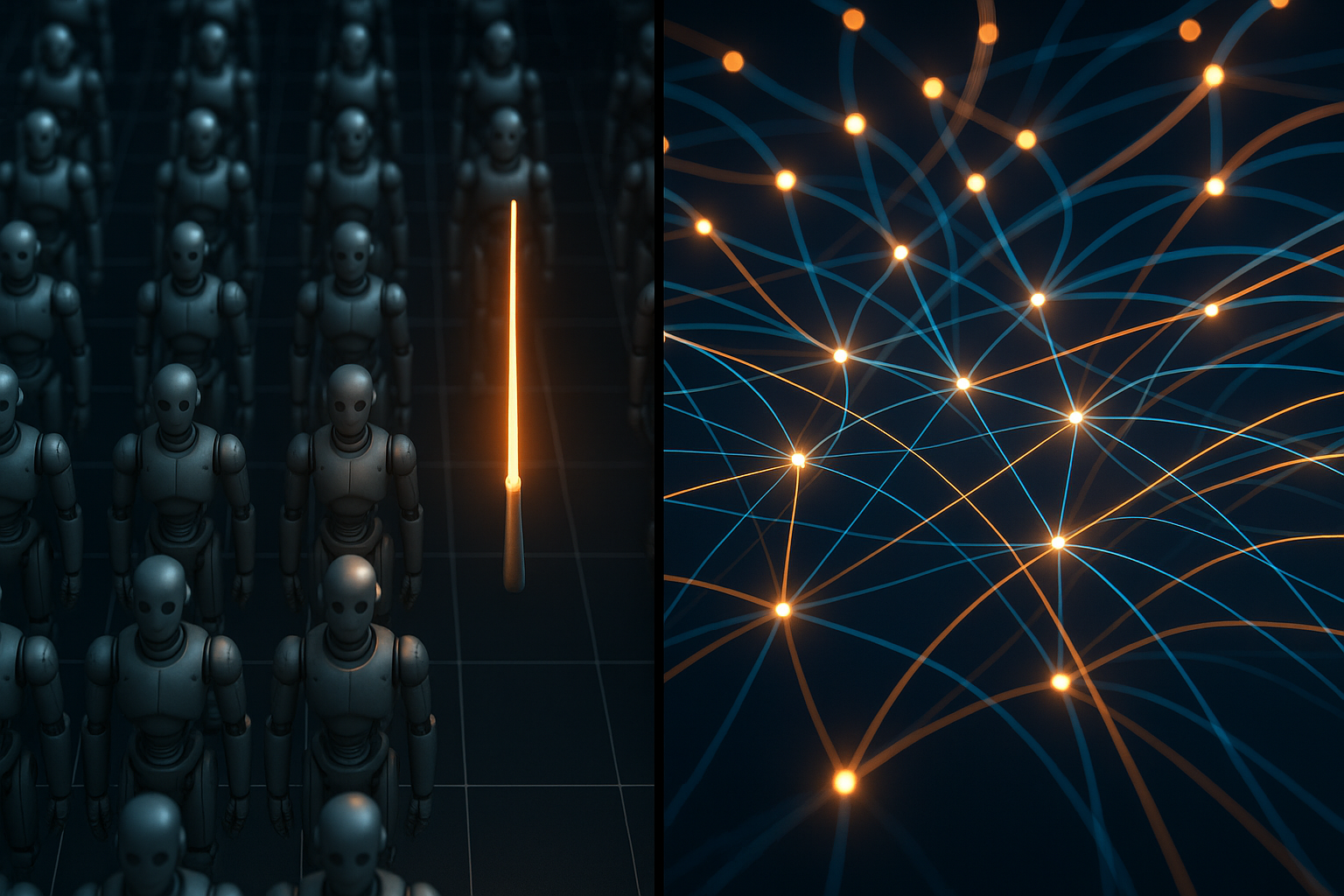
There is a quiet architectural crisis unfolding inside the backend systems of companies that moved fast to adopt agentic AI. Teams built their first multi-agent pipelines, reached for the most intuitive design pattern available, and landed on the conductor model: one orchestrator agent at the center, routing tasks, managing state, and coordinating every downstream worker agent like a maestro in front of an orchestra. It felt clean. It felt controllable. It felt right.
It was a trap.
As of 2026, the organizations running high-scale, multi-tenant AI systems are hitting a wall that their initial architecture reviews never anticipated. The conductor pattern, also called centralized AI agent orchestration, introduces a class of performance and reliability problems that only become visible at scale. Meanwhile, a growing cohort of platform engineers are quietly migrating toward decentralized multi-agent mesh architectures, and the throughput gains are not marginal. They are transformational.
This article breaks down both patterns in depth, examines where each one excels and where each one fails, and makes a direct case for why backend engineers in 2026 need to stop defaulting to the conductor model in high-scale, multi-tenant contexts.
First, Let's Define the Two Patterns Precisely
The Conductor Pattern (Centralized Orchestration)
In the conductor pattern, a single orchestrator agent, sometimes called the "planner," "router," or "supervisor," receives every incoming task and is responsible for:
- Decomposing the task into subtasks
- Routing each subtask to the appropriate specialist worker agent
- Collecting intermediate results and managing shared state
- Deciding on next steps based on prior outputs
- Assembling and returning the final response
This is the dominant pattern taught in most agentic AI frameworks. LangGraph's supervisor workflow, CrewAI's hierarchical process, and AutoGen's GroupChatManager all implement variations of this model. It is intuitive because it mirrors how humans think about task delegation. The orchestrator is the "brain," and the workers are the "hands."
The Multi-Agent Mesh (Decentralized Architecture)
In a mesh architecture, there is no single orchestrating authority. Instead, agents operate as autonomous, peer-level nodes in a graph. Each agent:
- Maintains its own local context and decision-making logic
- Communicates directly with peer agents via message-passing protocols or shared event buses
- Self-routes subtasks based on capability registries or semantic routing tables
- Handles failures locally through retry logic or peer delegation
- Contributes results to a distributed state store rather than reporting back to a single parent
Think of it less like an orchestra and more like a peer-to-peer network with intelligent nodes. Each agent knows what it can do, what its neighbors can do, and how to pass work forward without asking permission from a central authority.
The Case for Centralized Orchestration (And Why It's Not Wrong Everywhere)
To be fair, the conductor pattern is not inherently bad. It earns its place in specific contexts, and dismissing it entirely would be intellectually dishonest.
Where It Genuinely Excels
Low-concurrency, linear workflows: When you have a predictable, sequential pipeline with a small number of agents (say, three to five), centralized orchestration is perfectly adequate. The overhead of a coordinator is trivial at this scale.
Strict auditability requirements: Regulated industries, including healthcare, finance, and legal tech, often need a single, traceable decision log. A central orchestrator provides a natural choke point for logging every routing decision and state transition. This is genuinely valuable.
Complex dependency graphs: If Task C cannot begin until both Task A and Task B complete, and the dependency logic is intricate and dynamic, a centralized planner can manage that dependency resolution more cleanly than a mesh, where dependency awareness must be distributed across nodes.
Rapid prototyping: The conductor pattern is faster to build. For a proof-of-concept or an internal tool serving a handful of concurrent users, it is the pragmatic choice. The engineering cost of building a proper mesh is not justified at prototype scale.
The problem is not that engineers choose the conductor pattern for these use cases. The problem is that they keep using it when the use case changes, specifically when the system grows into high-scale, multi-tenant production traffic.
Where the Conductor Pattern Breaks Down at Scale
This is where the conversation gets uncomfortable for a lot of backend teams. The conductor pattern carries structural liabilities that compound as load increases. Here are the five most damaging failure modes.
1. The Orchestrator Becomes a Throughput Ceiling
Every agent task in a centralized system must pass through the orchestrator twice: once on the way in (task decomposition and routing) and once on the way out (result aggregation and decision on next step). In a multi-tenant system serving thousands of concurrent sessions, this means the orchestrator is processing 2N messages for every N tasks, plus its own LLM inference calls for planning decisions.
Even if your worker agents are horizontally scaled across dozens of replicas, the orchestrator becomes the narrowest pipe in the system. You cannot scale it as easily as stateless workers because it holds session state. You can shard it, but now you have introduced routing complexity at the infrastructure layer that you were trying to avoid at the application layer. The ceiling moves up, but it does not disappear.
2. It Is a Single Point of Failure by Design
In a multi-tenant production system, an orchestrator crash, an LLM timeout on the planning step, or a context window overflow on a complex task does not fail one session. It fails every session that orchestrator is managing. In a sharded setup, it fails an entire shard.
Mesh architectures distribute this failure surface. If one agent node fails, its peers detect the absence via heartbeat or message timeout and reroute work. No single node failure cascades to the entire system. This is not a theoretical benefit; it is the same reason distributed databases replaced monolithic database servers for high-availability requirements.
3. Latency Compounds Through the Orchestrator Hop
In a centralized system, consider a task that requires five sequential agent steps. Each step requires the worker to complete its work, return results to the orchestrator, the orchestrator to run an LLM inference call to decide what to do next, and then dispatch the next worker. That is five round trips through the orchestrator, each adding network latency plus inference latency for the planning model.
In a mesh, agents that have clear next-step logic can chain directly. Step 3 does not need to ask the conductor for permission to hand off to Step 4. It already knows. The latency profile for a five-step chain in a well-designed mesh can be 30 to 50 percent lower than the equivalent centralized flow, purely from eliminating unnecessary orchestrator hops.
4. Context Window Pressure Accumulates at the Orchestrator
The orchestrator in a centralized system must maintain awareness of the full task state across all active subtasks. In complex, long-running workflows, this means the orchestrator's context window fills with the outputs of every worker it has dispatched. At scale, this creates two problems: increased inference cost per orchestrator call, and a hard ceiling on workflow complexity imposed by the context window size of the planning model.
Mesh architectures sidestep this by distributing state. Each agent maintains only the context relevant to its local subtask. A shared vector store or distributed key-value store holds cross-agent state that any node can query selectively. No single node is burdened with the full cognitive load of the entire workflow.
5. Multi-Tenancy Isolation Is Harder to Enforce
In a multi-tenant system, different tenants must have strict data isolation. In a centralized orchestrator, tenant isolation logic must be baked into the orchestrator itself. Every routing decision, every state read, every result aggregation must be tenant-aware. This creates a sprawling surface area for isolation bugs.
In a mesh, tenant isolation can be enforced at the infrastructure layer: separate message bus topics per tenant, separate state store namespaces, separate agent pools for premium tiers. The isolation boundary is structural rather than logical, which is far more robust.
The Multi-Agent Mesh: How It Actually Works in Practice
Describing the mesh as "agents talking to each other" is too vague to be actionable. Here is what a production mesh architecture actually looks like in 2026.
Capability Registries and Semantic Routing
Each agent in the mesh registers its capabilities in a shared registry, essentially a structured description of what tasks it can handle, what inputs it expects, and what outputs it produces. When an agent needs to delegate a subtask, it queries the registry semantically: "Which agent can perform document summarization with legal domain expertise?" The registry returns the best-matched agent, and the delegating agent routes directly.
This eliminates the orchestrator's routing function without sacrificing routing intelligence. The routing logic is distributed across the registry and the agents themselves.
Event-Driven Message Passing
Agents in a mesh communicate via an event bus (Apache Kafka, Redpanda, and NATS are popular choices in 2026 deployments). Rather than synchronous request-response through a central coordinator, agents publish task completion events and subscribe to task request topics. This decouples producers from consumers and enables natural backpressure handling: if a worker agent pool is saturated, messages queue in the bus rather than blocking the entire pipeline.
Distributed State with Selective Context Retrieval
Shared state lives in a distributed store, typically a combination of a vector database for semantic retrieval and a fast key-value store for structured state. Agents pull only the context they need for their specific subtask. This keeps individual agent context windows lean and inference costs predictable per agent type.
Local Failure Handling and Peer Delegation
Each agent implements its own retry logic and failure escalation. If an agent cannot complete a task after a configured number of retries, it publishes a failure event to a dead-letter topic. A designated recovery agent, not a central orchestrator, subscribes to that topic and handles escalation. The recovery agent is itself just another peer in the mesh, not a privileged central authority.
A Direct Performance Comparison
To make this concrete, consider a representative high-scale scenario: a multi-tenant AI research assistant platform serving 10,000 concurrent sessions, each involving a five-agent workflow (query understanding, retrieval, reasoning, citation validation, and response synthesis).
| Dimension | Centralized Conductor | Decentralized Mesh |
|---|---|---|
| Orchestrator hops per workflow | 10 (2 per agent step) | 0 to 2 (direct chaining) |
| Single point of failure | Yes (orchestrator) | No (distributed failure surface) |
| Horizontal scalability | Limited (stateful orchestrator) | High (stateless agent nodes) |
| Tenant isolation mechanism | Logical (code-level) | Structural (infra-level) |
| Context window pressure | High (full state at orchestrator) | Low (local context per agent) |
| Engineering complexity | Low (initial build) | Higher (initial build) |
| Operational complexity at scale | High (orchestrator bottleneck) | Lower (distributed scaling) |
The Hybrid Middle Ground: When to Use Both
The most pragmatic position in 2026 is not "always mesh, never conductor." It is to understand the scope boundary of each pattern and apply them at the appropriate level of granularity.
A common production pattern is the mesh of conductors: at the macro level, the system is a mesh of autonomous domain clusters. Within each domain cluster, a lightweight conductor manages a small, tightly related set of agents (three to five) that always work together. The conductor handles intra-cluster coordination; the mesh handles inter-cluster routing and failure isolation.
This gives you the auditability and dependency management benefits of the conductor pattern at the local level, while avoiding the global bottleneck by ensuring no single conductor ever becomes the gateway for the entire system's traffic.
Migration Strategy: Moving from Conductor to Mesh Without Burning Down the System
For teams already running conductor-pattern systems in production, a full rewrite is rarely the right answer. Here is a pragmatic migration path.
Step 1: Identify the Routing-Only Decisions
Audit your orchestrator's LLM calls. Separate the calls that are purely routing decisions (which agent handles this?) from the calls that involve genuine reasoning (what should the system do given this unexpected result?). The routing-only decisions are your first migration targets. Replace them with capability registry lookups. This alone will reduce orchestrator inference load significantly.
Step 2: Extract Stateless Chains into Direct Agent Handoffs
Identify sequences of two or more agents that always execute in the same order with no branching. Convert these into direct handoff chains. Agent A calls Agent B directly when its work is complete, without routing through the orchestrator. The orchestrator only re-enters the picture when a decision point is reached.
Step 3: Move State to a Distributed Store
Begin externalizing the orchestrator's state into a distributed key-value store. This is a prerequisite for eventually removing the orchestrator's statefulness entirely. Once state is external, the orchestrator becomes stateless and horizontally scalable, which dramatically reduces its failure blast radius even before you fully migrate to a mesh.
Step 4: Introduce the Event Bus for Async Flows
For workflows that do not require synchronous responses, introduce an event bus and convert orchestrator dispatches to published events. Workers subscribe and pull work. This decouples the orchestrator from worker availability and introduces natural backpressure handling.
Step 5: Deprecate the Central Orchestrator Incrementally
Once routing is in the registry, chains are direct, state is external, and async flows are event-driven, the orchestrator's remaining role is small. Migrate its remaining functions to specialized peer agents (a planning agent, a recovery agent) and decommission the central role entirely.
The Deeper Problem: Architecture Defaults and Cognitive Inertia
The reason so many teams are stuck in the conductor pattern is not technical ignorance. It is cognitive inertia amplified by framework defaults. The most popular agentic AI frameworks in 2026 still present the supervisor/conductor pattern as the primary example in their documentation. It is the "hello world" of multi-agent systems. Engineers learn it first, build with it first, and it works well enough in development that the problems only surface in production.
This is the same pattern that played out with monolithic web applications in the early 2010s. The monolith was the default. It worked fine until it did not. The engineers who recognized the inflection point early, and invested in the harder architectural work of decomposition, were the ones whose systems survived the scale-up. The engineers who waited until the monolith was actively on fire paid a much higher cost to migrate.
The inflection point for multi-agent architectures is happening right now, in 2026. The teams hitting 10,000-plus concurrent agent sessions are finding the conductor pattern's limits in real time. The teams that are still at 500 concurrent sessions think the pattern is fine, and they are right, until they are not.
Conclusion: The Conductor Is a Starting Point, Not a Destination
The centralized conductor pattern is a legitimate and useful tool. It is not wrong. It is scope-limited. It belongs in low-concurrency workflows, in prototypes, in tightly controlled sequential pipelines, and as a local coordinator within a larger mesh cluster. It does not belong as the global architecture of a high-scale, multi-tenant AI system in 2026.
The engineers who will define the next generation of production AI infrastructure are the ones who understand that the conductor pattern is a starting point for learning, not a destination for scaling. The mesh is harder to build. It requires more upfront investment in capability registries, event infrastructure, distributed state management, and peer-level failure handling. But it is the architecture that actually survives contact with real production load.
If your multi-agent system is still running a single central orchestrator and you are beginning to see latency spikes, orchestrator saturation alerts, or cascading failures when one tenant's workload spikes, you are not experiencing bad luck. You are experiencing the predictable consequences of a pattern that was never designed for your current scale.
The good news is that the migration path is incremental. You do not have to rewrite everything at once. But you do have to start, and the best time to start is before the conductor becomes the crisis.