Centralized AI Agent Orchestration vs. Decentralized Mesh Architecture: Which Topology Actually Minimizes Blast Radius in H2 2026?
Somewhere in a Fortune 500 company's production environment right now, an AI agent is making a bad decision. Maybe it received a poisoned tool response. Maybe a subtle prompt injection slipped past its guardrails. Maybe it simply hallucinated a downstream API call that cascades into three dependent workflows. The question that enterprise architects are scrambling to answer in H2 2026 is not whether an agent will fail, but how much damage it takes with it when it does.
This is the blast radius problem, and it has quietly become the defining architectural challenge of the agentic AI era. As organizations move from single-agent assistants to sprawling multi-agent systems that autonomously manage procurement, code deployment, customer escalations, and financial reconciliation, the topology of how those agents connect and communicate is no longer an academic design preference. It is a risk management decision with real operational consequences.
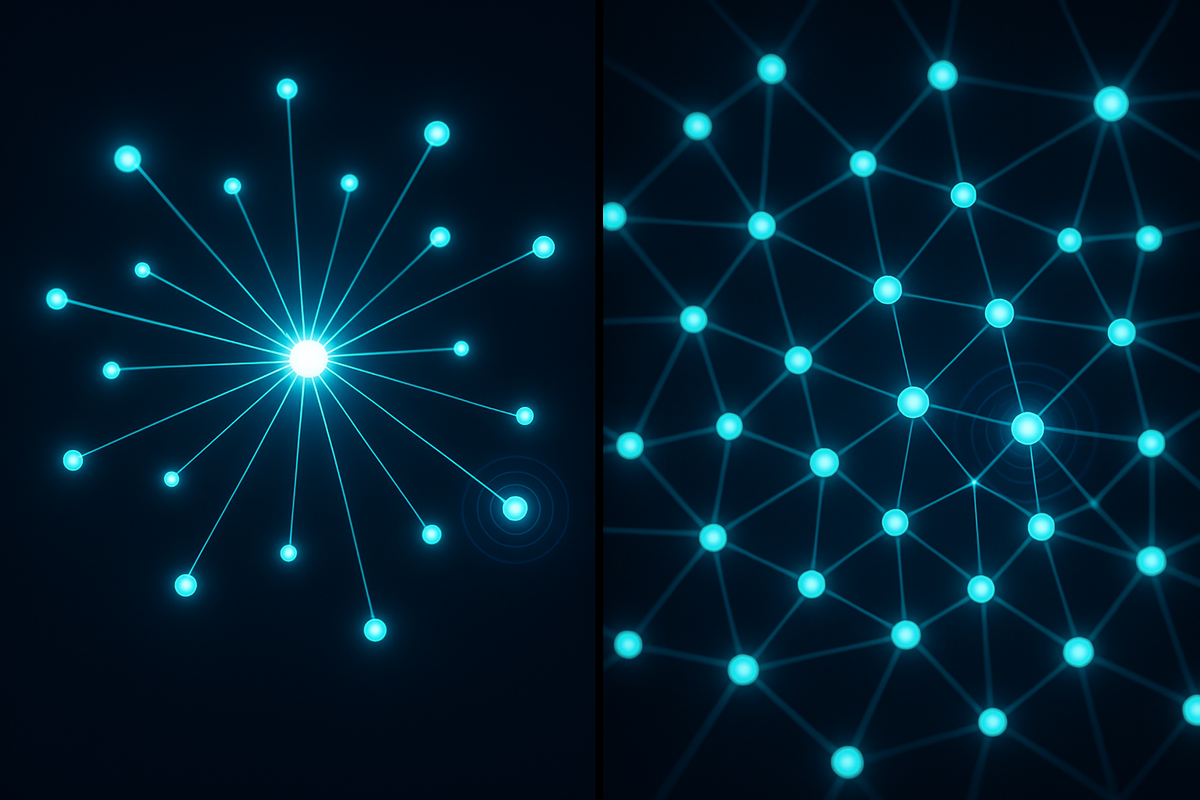
Two dominant schools of thought have emerged: Centralized Orchestration, where a single orchestrator agent directs and supervises all sub-agents, and Decentralized Mesh Architecture, where agents communicate peer-to-peer with no single point of control. Both have passionate advocates. Both have genuine failure modes. And in 2026, with enterprise agentic deployments scaling faster than the governance frameworks designed to contain them, choosing the wrong one can be catastrophic.
Let's break them down, head to head, specifically through the lens of failure containment and blast radius minimization.
Understanding the Blast Radius Problem in Agentic Systems
Before comparing topologies, it is worth defining what "blast radius" actually means in the context of multi-agent AI systems. The term is borrowed from cloud infrastructure, where it describes the scope of damage a single failure or security breach can cause. In agentic AI, blast radius encompasses several dimensions:
- Data integrity blast radius: How many data stores, records, or pipelines can a compromised agent corrupt or poison?
- Action blast radius: How many real-world actions (API calls, database writes, external service triggers) can a rogue agent execute before being stopped?
- Trust propagation blast radius: How far can a compromised agent's false outputs travel as trusted inputs to other agents?
- Workflow continuity blast radius: How many dependent workflows halt or degrade when a single agent is quarantined or fails?
In H2 2026, enterprise agentic systems routinely involve anywhere from a dozen to several hundred specialized agents. The interconnection density of those agents directly determines how quickly damage propagates. Topology is not decoration. It is your containment strategy.
Centralized Orchestration: The Command-and-Control Model
How It Works
In a centralized orchestration topology, a single orchestrator agent (sometimes called a "conductor" or "supervisor agent") holds the master workflow plan. It decomposes tasks, assigns work to specialized sub-agents, collects their outputs, evaluates results, and decides next steps. Sub-agents do not communicate directly with each other. All information flows up to the orchestrator and back down. Frameworks like LangGraph's supervisor pattern, AutoGen's group chat manager, and proprietary enterprise orchestration layers from major cloud vendors follow this model.
Blast Radius Profile: Centralized Orchestration
The centralized model has a deeply asymmetric blast radius profile. Its strengths and vulnerabilities are mirror images of each other.
Where it excels at containment: When a sub-agent is compromised or produces erroneous output, the blast radius of that agent's actions is naturally limited. The sub-agent only does what the orchestrator explicitly tasks it to do. It cannot spontaneously initiate lateral communication with other agents, trigger unrelated workflows, or chain its bad output directly into a sibling agent's input. The orchestrator acts as an inspection layer. Anomaly detection, output validation, and circuit-breaker logic live in one place, making them easier to implement and audit.
Where it catastrophically fails: The orchestrator itself is the single most dangerous attack surface in your entire system. If the orchestrator agent is compromised via prompt injection, adversarial tool poisoning, or a corrupted context window, the blast radius is effectively the entire system. A malicious actor who successfully manipulates the orchestrator does not need to compromise individual agents. They own the task assignment logic, the result aggregation layer, and the decision gateway simultaneously. In a 200-agent enterprise system, a compromised orchestrator is a master key.
Additionally, centralized orchestration creates a trust propagation bottleneck. Because all agents treat the orchestrator's instructions as authoritative, a corrupted orchestrator can instruct agents to take actions they would otherwise refuse, bypassing individual agent-level guardrails. The very feature that makes centralized systems easy to govern, namely a single authoritative controller, becomes the mechanism of maximum damage.
Operational Failure Modes in 2026 Deployments
In practice, the centralized model also suffers from what practitioners are calling "orchestrator context bloat." As enterprise workflows grow more complex, the orchestrator's context window must hold increasingly large representations of workflow state, sub-agent outputs, and decision history. In H2 2026, even with context windows measured in millions of tokens, orchestrators managing complex financial or DevOps workflows regularly hit coherence degradation thresholds. When the orchestrator's reasoning degrades, it does not fail cleanly. It fails subtly, producing plausible-sounding but incorrect task assignments that sub-agents dutifully execute.
Decentralized Mesh Architecture: The Peer-to-Peer Model
How It Works
In a decentralized mesh topology, agents communicate directly with each other through a shared message bus, a publish-subscribe event system, or direct peer-to-peer API calls. There is no single orchestrator. Instead, agents self-organize around tasks using negotiation protocols, capability registries, and local decision logic. An agent that needs a piece of work done broadcasts a request or queries a registry to find a capable peer, negotiates the handoff, and receives results directly. Emergent workflow coordination replaces top-down control. This model draws inspiration from microservices architecture, distributed systems design, and multi-agent reinforcement learning research.
Blast Radius Profile: Decentralized Mesh
The mesh model's blast radius profile is essentially the inverse of centralized orchestration, with its own distinct asymmetries.
Where it excels at containment: There is no single point of catastrophic failure. Compromising one agent in a mesh does not grant control over the workflow coordination layer, because there is no centralized coordination layer to control. The blast radius of a compromised agent is theoretically limited to its direct peer connections and the scope of its own capabilities. Fault isolation is structural rather than policy-dependent. You do not need to write a rule that says "quarantine compromised agents." The architecture inherently limits lateral blast propagation because each agent independently validates inputs from peers rather than deferring to a trusted authority.
Where it catastrophically fails: The decentralized mesh has a severe trust propagation blast radius problem that is often underestimated. Because agents communicate peer-to-peer and must make local trust decisions about incoming messages, a compromised agent can systematically poison the inputs of every agent it communicates with. In a densely connected mesh, a single bad actor agent can reach a large portion of the network within just two or three communication hops. Unlike the centralized model, where poisoned output is caught at the orchestrator before redistribution, in a mesh there is no natural inspection chokepoint.
Furthermore, decentralized systems are significantly harder to monitor and audit. When a workflow produces a bad outcome in a mesh architecture, reconstructing the causal chain of agent-to-agent messages to identify the root compromise is an extraordinarily complex forensic challenge. In regulated industries such as finance, healthcare, and critical infrastructure, this auditability gap is a serious compliance liability in 2026.
The Emergent Behavior Problem
Mesh architectures also introduce a failure mode that has no direct equivalent in centralized systems: emergent catastrophic coordination. When multiple agents in a mesh each make individually reasonable local decisions, the aggregate emergent behavior can produce outcomes that no single agent intended and no governance policy anticipated. This is not a security failure in the traditional sense. It is a systems dynamics failure, and it is uniquely difficult to detect because every individual agent appears to be behaving correctly when examined in isolation.
Head-to-Head Comparison: Eight Critical Dimensions
Let's put both topologies side by side across the dimensions that matter most for enterprise blast radius management in H2 2026:
1. Single-Agent Compromise Impact
Centralized: Low impact for sub-agent compromise; catastrophic impact for orchestrator compromise.
Mesh: Moderate and bounded impact for any single agent compromise, but with higher lateral propagation risk through trust poisoning.
Edge: Mesh (no single catastrophic failure point)
2. Auditability and Forensics
Centralized: Excellent. All workflow decisions pass through one node, creating a natural audit log with clear causal chains.
Mesh: Poor to moderate. Distributed message logs must be correlated across many agents to reconstruct causality.
Edge: Centralized
3. Guardrail Implementation Complexity
Centralized: Low complexity. Guardrails implemented once at the orchestrator protect the entire system.
Mesh: High complexity. Every agent must independently implement and maintain its own validation, rate limiting, and anomaly detection logic.
Edge: Centralized
4. Resilience to Orchestrator-Layer Attacks
Centralized: Very poor. A successful orchestrator compromise is a system-wide compromise.
Mesh: Excellent. No orchestrator exists to target.
Edge: Mesh
5. Workflow Continuity Under Partial Failure
Centralized: Poor. Orchestrator failure halts all dependent workflows simultaneously.
Mesh: Excellent. Agents dynamically reroute around failed peers using capability registries.
Edge: Mesh
6. Trust Propagation Containment
Centralized: Moderate. Corrupted orchestrator propagates bad trust universally; sub-agent corruption is contained.
Mesh: Variable. Depends heavily on connection density and peer validation rigor.
Edge: Tie (context-dependent)
7. Regulatory Compliance Readiness
Centralized: Strong. Centralized decision logs align well with audit requirements under frameworks like the EU AI Act's 2026 enforcement provisions.
Mesh: Weak without significant additional tooling investment.
Edge: Centralized
8. Scalability Without Proportional Risk Growth
Centralized: Poor. Orchestrator becomes a bottleneck and a proportionally larger attack surface as agent count grows.
Mesh: Good. Risk does not concentrate as the system scales, though complexity does.
Edge: Mesh
The Emerging Consensus: Hierarchical Mesh Hybrid
Here is the uncomfortable truth that the either-or framing obscures: in H2 2026, the most resilient enterprise deployments are not using pure centralized orchestration or pure mesh architecture. They are using a hierarchical mesh hybrid, and the specific design decisions within that hybrid are where blast radius management actually happens.
The pattern looks roughly like this: a small cluster of domain-scoped orchestrators (not a single global one) each manage a bounded set of sub-agents within their domain. These domain orchestrators themselves communicate peer-to-peer in a mesh topology, with no global super-orchestrator above them. Think of it as a federated model. Each domain orchestrator limits blast radius within its domain. The mesh topology between domains prevents any single domain orchestrator compromise from cascading system-wide.
This hybrid approach captures the auditability and guardrail simplicity of centralized orchestration within bounded domains, while capturing the resilience and continuity benefits of mesh topology at the inter-domain level. Critically, it also limits the blast radius of orchestrator compromise to a single domain rather than the entire system.
Key design principles for the hybrid model include:
- Domain boundary enforcement: Agents within a domain cannot directly invoke agents in another domain without passing through the inter-domain mesh protocol, creating natural inspection points at domain boundaries.
- Orchestrator redundancy: Each domain orchestrator runs with a hot standby that uses independent model weights and system prompts, preventing a single prompt injection from compromising both the primary and backup simultaneously.
- Cryptographic message provenance: All inter-agent messages are signed with agent-specific keys, enabling rapid forensic reconstruction and preventing message spoofing in the mesh layer.
- Capability-scoped permissions: Agents are granted the minimum tool and data access required for their specific function, enforced at the infrastructure layer rather than the agent layer, so a compromised agent cannot self-escalate privileges regardless of what instructions it receives.
What This Means for Enterprise Architects Right Now
If you are designing or auditing a multi-agent system for enterprise deployment in H2 2026, here is the practical guidance that follows from this analysis:
Do not build a global orchestrator for systems with more than 15 to 20 agents. The attack surface and context coherence risks outweigh the governance simplicity benefits at that scale. Decompose into domain orchestrators instead.
Do not deploy a pure mesh without investing heavily in distributed observability. A mesh without comprehensive message tracing, anomaly correlation, and automated causal reconstruction is a forensic nightmare waiting to happen. Tools like distributed agent telemetry platforms and agentic SIEM integrations are no longer optional in regulated environments.
Treat the orchestrator as your highest-value hardening target. Whether you use a centralized or hybrid model, the orchestrator's system prompt, tool access, and context validation deserve the same security rigor as a privileged identity in your IAM system. Red-team it specifically for prompt injection and tool poisoning attacks before production deployment.
Design for quarantine, not just prevention. Every agent in your topology should have a defined quarantine protocol: what happens to in-flight tasks, how dependent agents are notified, and how the system degrades gracefully when that agent is removed. Blast radius minimization is not just about preventing compromise. It is about containing it rapidly when prevention fails.
Conclusion: Topology Is Your First Line of Defense
The debate between centralized orchestration and decentralized mesh is not going to be settled by a single architecture winning out. The reality of enterprise agentic AI in H2 2026 is that the right topology is context-dependent, scale-dependent, and risk-profile-dependent. But the framing of the question matters enormously.
Too many organizations are still choosing their multi-agent topology based on developer convenience, framework defaults, or demo aesthetics. In a world where AI agents are autonomously executing financial transactions, modifying production infrastructure, and managing customer relationships, topology is a risk management decision that belongs in the same conversation as your security architecture, your compliance posture, and your incident response plan.
The agents will fail. The question is whether your architecture was designed for that reality. Blast radius is not a product feature you can patch in later. It is a structural property of your system from day one. Choose your topology accordingly.



