Centralized Agentic Orchestration vs. Decentralized Mesh Architecture: Which Model Should Enterprise Backend Teams Choose at Scale?
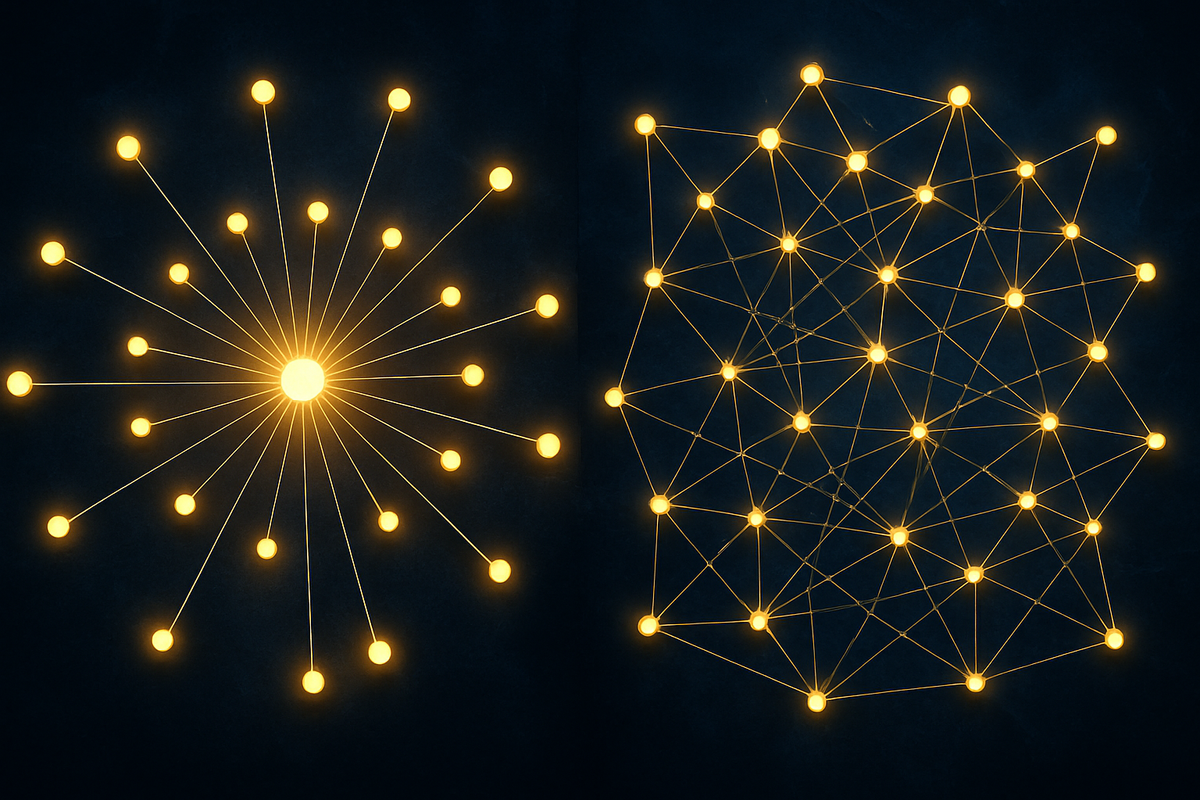
Something quietly broke in enterprise AI deployments late last year. Teams that had carefully built multi-agent pipelines on centralized orchestration platforms started hitting walls, not just performance walls, but architectural ones. A single orchestrator routing 60, 80, or 100 concurrent agent workflows began to look less like a control tower and more like a bottleneck wearing a suit. Meanwhile, a growing cohort of backend teams was quietly shipping decentralized agent mesh architectures and reporting surprisingly different results.
This is the conversation that matters most in enterprise AI infrastructure right now. As multi-agent systems mature beyond proof-of-concept and into production at scale, the deployment model you choose will define your system's ceiling. In 2026, with agentic AI embedded in everything from financial reconciliation pipelines to autonomous DevOps loops, the stakes of that choice have never been higher.
This article breaks down both models with precision: what they are, how they perform under real enterprise load, where each breaks, and which teams should choose which, especially when concurrent workflows push past that critical threshold of 50.
Setting the Stage: What "Agentic Scale" Actually Means in 2026
Before comparing architectures, it's worth anchoring on what "scale" means in the current agentic context. An AI agent, in the enterprise sense, is no longer a simple LLM call wrapped in a Python function. Modern agents in 2026 carry persistent memory, tool-use capabilities, access to real-time data APIs, and the ability to spawn sub-agents or delegate tasks laterally. A single "workflow" may involve 5 to 20 agents operating across multiple model providers, retrieval systems, and external services.
When we say 50+ concurrent workflows, we mean:
- 50+ distinct goal-directed agent chains running simultaneously, each potentially spawning child agents
- Hundreds to thousands of individual LLM inference calls per minute across those workflows
- Shared resource contention across vector stores, tool registries, memory backends, and rate-limited external APIs
- State management complexity that grows non-linearly with workflow count
This is not a hypothetical load. It is the operational reality for enterprise teams in financial services, healthcare operations, e-commerce, and large-scale SaaS platforms deploying agentic systems in 2026. The architecture you choose to handle this load is a foundational decision.
Model One: Centralized Agentic Orchestration
How It Works
In a centralized orchestration model, a single orchestrator layer (sometimes called a "conductor," "supervisor," or "master agent") owns the full lifecycle of every workflow. It receives incoming tasks, decomposes them into subtasks, assigns those subtasks to specialized worker agents, collects results, manages retries, and produces final outputs. Frameworks like LangGraph, AutoGen's group chat manager pattern, and proprietary enterprise platforms such as Salesforce Agentforce and ServiceNow's AI Agent Fabric lean heavily into this paradigm.
The orchestrator maintains a global view of the system state. It knows which agents are busy, which workflows are in flight, what tools have been used, and what the current execution graph looks like. This is its core value proposition: visibility and control from a single plane.
Strengths of Centralized Orchestration
- Unified observability: Every agent action, tool call, and state transition flows through one system. Logging, tracing, and debugging are dramatically simpler. Your on-call engineer has one dashboard to check, not fifteen.
- Deterministic workflow control: The orchestrator can enforce strict sequencing, dependency resolution, and conditional branching with high predictability. This matters enormously in regulated industries where audit trails are mandatory.
- Simpler security model: Access control, secret management, and API key distribution happen at one layer. There is no need to distribute credentials to dozens of autonomous nodes.
- Easier onboarding: New agents are registered with the orchestrator. Teams don't need to understand the full mesh topology to add capabilities.
- Conflict prevention: The orchestrator can arbitrate resource contention, preventing two workflows from hammering the same rate-limited API simultaneously.
Where Centralized Orchestration Breaks Down
The problems emerge at scale, and they are structural, not just operational.
- Single point of failure: If the orchestrator crashes or degrades, every workflow in flight is affected. High-availability clustering of the orchestrator adds significant engineering overhead and cost.
- Latency amplification: Every agent interaction routes through the orchestrator. At low concurrency this is negligible. At 50+ concurrent workflows, the orchestrator's own processing time becomes a measurable component of end-to-end latency, often adding 80 to 300ms per hop depending on implementation.
- Horizontal scaling friction: The orchestrator itself is stateful. Scaling it horizontally requires careful distributed state synchronization, which effectively means you're rebuilding a distributed system inside your "centralized" model.
- Cognitive load on the orchestrator agent: When the orchestrator is itself an LLM-based agent (as in many modern agentic frameworks), asking it to manage 50+ active workflows simultaneously is asking a single model context to hold enormous state. Token limits, context degradation, and reasoning errors increase with orchestrator load.
- Throughput ceiling: In benchmarks run by enterprise AI teams throughout early 2026, centralized orchestrators on standard cloud infrastructure typically plateau at 40 to 70 concurrent workflows before requiring expensive vertical scaling or architectural workarounds.
Model Two: Decentralized Agent Mesh Architecture
How It Works
In a decentralized mesh architecture, there is no single orchestrator. Instead, agents are autonomous peers that communicate directly with each other through message-passing protocols, shared event buses, or peer-to-peer APIs. Each agent is responsible for its own state, its own tool access, and its own decision-making about what to do next. Coordination happens through shared contracts: well-defined message schemas, capability registries, and consensus mechanisms rather than top-down command.
Think of it less like an army with a general and more like a market with buyers and sellers. Agents advertise capabilities, accept tasks that match their specialization, and publish results that other agents can consume. Architecturally, this resembles microservices but with autonomous, goal-directed nodes instead of stateless request handlers.
Emerging frameworks and protocols driving this model in 2026 include Google's Agent-to-Agent (A2A) protocol, Anthropic's inter-agent communication patterns built on the Model Context Protocol (MCP), and open-source projects like AgentMesh and CrewAI's multi-crew federation features.
Strengths of Decentralized Mesh Architecture
- Horizontal scalability by design: Adding more agents to the mesh increases capacity without touching existing nodes. There is no central bottleneck to scale around. Teams running mesh architectures have reported sustaining 150 to 300+ concurrent workflows on the same infrastructure footprint that would choke a centralized orchestrator at 60.
- Fault isolation: When one agent node fails, only the workflows it was directly handling are affected. Other agents continue operating. The mesh self-heals by redistributing tasks to available peers.
- Lower latency for peer communication: Agents that need to collaborate can communicate directly without routing through a central hub. For tightly coupled subtasks, this can reduce inter-agent round-trip times by 40 to 60 percent.
- Independent deployment and versioning: Individual agent nodes can be updated, redeployed, or replaced without coordinating a full system deployment. This is a massive operational advantage for teams shipping fast.
- Natural alignment with domain teams: In large enterprises, different business units own different capabilities. A mesh architecture maps cleanly onto organizational boundaries: the finance team owns the reconciliation agent cluster, the DevOps team owns the infrastructure agents, and so on.
Where Decentralized Mesh Architecture Breaks Down
The mesh model is not a free lunch. Its costs are real and often underestimated by teams seduced by its scaling story.
- Observability is genuinely hard: Distributed tracing across a mesh of autonomous agents requires serious investment in telemetry infrastructure. Without it, debugging a failed workflow means reconstructing a causal chain across dozens of independent logs. OpenTelemetry integration is non-negotiable, and even then, the cognitive overhead is substantial.
- Emergent behavior and coordination failures: Without a central arbiter, agents can enter deadlocks, race conditions, or feedback loops. Two agents can simultaneously decide to call the same external API, triggering rate limits that cascade across the mesh. Designing against these failure modes requires sophisticated contract design and testing.
- Security surface area expansion: Every agent-to-agent communication channel is a potential attack surface. Secret management, mTLS between agents, and capability-based access control must be implemented at every node. This is not a one-time setup; it's an ongoing operational discipline.
- Harder to enforce compliance and audit: In regulated industries, proving that a specific decision was made by a specific agent at a specific time, based on specific inputs, is much harder when there is no central record of authority. Mesh architectures require purpose-built audit logging that can reconstruct the full causal graph of any workflow.
- Steeper initial engineering investment: Getting a mesh to 80 percent reliability is straightforward. Getting it to 99.9 percent reliability requires solving hard distributed systems problems that centralized architectures sidestep entirely.
Head-to-Head Comparison: The Metrics That Matter
Let's put both models side by side across the dimensions that enterprise backend teams actually care about at scale.
- Concurrent Workflow Capacity (50+ threshold): Centralized orchestration struggles and requires expensive mitigation. Mesh architecture handles it natively with linear scaling. Winner: Mesh.
- Operational Observability: Centralized orchestration offers a single pane of glass out of the box. Mesh requires significant telemetry investment. Winner: Centralized.
- Fault Tolerance: Centralized creates a single point of failure (mitigated but not eliminated by HA clustering). Mesh provides natural fault isolation. Winner: Mesh.
- Time to First Deployment: Centralized architectures are faster to stand up and reason about initially. Winner: Centralized.
- Regulatory Compliance and Auditability: Centralized wins with deterministic, traceable execution paths. Mesh requires significant additional engineering to match. Winner: Centralized.
- Long-term Infrastructure Cost at Scale: Mesh architecture distributes load more efficiently, reducing the need for expensive vertical scaling. Winner: Mesh.
- Team Autonomy and Independent Deployability: Mesh architecture aligns naturally with distributed team ownership. Winner: Mesh.
- Security Implementation Complexity: Centralized has a smaller, more manageable security surface. Winner: Centralized.
The 50-Workflow Inflection Point: Why This Number Matters
Fifty concurrent workflows is not an arbitrary threshold. It represents the point at which the tradeoffs of centralized orchestration stop being theoretical and start showing up in production metrics. Here is what typically happens to centralized systems crossing this threshold:
Between 1 and 30 concurrent workflows, centralized orchestration performs excellently. Latency is predictable, debugging is straightforward, and the engineering team maintains full situational awareness. This is the sweet spot for centralized models.
Between 30 and 50 concurrent workflows, the first signs of strain appear. Orchestrator queue depths increase. P95 latencies begin climbing. Teams start adding caching layers, rate-limit management middleware, and orchestrator replicas, each of which adds complexity to what was supposed to be a simple system.
Beyond 50 concurrent workflows, centralized orchestration requires one of three expensive choices: vertical scaling of the orchestrator (costly and has a ceiling), horizontal scaling with distributed state (effectively rebuilding a distributed system), or workflow sharding (splitting the system into multiple isolated orchestrators, which sacrifices the global visibility that justified the centralized model in the first place).
This is precisely where the mesh architecture's upfront complexity investment starts paying dividends. The engineering debt you paid to build robust agent contracts, distributed tracing, and peer-to-peer communication now buys you a system that scales to 200 concurrent workflows with configuration changes, not architectural rewrites.
A Hybrid Path: The Hierarchical Mesh
The most sophisticated enterprise teams in 2026 are not choosing one model or the other in pure form. They are building what practitioners are calling the hierarchical mesh: a tiered architecture that uses lightweight domain orchestrators at the top of each functional cluster, with autonomous agent meshes operating within each cluster and peer-to-peer protocols connecting clusters to each other.
In this model:
- Each business domain (finance, operations, customer experience) has its own lightweight orchestrator responsible for 10 to 20 agents maximum, keeping the orchestrator load well within the comfortable range.
- Within each domain, agents operate as peers, communicating directly and scaling horizontally.
- Cross-domain workflows are handled via inter-cluster messaging protocols (A2A or MCP-based), without any single orchestrator needing global visibility.
- A global observability plane (built on OpenTelemetry and a distributed trace aggregator) stitches together the full picture without being in the critical path of execution.
This hybrid approach preserves the auditability and control benefits of orchestration within each domain while gaining the horizontal scalability and fault isolation of the mesh at the system level. It is more complex to design initially, but it is the architecture that teams report the fewest regrets about at the 12-month mark.
Which Teams Should Choose Which Model
Choose Centralized Orchestration If:
- Your peak concurrent workflow load is reliably below 40 and growth projections are modest
- You operate in a heavily regulated industry (financial services, healthcare, government) where auditability is a hard requirement and you cannot yet invest in mesh-native compliance tooling
- Your backend team is small (fewer than 6 engineers) and cannot absorb the operational complexity of a distributed agent mesh
- You are in an early-stage deployment where iteration speed and debuggability matter more than raw throughput
- Your agent workflows are tightly sequential and benefit from strict dependency enforcement
Choose Decentralized Mesh Architecture If:
- You are already at or approaching 50+ concurrent workflows with no signs of load reduction
- Your organization has multiple independent teams that need to own and deploy agents autonomously
- Your workflows are highly parallel with many independent subtasks that don't require strict sequential coordination
- You have the engineering maturity to invest in distributed tracing, contract testing, and mesh security from day one
- Long-term infrastructure cost efficiency is a strategic priority
Choose the Hierarchical Mesh If:
- You are building for scale from the start and expect to cross 50 concurrent workflows within 6 months
- You need both domain-level auditability and system-level scalability
- Your organization is large enough to have distinct domain teams but centralized enough to align on shared protocols
- You want the architecture that offers the most headroom without a full rewrite at scale
Conclusion: The Architecture Is the Strategy
In 2026, the choice between centralized agentic orchestration and decentralized mesh architecture is not a technical detail to be deferred. It is a strategic decision that will shape your system's scalability ceiling, your team's operational burden, your compliance posture, and your infrastructure costs for years. Getting it wrong at the foundation means expensive rewrites precisely when your business is trying to accelerate on the back of agentic AI.
The honest summary: centralized orchestration is the right starting point for most teams, but it has a hard ceiling that becomes visible around 50 concurrent workflows. Decentralized mesh architecture is the right model for scale, but it demands engineering maturity and upfront investment that not every team is ready to make. The hierarchical mesh is the emerging consensus for enterprise teams that need both control and scale, and it is quickly becoming the reference architecture for serious production deployments.
Whatever model you choose, make the decision deliberately, document the tradeoffs you accepted, and build observability into the architecture from day one. In agentic systems at scale, the teams that win are not the ones who picked the cleverest architecture. They are the ones who understood their architecture deeply enough to know exactly where it would break, and planned for it before it did.



