A Beginner's Guide to AI Agent Dependency Graph Architecture: What Enterprise Backend Teams Need to Know Before Circular Tool References Deadlock Your Multi-Agent Workflows
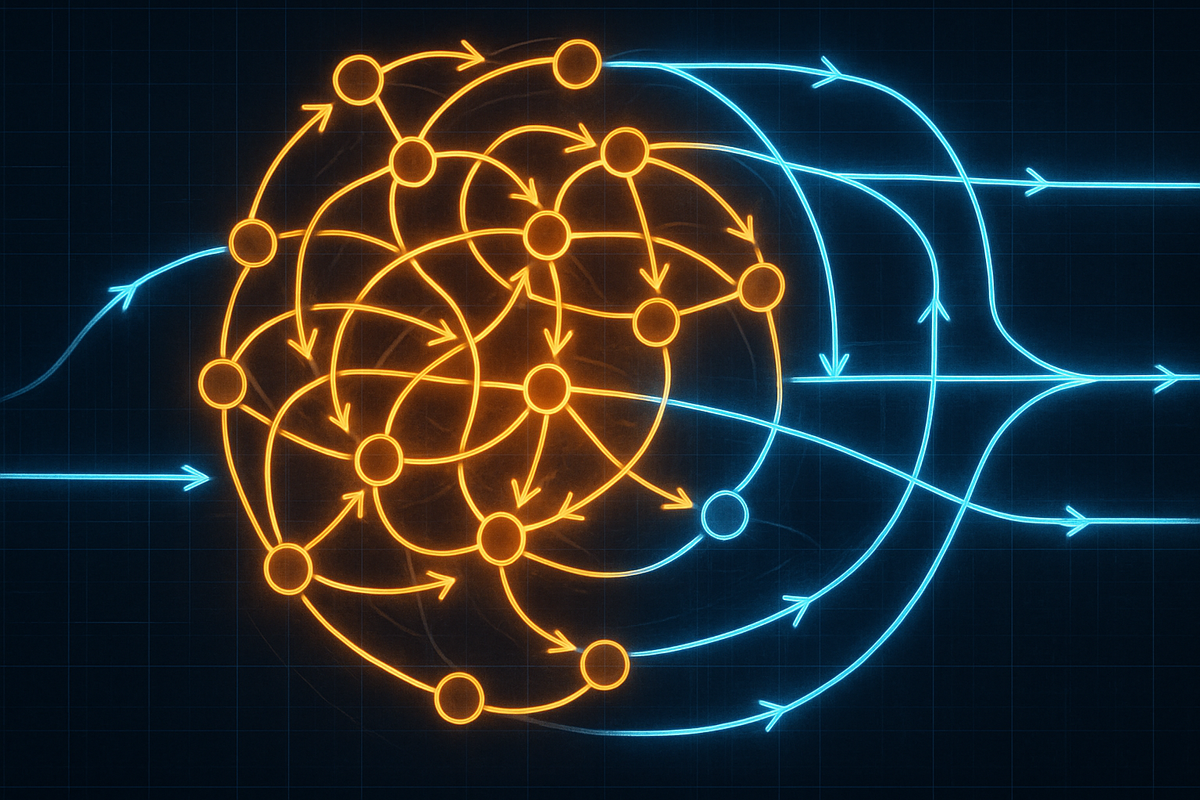
Here is a scenario that is becoming painfully common in enterprise backend teams in 2026: you spin up a promising multi-agent AI workflow, everything looks clean in the design doc, and then, somewhere in production, the whole thing quietly grinds to a halt. No crash. No error. Just silence. The culprit, more often than not, is a circular tool reference buried inside your agent dependency graph.
If you have never heard the term "agent dependency graph" before, you are in the right place. This guide is written specifically for backend engineers and platform teams who are being handed multi-agent AI systems to build or maintain, often without a formal background in AI orchestration. We will break down what dependency graphs are, why they matter, how circular references form, and what you can do right now to prevent deadlocks before they cost you a production incident.
What Is an AI Agent Dependency Graph?
Let's start from the ground up. In a modern enterprise AI system, you rarely have just one AI agent doing all the work. Instead, you have a network of specialized agents, each responsible for a narrow task: one agent queries a database, another summarizes documents, another validates outputs, another routes decisions. These agents communicate by calling each other's tools or passing outputs as inputs.
A dependency graph is simply a map of those relationships. It is a directed graph where:
- Nodes represent individual agents or tools.
- Edges represent dependencies, meaning "Agent A needs the output of Agent B before it can proceed."
In graph theory terms, a healthy dependency graph is a Directed Acyclic Graph (DAG). The "acyclic" part is the critical word. It means there are no loops. Work flows in one direction, from upstream agents to downstream agents, and eventually terminates with a result.
Think of it like a well-designed build pipeline. Task A compiles code, Task B runs tests on that compiled code, Task C deploys the tested artifact. Each step depends on the previous one, but no step depends on something that comes after it. Clean, predictable, terminable.
Why Enterprise Teams Are Getting This Wrong in 2026
The explosion of agentic frameworks (think LangGraph, AutoGen, CrewAI, and the newer wave of proprietary enterprise orchestration platforms) has made it remarkably easy to wire agents together. That ease of wiring is a double-edged sword. When you can connect anything to anything with a few lines of configuration, it becomes very tempting to create feedback loops that seem logical but are architecturally catastrophic.
Here are the most common reasons enterprise teams accidentally introduce cycles into their agent graphs:
1. "Validation Loop" Anti-Pattern
A generation agent produces an output and hands it to a validation agent. The validation agent flags an issue and, instead of returning the failure to the orchestrator, it calls back directly to the generation agent to request a fix. The generation agent, in turn, may call the validation agent again to re-check. You now have a cycle: Generator → Validator → Generator → Validator → .... Without an explicit termination condition enforced at the graph level, this loop runs until a timeout or, worse, until it silently exhausts your token budget.
2. Shared Tool Registries With No Ownership Model
In large organizations, multiple teams contribute tools to a shared registry. Agent A from Team 1 calls a "data enrichment" tool. Unknown to Team 1, that tool was recently updated by Team 2 to internally invoke Agent A's parent workflow for context. The dependency is now circular, and it was introduced through a third-party tool update with no architectural review.
3. Dynamic Tool Discovery
Some modern agent frameworks allow agents to discover and invoke tools at runtime based on semantic search over a tool registry. This is powerful but dangerous. When an agent can call any tool that seems relevant, it may inadvertently call a tool that belongs to an ancestor in the dependency chain, creating a runtime cycle that was invisible at design time.
Understanding Deadlocks in Multi-Agent Contexts
A deadlock in a multi-agent system occurs when two or more agents are each waiting for the other to complete before they can proceed, and neither can make progress. It is the AI orchestration equivalent of the classic operating systems problem: Process A holds Resource 1 and waits for Resource 2, while Process B holds Resource 2 and waits for Resource 1. Neither moves. Both stall.
In agent terms, this looks like:
- Agent A is waiting for a result from Agent B's "summarize" tool before it can call its own "analyze" tool.
- Agent B is waiting for a result from Agent A's "analyze" tool before it can call its own "summarize" tool.
- Neither agent has a result to offer. The workflow hangs.
What makes this especially treacherous in LLM-based systems is that agents do not always fail loudly. An LLM agent stuck in a waiting state may simply keep retrying, generating log noise, consuming API credits, and holding thread locks, all while your monitoring dashboard shows the workflow as "in progress."
How to Detect Cycles Before They Reach Production
The good news is that cycle detection is a solved problem in computer science. The challenge is applying it consistently to your agent architecture. Here are the practical approaches your team should adopt.
Static Graph Analysis at Build Time
Before any agent workflow is deployed, run a Depth-First Search (DFS) cycle detection algorithm over the dependency graph. Most graph libraries (NetworkX in Python, graphlib in the standard library since Python 3.9, or JGraphT in Java) include this out of the box. The principle is simple: if DFS ever encounters a node it has already visited in the current traversal path (a "back edge"), a cycle exists.
Your CI/CD pipeline should treat a detected cycle as a hard build failure, not a warning. This is non-negotiable for production-grade systems.
Topological Sort Validation
A complementary approach is to attempt a topological sort of your agent graph. A topological sort is only possible on a DAG. If your sorting algorithm (Kahn's algorithm is a popular choice) cannot produce a valid linear ordering of all nodes, it means a cycle exists. The nodes that cannot be sorted will tell you exactly where the cycle is located.
This is particularly useful because it not only detects the cycle but also gives you the execution order for agents that are cycle-free, which you need anyway for correct workflow scheduling.
Runtime Circuit Breakers
Static analysis catches design-time cycles. But what about dynamic tool discovery, where cycles can emerge at runtime? Here, you need a runtime circuit breaker: a middleware layer in your orchestrator that tracks the call stack for each workflow execution and raises an exception if any agent attempts to invoke a tool or agent that already appears in the current call chain.
Pseudocode for a simple runtime guard looks like this:
class AgentCallStack:
    def __init__(self):
        self.stack = []

    def enter(self, agent_id):
        if agent_id in self.stack:
            raise CircularDependencyError(
                f"Cycle detected: {agent_id} already in call stack {self.stack}"
            )
        self.stack.append(agent_id)

    def exit(self, agent_id):
        self.stack.remove(agent_id)
This is lightweight, adds negligible overhead, and provides immediate, actionable error messages instead of silent hangs.
Designing Agent Graphs That Stay Acyclic
Prevention is always better than detection. Here are the architectural principles that keep dependency graphs clean as your system grows.
Enforce Strict Layer Separation
Organize your agents into explicit horizontal layers: a data retrieval layer, a processing layer, a reasoning layer, and an output layer. Establish a hard rule: agents in a given layer may only call agents in layers below them. They may never call agents in the same layer or layers above them. This single constraint eliminates the vast majority of accidental cycles.
Use an Orchestrator, Not Peer-to-Peer Calls
One of the most reliable patterns in enterprise multi-agent design is the central orchestrator model. Rather than allowing agents to call each other directly (peer-to-peer), all communication flows through a central orchestrator agent. Agents only communicate with the orchestrator, never with each other. The orchestrator is the sole entity that reads outputs and dispatches next steps.
This pattern naturally enforces a star topology, which is structurally incapable of forming cycles between worker agents. The only cycle risk is within the orchestrator itself, which is far easier to audit and control.
Treat Tools as Pure Functions
A tool should be a pure function: given the same inputs, it always produces the same outputs, and it has no side effects that trigger other agents. If a tool is internally calling other agents, it is no longer a tool. It is a hidden sub-workflow, and it will eventually create a dependency you cannot see from the graph. Enforce a strict policy: tools call APIs and data stores, not other agents.
Version and Audit Your Tool Registry
For teams using shared tool registries, implement dependency declarations as part of every tool's metadata. When a tool is registered or updated, its manifest must declare all agents or tools it calls internally. Your registry's CI pipeline then runs cycle detection across the full combined graph before any update is accepted. No declaration, no deployment.
A Quick Reference: Healthy vs. Unhealthy Agent Graph Patterns
- Healthy: Orchestrator dispatches to Worker A, Worker A returns result, Orchestrator dispatches to Worker B with Worker A's result, Worker B returns final output. (Linear DAG, clean termination.)
- Unhealthy: Worker A calls Worker B, Worker B calls Worker C, Worker C calls Worker A to "verify context." (Cycle: A → B → C → A.)
- Healthy: Validator returns a structured failure object to the orchestrator, which decides whether to retry the generator. (Retry logic lives in the orchestrator, not in the graph edges.)
- Unhealthy: Validator directly calls the generator to request a fix. (Implicit cycle, bypasses orchestrator control.)
- Healthy: Tools are stateless, call external APIs only, and return data. (No hidden agent invocations.)
- Unhealthy: A "data enrichment" tool silently calls a summarization agent that is a parent of the calling agent. (Hidden cycle via tool layer.)
Tooling and Frameworks to Know in 2026
Several frameworks have built meaningful guardrails around this problem. When evaluating or adopting an orchestration platform, ask specifically about dependency graph management:
- LangGraph (by LangChain) is built explicitly on the concept of stateful graphs and provides native support for defining DAGs with conditional edges. It does not prevent you from creating cycles, but it makes the graph structure explicit and inspectable.
- Microsoft AutoGen has matured considerably and now includes conversation flow controls that help prevent unbounded agent-to-agent loops in its group chat patterns.
- Temporal.io (not AI-specific, but widely adopted for AI workflow orchestration in enterprise) provides durable execution with workflow history, making it easier to detect and recover from stuck states caused by circular dependencies.
- Prefect and Dagster both enforce DAG semantics at the workflow level and are increasingly being used as the backbone for multi-agent orchestration pipelines in data-heavy enterprise environments.
Regardless of which framework you use, the architectural principles above apply universally. Frameworks provide guardrails; they do not replace sound design.
Conclusion: Draw the Graph Before You Write the Code
The single most impactful habit your team can adopt right now is this: draw the dependency graph before writing any agent code. Not in your head. On paper, in a whiteboard tool, or in a graph visualization library. Make the nodes and edges explicit. Then ask one question: does this graph have any cycles?
If the answer is yes, redesign before you build. If the answer is no, encode that graph structure directly into your CI/CD pipeline so that it stays cycle-free as the system evolves. Multi-agent AI systems are only as reliable as the architecture beneath them, and in 2026, with agentic workflows moving deeper into enterprise-critical processes, a silent deadlock is not just a technical inconvenience. It is a business risk.
The good news is that the computer science here is not new or exotic. Dependency graphs, cycle detection, topological sorting, and circuit breakers are well-understood tools. The work is in applying them deliberately to a domain that moves fast and rewards shortcuts. Your future self, debugging a production incident at midnight, will be very glad you took the time.



