7 Ways Enterprise Backend Teams Must Redesign AI Agent Dependency Graph Validation Now That Circular Tool-Call Chains Are Causing Silent Deadlocks in Production Multi-Agent Workflows
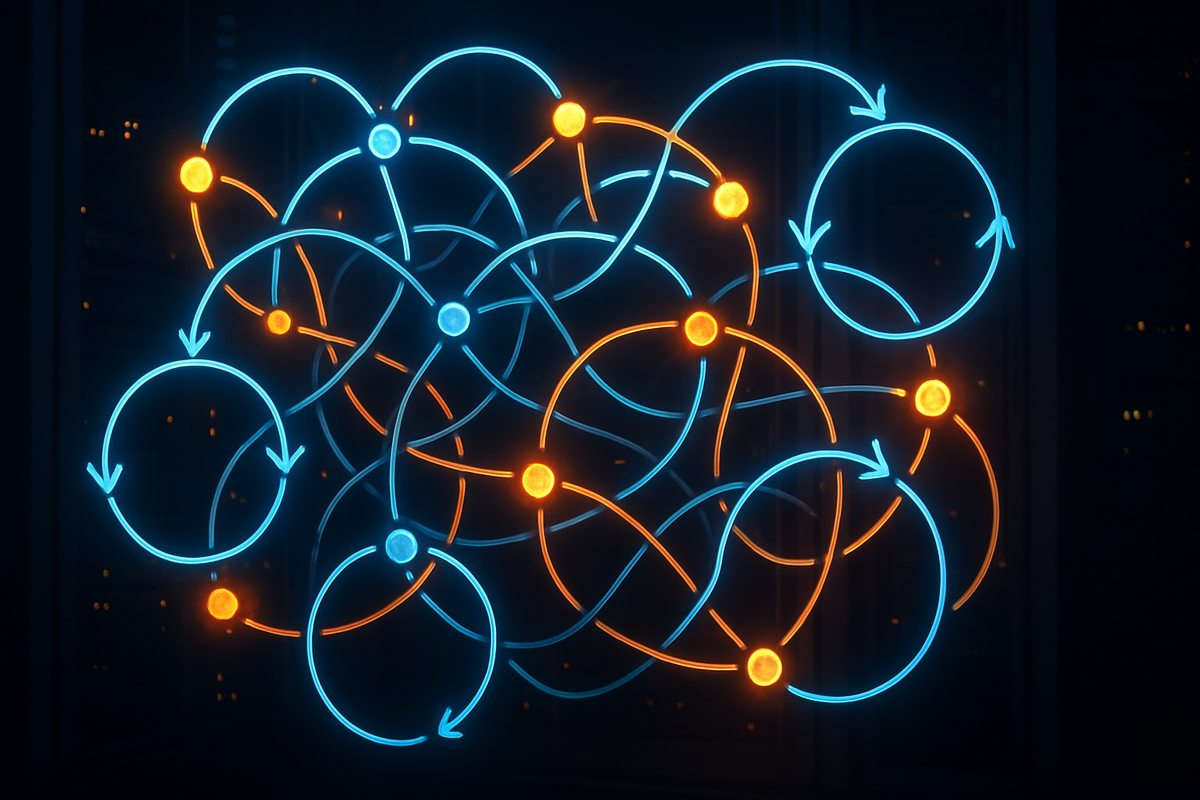
It starts quietly. A production multi-agent workflow stalls. Latency metrics creep upward. No error is thrown. No alert fires. Your on-call engineer spends two hours staring at traces before realizing: two agents are waiting on each other, each holding a tool-call lock the other needs to proceed. By the time the deadlock is confirmed, a downstream pipeline has silently dropped thousands of records and a business-critical report has gone ungenerated for six hours.
Welcome to the defining backend crisis of H2 2026: circular tool-call chain deadlocks in production multi-agent systems.
As enterprises have scaled from single-agent assistants to sprawling orchestration graphs, where dozens of specialized agents delegate, invoke, and await each other through shared tool registries, a dangerous architectural assumption has gone unchallenged: that agent dependency graphs are acyclic by design. They are not. And the compounding complexity of dynamic tool registration, runtime agent spawning, and LLM-driven delegation decisions has made cycle formation not just possible but statistically likely at scale.
The good news is that this problem is solvable. But solving it requires backend teams to fundamentally rethink how they model, validate, and monitor agent dependency graphs. Here are the seven most critical redesigns your team needs to make right now.
1. Shift from Static Schema Validation to Runtime Directed Acyclic Graph (DAG) Enforcement
Most enterprise teams adopted dependency validation strategies borrowed from CI/CD pipelines and microservice mesh configurations, where dependency graphs are defined at deploy time and validated statically. This worked fine when agent topologies were fixed. In 2026, they are not.
Modern multi-agent frameworks like those built on top of LangGraph, AutoGen successors, and proprietary orchestration layers allow agents to dynamically register new tools and delegate to agents that weren't part of the original graph definition. A static schema validator has no visibility into these runtime mutations. By the time a circular dependency forms, the validator has already signed off and moved on.
The fix is to enforce DAG constraints as a continuous runtime invariant, not a one-time pre-flight check. Every time an agent registers a new tool call or establishes a new delegation relationship, your orchestration layer must:
- Add the new directed edge to an in-memory graph representation of the current agent topology.
- Run an incremental cycle detection algorithm (Tarjan's or a modified DFS) against the updated graph before the call is permitted to proceed.
- Reject or quarantine the call if a cycle is detected, and emit a structured diagnostic event to your observability stack.
The performance overhead of incremental cycle detection on sparse graphs is negligible at O(V + E). There is no valid excuse for skipping it in 2026.
2. Introduce a Dedicated Dependency Graph Service (DGS) as a First-Class Infrastructure Component
Right now, most enterprise teams handle dependency tracking inside the orchestrator itself, often as a secondary concern bolted onto the agent router. This conflation of concerns is a root cause of the silent deadlock problem. When the orchestrator is also responsible for tracking its own dependency state, it has no independent authority to reject its own decisions.
The architectural pattern that is emerging as the gold standard in H2 2026 is the Dependency Graph Service (DGS): a dedicated, independently deployed microservice that owns the authoritative representation of the live agent topology. Think of it as a control plane for your agent mesh, analogous to what Istio does for service meshes but purpose-built for tool-call semantics.
A well-designed DGS exposes three core APIs:
- RegisterEdge(source_agent, target_tool, target_agent): Adds a new dependency relationship and returns a validation result (approved or rejected with cycle path details).
- ReleaseEdge(edge_id): Removes a dependency when a tool call completes or times out, keeping the graph accurate in real time.
- QueryTopology(agent_id): Returns the current dependency subgraph for a given agent, useful for debugging and audit logging.
Decoupling this responsibility means your DGS can enforce invariants that the orchestrator itself is structurally incapable of self-enforcing. It also gives you a single, auditable source of truth for post-incident forensics.
3. Implement Tool-Call Scope Tokens to Break Implicit Dependency Inheritance
One of the sneakiest sources of circular dependencies in multi-agent systems is implicit dependency inheritance through shared context objects. When Agent A calls Tool X and passes its full execution context to Agent B as part of the handoff, Agent B may silently inherit a dependency on Agent A's pending tool calls, even though no explicit edge was ever drawn between them.
This is particularly common in systems where agents share a mutable memory store or a unified tool registry namespace. Agent B invokes a tool that internally resolves back to Agent A's active context, and suddenly you have a cycle that no graph validator can see because it was never explicitly registered.
The solution is to introduce Tool-Call Scope Tokens (TCSTs): cryptographically signed, immutable capability tokens that define the exact set of tools and agents an agent is authorized to call within a specific execution scope. Key properties include:
- Scope isolation: A TCST grants access only to tools and agents that were explicitly enumerated at scope creation time, preventing runtime discovery of new call targets.
- Lineage encoding: Each TCST embeds the full call chain lineage (the ordered list of agent IDs that led to the current execution), allowing the DGS to detect if any proposed new call would create a back-edge to a lineage ancestor.
- Expiry and revocation: TCSTs carry a TTL and can be revoked by the DGS when a deadlock is suspected, enabling graceful degradation rather than silent stall.
4. Replace Timeout-Based Deadlock Detection with Causal Wait-Graph Analysis
The current industry default for handling agent deadlocks is embarrassingly primitive: set a timeout, wait for it to fire, log an error, and retry. This approach has three critical failures in the multi-agent context.
First, timeouts are too slow. A 30-second or 60-second timeout in a workflow that should complete in 2 seconds means a massive window of silent failure during which downstream agents may be making decisions based on stale or missing data.
Second, timeouts are not causal. They tell you that something took too long; they do not tell you why, and they provide no information about which agents are involved in the deadlock cycle.
Third, retries on deadlocked cycles make things worse. If two agents are deadlocked and you retry both, you simply re-establish the deadlock faster.
The correct approach is to maintain a live Wait-For Graph (WFG) at the DGS level. A WFG is a directed graph where each node is an agent and each edge represents "Agent A is waiting for Agent B to release a resource or complete a tool call." A cycle in the WFG is a deadlock by definition. Because the WFG is updated synchronously with every tool-call registration and release, deadlocks can be detected within milliseconds of formation, not after a timeout expires. Upon cycle detection, the DGS can immediately select a victim agent (typically the most recently added node in the cycle), cancel its pending call, and emit a structured deadlock event for observability and replay handling.
5. Enforce Hierarchical Agent Tier Constraints to Prevent Cross-Tier Circular Delegation
As multi-agent systems grow, teams naturally develop informal hierarchies: orchestrator agents, sub-orchestrators, specialist workers, and tool-wrapper agents. The problem is that these hierarchies are almost never formally enforced at the dependency graph level. They exist as conventions in documentation and code comments, not as runtime constraints.
The result is that an LLM-driven orchestrator, operating on its own judgment about the best delegation strategy, will sometimes route a task to a lower-tier agent that then delegates back upward to a higher-tier agent, creating a cross-tier circular dependency that violates the intended hierarchy but is invisible to any validator that doesn't know the hierarchy exists.
The fix is to formalize agent tier assignments and encode them as hard constraints in the DGS. Specifically:
- Assign each agent a numeric tier level (e.g., Tier 0 for orchestrators, Tier 1 for sub-orchestrators, Tier 2 for specialists, Tier 3 for tool wrappers).
- Enforce a strict rule: an agent may only delegate to agents at a higher tier number (lower in the hierarchy). Upward delegation is prohibited without explicit escalation authorization.
- Encode escalation paths as explicit, pre-approved edges in the DGS topology, so that legitimate upward communication (for error reporting, for example) is allowed but tracked and cycle-checked.
This single constraint eliminates an entire class of circular dependency that no amount of runtime cycle detection can prevent if the graph is allowed to be arbitrary.
6. Build Dependency Graph Snapshots into Your Observability and Replay Pipeline
Silent deadlocks are especially damaging because by the time you know one occurred, the live graph state that caused it has already been mutated by timeout handlers, retries, and cleanup routines. You are debugging a ghost. The graph you can inspect in post-incident review is not the graph that existed at the moment of deadlock formation.
This is a solvable observability problem, but only if you build for it proactively. Your DGS should emit immutable, timestamped graph snapshots to your event store (Kafka, Pulsar, or equivalent) on every edge registration and release. Each snapshot should include:
- The full adjacency list of the agent topology at that moment.
- The triggering event (edge added, edge removed, cycle detected).
- The active WFG state at the time of the snapshot.
- The trace IDs of all in-flight tool calls associated with the current topology.
With this event log in place, you can replay the exact sequence of graph mutations that led to a deadlock, step by step, in a local or staging environment. This transforms post-incident analysis from guesswork into deterministic forensics. It also enables proactive testing: you can feed synthetic graph mutation sequences into a replay harness and check whether your DGS would have caught the cycle before it caused a production incident.
7. Adopt LLM-Aware Dependency Contracts to Constrain Autonomous Delegation Decisions
All six of the previous strategies address the infrastructure and architecture layers. But in 2026, there is a seventh dimension to the problem that is unique to AI-native systems: the LLM itself is making delegation decisions at runtime. An orchestrator agent powered by a frontier model may, in the course of reasoning about a complex task, decide to delegate to an agent or invoke a tool that its human designers never anticipated. No static architecture can fully prevent this without crippling the flexibility that makes LLM-driven orchestration valuable.
The emerging best practice is to introduce LLM-Aware Dependency Contracts (LADCs): structured, machine-readable constraint documents that are injected into the orchestrator agent's system prompt and also enforced at the DGS level. An LADC specifies:
- Permitted delegation targets: The explicit list of agents and tools this agent is allowed to call, expressed in a format the LLM can reason about in its chain-of-thought.
- Prohibited back-edges: A list of agents that this agent must never delegate to because doing so would create a known cycle risk, given its position in the current topology.
- Escalation protocols: The exact conditions under which upward delegation is permitted and the specific escalation path to follow.
The dual-enforcement model is key: the LLM is informed of the constraints via its system prompt (making it less likely to attempt a prohibited delegation in the first place) and the DGS enforces the constraints at the infrastructure level (catching any case where the LLM ignores or misinterprets the contract). Neither layer alone is sufficient. Together, they create defense in depth against LLM-driven circular delegation.
The Cost of Doing Nothing
Silent deadlocks in multi-agent systems are not edge cases. As enterprise AI deployments mature through H2 2026 and agent graphs grow in size and dynamism, circular tool-call chains will become an increasingly common failure mode. The teams that treat dependency graph validation as a first-class engineering concern today will be the ones whose AI systems remain reliable and auditable as complexity scales. The teams that don't will keep spending their on-call hours staring at traces, wondering why nothing is moving.
The seven strategies outlined here form a coherent, layered defense: runtime DAG enforcement, a dedicated Dependency Graph Service, scope token isolation, Wait-For Graph analysis, hierarchical tier constraints, snapshot-based observability, and LLM-aware dependency contracts. None of these are exotic research ideas. All of them are implementable today with existing infrastructure primitives and a clear architectural mandate.
The only thing missing is the decision to prioritize them. Make that decision before your next production deadlock makes it for you.



