7 Predictions for How Enterprise Backend Teams Must Prepare for AI Agent Data Residency Conflicts in H2 2026
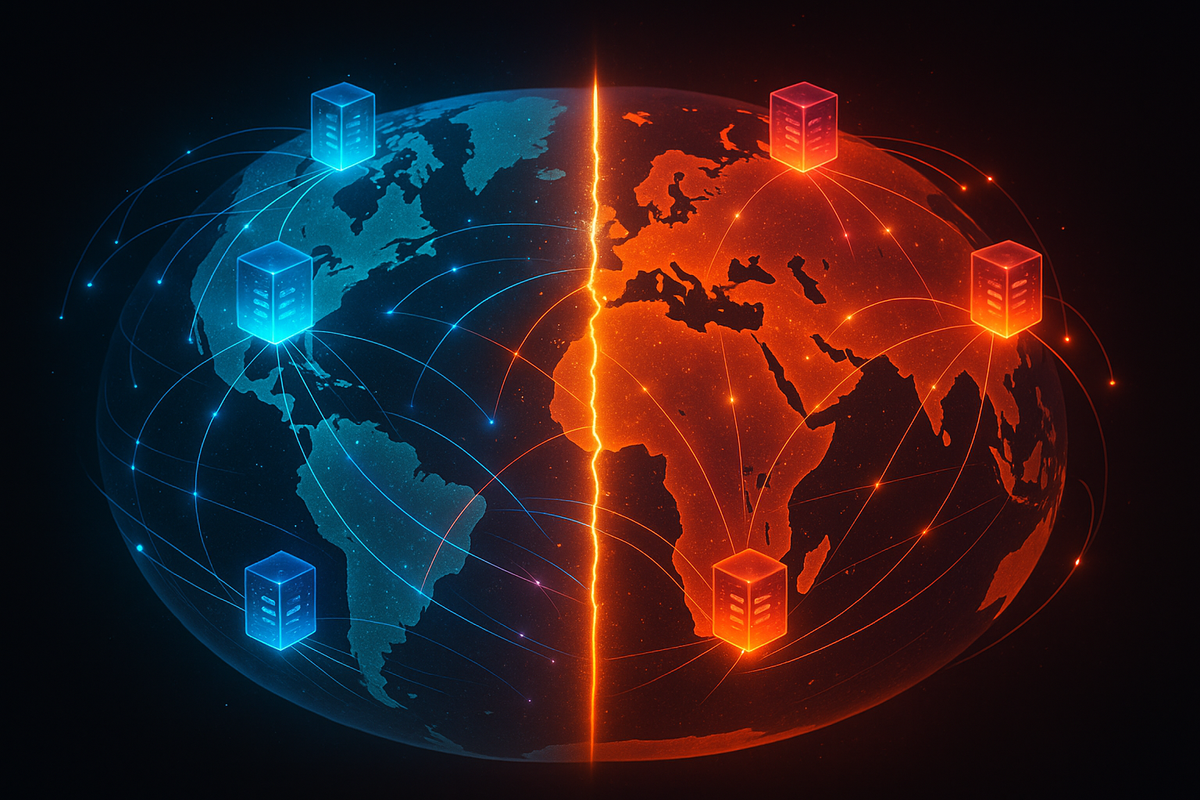
Something quietly seismic is happening inside enterprise backend stacks right now. As organizations scale their AI agent deployments across multi-cloud, multi-region environments, a dangerous collision course is forming between two powerful forces: the operational logic of cross-border inference routing and the expanding web of national AI data localization mandates.
Inference routing, by its very nature, is opportunistic. AI orchestration layers push workloads to wherever compute is cheapest, latency is lowest, or model availability is highest. In H2 2026, that could mean a prompt initiated in Frankfurt gets partially processed in Singapore, enriched with context stored in Virginia, and returned through a model endpoint in Tokyo. Efficient? Absolutely. Legally defensible? Increasingly, not always.
Governments across the EU, India, Brazil, Saudi Arabia, and Southeast Asia have either enacted or are actively enforcing AI-specific data localization rules that go far beyond legacy GDPR-style frameworks. These laws are not just about where data rests. They govern where data is inferred upon, where model weights that touch sensitive national data can reside, and in some cases, which AI vendors are even permitted to process certain categories of information.
Backend engineering teams are caught in the crossfire. This is no longer a legal department problem. It is an infrastructure problem, an architecture problem, and increasingly, a business continuity problem. Here are seven predictions for how enterprise backend teams must prepare before the second half of 2026 turns these tensions into full-blown compliance crises.
1. "Inference Sovereignty" Will Become a First-Class Architectural Concept
For years, data sovereignty meant knowing where your databases lived. In H2 2026, backend teams will be forced to extend that concept to inference sovereignty: the ability to prove, audit, and enforce exactly where a model processes a given input, not just where the output is stored.
This is a fundamentally harder problem. Traditional data residency controls operate on storage layers. Inference happens ephemerally, across distributed GPU clusters, often with no persistent audit trail unless one is explicitly engineered. AI agent frameworks like LangGraph, AutoGen, and emerging agentic middleware from major cloud providers route tasks dynamically. Without deliberate intervention, these systems have no concept of geopolitical boundaries.
The prediction: within H2 2026, leading enterprise backend teams will begin treating inference sovereignty as a first-class requirement at the architecture design phase, not as an afterthought during compliance review. Expect new internal standards documents, infrastructure-as-code modules for geo-fenced inference pools, and dedicated platform engineering roles focused exclusively on AI compliance plumbing.
What Teams Should Do Now
- Map every AI agent workflow to identify all inference touchpoints and their current geographic distribution.
- Audit your orchestration layer (LangChain, Semantic Kernel, custom middleware) for geo-awareness capabilities.
- Begin drafting an "inference data flow diagram" as a compliance artifact, similar to existing data flow diagrams for GDPR Article 30 records.
2. The EU AI Act's "High-Risk" Classification Will Trigger Cascading Backend Refactors
The EU AI Act's enforcement machinery is now fully operational in 2026, and its high-risk system classifications are creating unexpected backend consequences. When an AI agent is classified as high-risk under Annex III (covering employment decisions, credit scoring, biometric categorization, and more), the technical documentation and logging requirements are extraordinarily demanding.
The problem is that most enterprise AI agents were not built with these requirements in mind. Agentic systems that chain multiple model calls, use retrieval-augmented generation (RAG), and dynamically select tools at runtime produce inference chains that are notoriously difficult to reconstruct for audit purposes. Regulators are not interested in "the model decided." They want a reproducible, inspectable record of every decision node.
The prediction: H2 2026 will see a wave of emergency backend refactors as organizations realize their agentic pipelines cannot produce the audit trails required for EU AI Act compliance. Teams that invested early in structured logging, trace IDs that persist across agent tool calls, and immutable audit logs stored in jurisdiction-compliant infrastructure will have a significant competitive advantage.
What Teams Should Do Now
- Implement OpenTelemetry-based tracing across all agent tool calls, with trace context propagated through every LLM invocation.
- Store audit logs in write-once, jurisdiction-specific object storage (EU-only S3 buckets, Azure Blob with data residency locks, etc.).
- Classify your AI agents against EU AI Act Annex III categories now, before a regulator does it for you.
3. India's DPDP Act Will Become the Most Disruptive Localization Force for Global SaaS Backends
Much of the enterprise compliance conversation in 2026 centers on Europe. But the Digital Personal Data Protection (DPDP) Act in India is quietly becoming the most operationally disruptive data localization framework for global SaaS and enterprise backend teams, particularly those with significant user bases or processing operations touching Indian personal data.
India's framework, now enforced with meaningful penalty structures, restricts cross-border transfer of certain categories of personal data and requires explicit government approval for transfers involving "sensitive" personal data processed by AI systems. The ambiguity in how AI inference is classified under the DPDP Act is, itself, a major risk. If your AI agent processes Indian user data to generate a recommendation, is that "processing" subject to localization? Indian regulators are increasingly saying yes.
The prediction: by Q4 2026, enterprises operating in India will be forced to deploy dedicated in-country inference infrastructure or accept severe limitations on which AI agent capabilities they can offer Indian users. The cost implications are substantial, and the architectural complexity of maintaining feature parity between geo-fenced and global deployments will strain backend teams significantly.
What Teams Should Do Now
- Identify all data flows involving Indian personal data that touch AI inference pipelines.
- Evaluate in-country model hosting options, including partnerships with Indian cloud providers like Jio Cloud or localized Azure and AWS India regions.
- Design feature flags that can gracefully degrade AI agent capabilities for specific geographic user segments without breaking core application functionality.
4. Multi-Agent Systems Will Require "Data Passport" Metadata Standards
One of the most underappreciated technical problems in agentic AI systems is context propagation. When an AI agent spawns sub-agents, delegates tasks, or passes context windows between specialized models, the originating data's residency requirements travel with it. But in most current implementations, they do not. The context blob is passed without any attached metadata about where its constituent data is legally permitted to be processed.
This is the multi-agent data residency gap, and it is about to become a serious compliance vulnerability. Imagine a master orchestrator agent that receives a request containing EU personal data, then delegates a summarization subtask to a sub-agent running on a US-based model endpoint. The orchestrator "knows" the data is EU-restricted. The sub-agent does not. The inference happens in the wrong jurisdiction. The enterprise is liable.
The prediction: H2 2026 will see the emergence of informal and then formalized "data passport" metadata standards for agentic systems. These will be structured headers or envelope schemas attached to agent context payloads that specify the permissible processing jurisdictions, data classification, and consent basis for the information being passed. Early movers will likely be large cloud providers and open-source agentic framework maintainers.
What Teams Should Do Now
- Begin designing a custom metadata envelope for your internal agent communication protocols that includes jurisdiction tags and data classification labels.
- Contribute to or monitor working groups within the Linux Foundation AI and Data, OWASP LLM Security, and W3C communities for emerging standards.
- Implement middleware in your orchestration layer that validates jurisdiction metadata before any sub-agent invocation.
5. "Sovereign AI" Cloud Regions Will Fragment the Model Ecosystem and Force Painful Version Divergence
Major cloud providers have been racing to build sovereign cloud regions throughout 2025 and into 2026, dedicated infrastructure deployments designed to meet the strictest national data localization requirements. AWS, Microsoft Azure, and Google Cloud all now offer variants of sovereign cloud offerings for the EU, Saudi Arabia, Australia, and several other jurisdictions.
The problem that backend teams are only beginning to reckon with is that these sovereign regions do not always offer the same AI model versions, the same fine-tuning capabilities, or the same inference performance as standard global regions. A model available at full capability on us-east-1 may exist in a reduced, locally-approved variant in the EU sovereign zone. This creates a painful new form of technical debt: model version divergence across jurisdictions.
The prediction: by late 2026, enterprises operating across five or more jurisdictions will be managing meaningfully different AI model versions, capability sets, and fine-tuned variants per region. Backend teams will need model registry systems that track not just version numbers but jurisdiction-specific capability matrices. Continuous integration pipelines will need to test against multiple model variants simultaneously, dramatically increasing testing complexity and infrastructure cost.
What Teams Should Do Now
- Implement a centralized model registry that tracks model versions, capability flags, and approved jurisdictions for each deployed model variant.
- Build abstraction layers in your AI integration code that allow jurisdiction-specific model substitution without rewriting business logic.
- Begin load-testing sovereign region inference endpoints now, before production traffic depends on them. Performance characteristics can differ significantly.
6. Real-Time Inference Routing Will Require Embedded Legal Logic at the Infrastructure Layer
Today, routing logic in AI-powered applications is primarily driven by technical signals: latency, cost, model capability, and availability. In H2 2026, legal signals will need to be embedded directly into routing decisions at the infrastructure layer, not handled as application-level conditional logic.
This is a significant architectural shift. Currently, a developer might write: "if user is in EU, use this endpoint." That approach does not scale to the complexity of agentic systems, dynamic data compositions, or real-time regulatory updates. What is needed is a routing layer that consults a continuously updated legal rules engine before dispatching any inference request, one that understands the data classification of the payload, the jurisdiction of the user, the regulatory status of the target inference endpoint, and any applicable data transfer agreements in effect at that moment.
The prediction: by Q4 2026, a new category of infrastructure tooling will emerge (or existing API gateway and service mesh vendors will extend their products) to provide AI-aware, compliance-driven inference routing. Think of it as a policy enforcement point specifically designed for LLM traffic, similar to how OPA (Open Policy Agent) works for general API authorization but purpose-built for the unique characteristics of AI inference workloads.
What Teams Should Do Now
- Evaluate whether your current API gateway (Kong, Envoy, AWS API Gateway, Azure APIM) can be extended with custom plugins to enforce inference routing policies.
- Prototype an OPA-based policy layer that consumes jurisdiction metadata and makes routing decisions for AI inference traffic.
- Establish a process for keeping legal rules current, because regulations change, and your routing logic needs to change with them without requiring a code deployment.
7. Data Residency Conflicts Will Become a Board-Level Risk Item, Forcing Backend Teams Into Unprecedented Legal-Engineering Collaboration
Perhaps the most culturally significant prediction for H2 2026 is not technical at all. It is organizational. The combination of substantial financial penalties (the EU AI Act allows fines up to 3% of global annual turnover for certain violations; India's DPDP Act penalties are similarly significant), reputational exposure, and the operational complexity of managing AI data residency across jurisdictions is about to elevate this issue to the board room.
When board members and general counsels start asking pointed questions about AI inference data flows, the answers will need to come from backend engineering teams. This will force a new kind of collaboration between legal, compliance, and engineering that most organizations are structurally unprepared for. Legal teams do not speak Kubernetes. Backend engineers do not speak data protection law. The translation layer between them is currently a gap that costs enterprises both compliance violations and missed opportunities.
The prediction: forward-thinking enterprises will create new hybrid roles and cross-functional teams in H2 2026, often called AI Governance Engineering or AI Compliance Architecture teams, staffed with engineers who have deep legal literacy and legal professionals who have genuine technical fluency. Backend leads who proactively build relationships with their legal and compliance counterparts now will be far better positioned when the pressure inevitably arrives.
What Teams Should Do Now
- Schedule joint working sessions between backend platform teams and legal/compliance to map AI data flows against current regulatory requirements.
- Create shared documentation artifacts (data flow diagrams, inference topology maps) that both engineers and lawyers can read and validate.
- Advocate internally for dedicated AI governance engineering headcount before a compliance incident forces the conversation.
The Bottom Line: Compliance Debt Is the New Technical Debt
For the past decade, the dominant form of debt haunting engineering organizations was technical debt: shortcuts taken under deadline pressure that eventually required painful refactors. In the age of AI agents and global data localization, a new and equally dangerous form of debt is accumulating: compliance debt.
Every AI agent deployed without inference sovereignty controls, every multi-agent workflow without jurisdiction-aware context propagation, and every inference routing decision made purely on technical signals is a unit of compliance debt being added to the ledger. In H2 2026, that ledger is coming due.
The backend teams that will emerge from this period strongest are not necessarily those with the most sophisticated AI capabilities. They are the ones that treated regulatory requirements as engineering requirements from the start, built jurisdiction-awareness into their infrastructure primitives, and established the organizational bridges between legal and technical disciplines before a crisis forced them to.
The collision between cross-border inference routing and national AI data localization mandates is not a future problem. It is a present one, and the clock on H2 2026 is already ticking.



